Showing posts sorted by relevance for query stanford encyclopedia. Sort by date Show all posts

Thursday, December 02, 2021

Comparing Three (No, Four) Top 20 Lists in Philosophy

Published rankings of philosophers' impact or importance might contribute to reinforcing toxic hierarchies, amplifying academia's unfortunate obsession with prestige. So in some sense, yuck. Nonetheless, I confess to finding rankings of philosophers sociologically interesting. So much in the field depends upon perception. If you're embroiled in the culture of Anglophone academic research philosophy, it's hard not to be curious about, and care about, how the philosophers you admire are perceived, discussed, cited, and evaluated by others.

Naturally, then, I was interested to see the Scopus citation rankings of philosophers recently released at Daily Nous. As noted in the Daily Nous post and various comments, the list has some major gaps and implausibilities, in addition to reflecting the generally science-oriented focus of Scopus. Some people have suggested that Google Scholar is better. However, my own assessment is that, if you're trying to capture something like visibility or influence in mainstream Anglophone academic philosophy, the best (still imperfect) measure is citation in the Stanford Encyclopedia of Philosophy.

Let's compare the top 20 from Scopus, Google Scholar, and the Stanford Encyclopedia.

Scopus:

1. Nussbaum, Martha
2. Lewis, David
3. Floridi, Luciano
4. Habermas, Jürgen
5. Pettit, Philip
6. Buchanan, Allen
7. Goldman, Alvin I.
8. Williamson, Timothy
9. Lefebvre, Henri
10. Chalmers, David J.
11. Fine, Kit
12. Hansson, Sven Ove
13. Pogge, Thomas
14. Anderson, Elizabeth
15. Schaffer, Jonathan
16. Walton, Douglas
17. Stalnaker, Robert
18. Sober, Elliott
19. Priest, Graham
20. Arneson, Richard

The top 20 Google Scholar profiles in "philosophy":

1. Martin Heidegger
2. Jacques Derrida
3. Hannah Arendt
4. Friedrich Nietzsche
5. Karl Popper
6. Émile Durkheim
7. Wahid Bhimji
8. Slavoj Zizek
9. Daniel C. Dennett
10. Rom Harré (Horace Romano Harré)
11. George Herbert Mead
12. Mark D. Sullivan
13. Martyn Hammersley
14. Pierre Lévy
15. David Bohm
16. Ernest Gellner
17. Yuriko Saito
18. Mario Bunge
19. Jeremy Bentham
20. Andy Clark

The top 20 most cited philosophers in the Stanford Encyclopedia (full list and methodological details here):

1. Lewis, David K.
2. Quine, W.V.O.
3. Putnam, Hilary
4. Rawls, John
5. Davidson, Donald
6. Kripke, Saul
7. Williams, Bernard
8. Nozick, Robert
9. Nussbaum, Martha
10. Williamson, Timothy
11. Jackson, Frank
11. Nagel, Thomas
13. Searle, John R.
13. Van Fraassen, Bas
15. Armstrong, David M.
16. Dummett, Michael
16. Fodor, Jerry
16. Harman, Gilbert
19. Chisholm, Roderick
19. Dennett, Daniel C.

My subjective impression of the three lists, as an active and fairly well-connected participant in the mainstream Anglophone research philosophy tradition is this. The Scopus list includes a bunch of very influential philosophers, but not an especially well-selected or well-ordered list. The Scholar list starts with several famous "Continental" philosophers who are historically important (but who aren't much cited in the most elite mainstream Anglophone philosophy journals when I checked several years ago), then moves to a number of scholars who aren't primarily known as philosophers (including some who are unknown to me). Only a few among the top twenty are mainstream Anglophone philosophers.

In contrast, when I see the Stanford Encyclopedia list I enjoy the comfortable feeling of prejudices confirmed. If asked to list the recent philosophers who been most influential in the mainstream Anglophone philosophy community, I'd probably produce a list not radically different from that one. I'm not saying that these are the most important philosophers, or the best, or those likeliest to be remembered by history (though maybe they will be). And I'm not saying that the list is perfect. But as a measure of approximate prominence in mainstream Anglophone philosophy, the SEP list seems pretty good and much better than the Scopus or Scholar lists.

Besides my own insider's sense, which you might or might not share, I see at least three sources of convergent evidence supporting the validity of the Stanford Encyclopedia list as a measure of prominence. One is Brian Leiter's 2014 ranking of philosophy departments by SEP citation rates, which correlates not too badly with Philosophical Gourmet rankings from the same period. That suggests that departments with philosophers highly cited in the Stanford Encyclopedia tend to be rated well by Philosophical Gourmet raters. Another is Brian Leiter's poll asking people to rank the "most important Anglophone philosophers, 1945-2000", which generates a top five list very similar to the Stanford Encyclopedia top 5: Quine, Kripke, Rawls, Lewis, and Putnam. A third is Kieran Healy's 2013 citation analysis of four prominent Anglophone philosophy journals (Phil Review, J Phil, Mind, and Nous), which yields a similar list of names at the top: Kripke, Lewis, Quine, Williamson.

Eric Schliesser sometimes discusses what he call the "PGR ecology" -- the Anglophone philosophical community roughly centered on late 20th-century philosophers from Princeton, Harvard, and Oxford, and their students. There is a sociological reality here worth noticing, in which prominence is roughly captured by belonging to departments highly rated in the Philosophical Gourmet, by publishing in or being cited in the four journals chosen by Healy, and by being cited in the Stanford Encyclopedia. The SEP citation metric does, I think, a much better job of capturing prominence in this community than do other better known measures like citation rates in Scopus, Google Scholar, or Web of Science.

----------------------------------------

After writing this post, I noticed that PhilPapers can generate a list ranking philosophers by citations in the PhilPapers database. The results:

1. David K. Lewis
2. Daniel C. Dennett
3. John R. Searle
4. Alvin Goldman
5. Fred Dretske
6. Noam Chomsky
7. Thomas Nagel
8. David Chalmers
9. Jürgen Habermas
10. Michel Foucault
11. Jaegwon Kim
12. Philip Kitcher
13. Ned Block
14. Kit Fine
15. Ian Hacking
16. Tyler Burge
17. Gilbert Harman
18. William G. Lycan
19. Alasdair MacIntyre
20. Martha Nussbaum

One striking difference from the Stanford Encyclopedia list is the high ranking of three figures sociologically somewhat outside mainstream Anglophone academic philosophy: Chomsky, Habermas, and Foucault. Dennett's, Searle's, and Chalmers's comparatively high rankings might also partly reflect their broader uptake in academia, though that wouldn't I think explain Goldman's or Kim's also comparatively high rankings.

Clearly, what we need is a ranking of philosophy rankings!

Friday, September 27, 2019

Age Effects on SEP Citation, Plus the Baby Boom Philosophy Bust and The Winnowing of Greats

I have a theory about the baby boom and academic philosophy in the major Anglophone countries. To explain and defend it, we'll need to work through some more numbers from my analysis of citations in the Stanford Encyclopedia of Philosophy.

Recency Bias

First, left's examine recency bias in the encyclopedia. I've done this by taking David Schwitzgebel's August 2019 scrape of the bibliographic sections of all the main-page SEP entries and searching for the first occurrence of "19", "20", or "forthcoming" on each line, then retrieving the first four characters from that location. Non-numbers (except "fort") and numbers <1900 or >2019 were excluded. Everything else was interpreted as a date. (I did not include dates from before 1900, since those works citation formats are less systematic, and often a translation date is cited rather than an original publication date.)

The result is a pretty little curve peaking at 2003-2007:

[click to enlarge]

In 2014, I'd conducted a similar analysis. In those data, the peak was 1999-2003:

[click to enlarge]

And in 2010, I'd also done a similar analysis! The peak year was 2000:

[click to enlarge]

Thus, in the Stanford Encyclopedia, the most recent works appear to be somewhat disadvantaged compared to works about ten years old. Back in time from the peak years, there's a steep linear decline to about 1950, before which there are few citations and the citation rate becomes approximately flat. (Probably, serious curve fitting wouldn't show it to be three linear phases; but close enough.) Over the past nine years, the peak appears to have advanced by about five years. Since SEP entries are updated about every five years on average, we might expect some delays for that reason; and if people are a little lazy about updating references when they update their entries, that could explain why the peak isn't advancing as fast as the clock.

I assume that all these effects are recency effects. Another alternative, of course, is that early 21st century philosophy is vastly better and more citable than earlier philosophy, so that a good a 23rd century encyclopedia would show a similar curve, also massively disproportionately citing early 21st century philosophers compared to 20th century philosophers. (If you find that plausible, I have a beautiful little Proof that P to sell you!)

Based on these results, one might expect that the most-cited philosophers in the 2019 Stanford Encyclopedia would be those whose most influential works appeared around 2003-2007. However, that is not the case.

I have a twofold explanation why: The Winnowing of Greats and The Baby Boom Philosophy Bust. But it's going to take a bit of data analyses to get there.

Most Cited Philosophers, Oldest Generation

For analysis, I have divided my list of the 295 most-cited philosophers into four generations based on age: 1900-1919 (oldest), 1920-1945 (pre-boom), 1946-1964 (boomers), and 1965-present (Generation X). Age was estimated based on birthyear as recorded in Wikipedia (for most authors) or estimated based on date of undergraduate degree (assuming age 22) or in a few cases date of PhD (assuming age 29). A CSV with the data is here. I welcome corrections.

Looking at the oldest generation (1900-1919), we see some stalwarts near the top of the most-cited list: Quine at #2 and Davidson at #5. Chisholm, Strawson, Popper, Geach, Goodman, Mackie, and Anscombe all appear in the top 50. Interestingly, although 19 philosophers from this generation rank among the top 100, only 13 appear in the remainder of the list of 295.

I'm inclined to attribute this to a phenomenon I call The Winnowing of Greats. This is the tendency for the difference between the top performers and the nearly-top performers in any group to come to seem larger with historical (and other types of) distance. We're still citing Quine and Davidson, and to some extent Richard Brandt (#129) and Norman Malcolm (#236), but less famous philosophers from that generation are quickly dropping off the radar.

The intuitive idea of Winnowing of Greats is this: If you're close to a field and you want to list, say, ten leaders in that field in rank order, you might list A, B, C, D, E, F, G, H, I, and J. Another person, also close, might partly agree, maybe listing A, C, B, E, G, D, I, K, L, and M. With more distance, someone might only list or think of five -- likely A, B, C (consensus top) and two of D, E, F, or G, starting to forget about H and higher. Still later, people might only mention A, B, and C. Over time, these will come to seem the consensus "best" and thus the ones who need to be discussed on grounds of historical importance in addition to whatever other reasons there are to discuss them; and others will be relatively less mentioned and mostly forgotten except by specialists, and the gap in apparent importance between the top and the remainder will grow -- eventually becoming the "consensus of history".

We could interpret such winnowing as a type of recency bias against all but the most famous, flowing from ignorance due to distance; or we could see it as a more legitimate winnowing process.

Starting somewhere around rank #50, the philosophers from the oldest generation who are still ranked might strike those of us who know the history of 20th century philosophy to be ranked rather low relative to their historical importance. I interpret this as recency bias. Quantitative evidence of recency bias is this: Looking at only those philosophers on both the 2014 and 2019 lists, the average loss in rank between the two measures was 11 spots. (Going logarithmic, the average natural log of the rank is 4.11 in 2014 and 4.29 in 2019.)

(For the curious, Chisholm was a notable decliner, rank 12 to 19, which is proportionally large in just 5 years, while Anscombe bucked the trend, climbing significantly, from 66 to 48.)

Most Cited Philosophers, Pre-Boom Generation

The dominant generation is the pre-boom generation (1920-1945). Although this generation includes the largest number of birth years, their dominance of the top of the list is too great to be explainable by that fact alone. This generation gives us six of the top ten (Lewis, Putnam, Rawls, Kripke, Williams, and Nozick) and 33 of the top 50. Most of these authors did their most influential work in the 1960s-1980s. Despite the citation curve peaking for works written in 2003-2007, foundational work by this generation is still being heavily cited. For example, the two most-cited works in the Stanford Encyclopedia are Rawls's A Theory of Justice (1971, cited in 115 entries) and Kripke's Naming and Necessity (1980, cited in 88 entries). (More data on this soon.)

Time is starting to affect the rankings of this generation, too, with an average decline in rank of 8 (average difference in ln of .05). Notably, however, in the top 50, there is an average increase in rank of 3. (It's 1.4 if we exclude Pettit, whose rank increased markedly due to a methodological change: I now include second authors.) This difference in trajectory between the top and bottom is consistent with the Winnowing of Greats.

According to a demographic theory that I call The Baby Boom Philosophy Bust, the Baby Boom generation had a substantial demographic advantage in academic philosophy in the United States. (This probably generalizes outside of the U.S. and outside of philosophy, but let me stick with what I know.) Undergraduate enrollments in the U.S. jumped from 2,444,900 in 1949-1950 to 3,639,847 in 1959-1960 to 8,004,660 to 1969-1970 to 11,569,899 in 1979-1980. After that, enrollments continued to grow, but at a much slower pace. The latter part of this period was of course when the baby boomers hit college, but the earlier part of the period was important too, in the wake of the G.I. Bill and the fast growth of the national prestige of higher education. This national prestige was, I conjecture, partly due to the prestige of the space race and the power of the atom bomb, and it extended into the humanities and arts partly due to the popularity of the idea of IQ and the emerging notion of "creativity". (I have a colleague here at UCR, Ann Goldberg, who is doing fascinating work on the history of the concept of creativity and its role in educational institutions.)

Who was hired to teach all of these new undergraduates? It was of course, the pre-boom generation. A flood of pre-boom Assistant Professors hit the universities during this period. Doing their foundational early-career work in the 1960s-1970s, they set the agenda for the philosophy of the period. Then when the boomers got their PhDs and hit the job market in the 1980s, they discovered that pre-boomers were already astride the academy -- mid-career now, at the height of their influence, not yet ready to step aside for their younger generation. The job market was terrible, and those who made it into tenure-track positions found themselves in an academic world already dominated by Rawls, Lewis, Kripke, Fodor, etc., without a lot of new space at the top. My hypothesis is that this fact about academia in the 1980s and early 1990s means that the baby boomers grew philosophically in the shade of the pre-boom generation -- and not to the heights of prestige and influence that they would have grown to, had they not been so overshadowed in their early careers.

With this hypothesis in mind....

Most Cited Philosophers, Baby-Boom Generation

The boomers (born 1946-1964) contribute two philosophers to the top ten: Nussbaum (#9) and Williamson (#10). Another five are among the top fifty: Fine, Sober, Kitcher, Hawthorne, Smith. (Hawthorne, born 1964, is right at the cutoff between Boom and Gen X, if I have his date right.) They are thus vastly underrepresented in the top 50 compared to the pre-boomers (7 vs 33). However, they are more proportionately represented in the list as a whole (113, compared to 129 for the pre-boomers).

Could the boomers rise in relative prestige, so that if we did a similar analysis in ten or twenty years, we'd find them dominating the top 50 in the way the pre-boomers do now? I see three reasons not to think so.

First, the boomers have already started declining in citation rate, comparing 2014 and 2019, with an average rank decline of 8 (ln = +.009). Mitigating this, however, if we look at the top 100, there's an overall average rank gain of 11 (ln = -.16) -- consistent with the winnowing hypothesis.

Second, in other research, I've found that philosophers tend to reach peak influence around ages 55-70. Thus, boomers should be at their peak influence now and we shouldn't expect a lot more climbing overall.

Third, as noted above, there is a strong recency bias in the Stanford Encyclopedia citations. This should tend to favor philosophers younger than the boomers, and increasingly so over time -- especially since philosophers on average tend to do their most influential work in their late 30s and 40s.

Most Cited Philosophers, Generation X

Gen Xers (born 1965-1980) are still too young to be very well represented among the top-cited philosophers in the Stanford Encyclopedia: Only 21 qualify for the list of 295, three in the top 100 (Chalmers, Schaffer, and Sider). In the past five years, the average rank gain in this group is 16 positions (ln = -.15), so, as one would expect, they are still on an upward trajectory. Also as one would expect, many of them are new to the list as of 2019 (11 of the 21), and so not included in these trajectory averages, though headed upward in another sense.

It is, I think, too early to know if Generation X will ultimately prove also to have grown too much in the shade of the pre-boom generation. I sense that this might be so: Mainstream analytic philosophers still to a large extent live in a philosophical world whose agenda was set by Lewis, Kripke, Rawls, Williams, and Putnam.

Side note on demographic diversity of most-cited Gen X philosophers: If my gender and race/ethnicity classifications are correct, then (perhaps surprisingly?) the most-cited Gen X philosophers are slightly farther from gender parity and racial diversity than the Boomers, with 3/21 women and no Latinx or non-White philosophers (compared to the Boomers' 17% women, 2% Latinx or non-White). However, since the numbers are small, this might be chance variation.

Explanation of the Misalignment of Peak Citation Year and the Age of the Most-Cited Philosophers

To cross my t's and dot my i's: Although the peak citation years are 2003-2007, the pre-boom generation is the most cited because, due to their demographic advantage in academia, they dominated philosophy from the 1970s at least into the 1990s (and maybe they still do, despite death and retirement), shading the boomers and maybe also the Gen-Xers. Although recent work is the most cited in the aggregate, the Winnowing process hasn't yet given us the distance required for consensus on the Greats, so those recent citations remain scattered among many authors.

This post is already plenty long, so I won't bother crossing my x's and dotting my j's.

Thursday, October 03, 2024

The Not-So-Silent Generation in Philosophy

The Silent Generation (born 1928-1945) is disproportionately represented among the most-cited authors in the Stanford Encyclopedia of Philosophy. Let's look at the numbers and think about why.

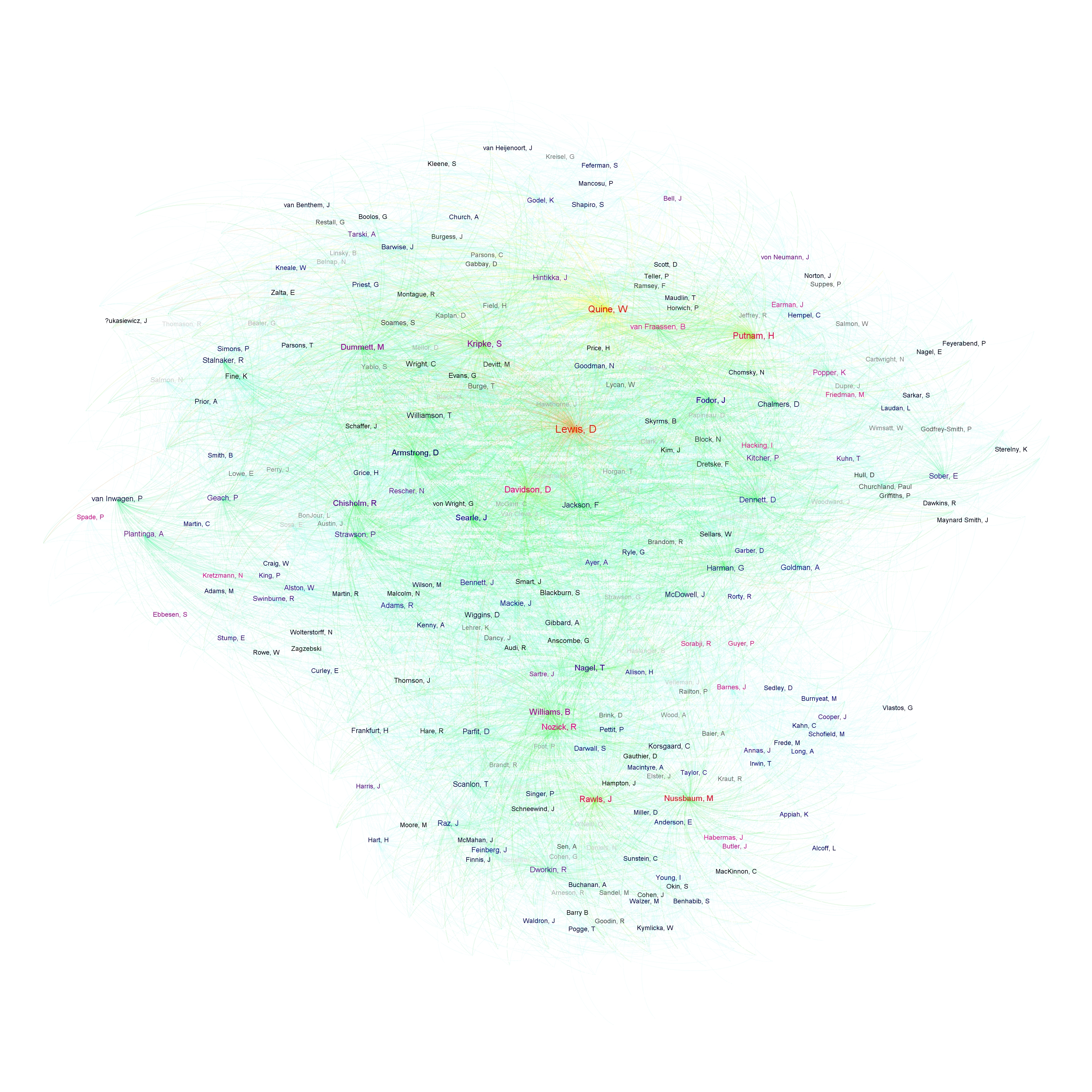
Background: This post is based on my analyses of citation rates in the Stanford Encyclopedia in 2010, 20142019, and 2024. As a measure of prominence in (as I call it) "mainstream Anglophone philosophy", no measure has better face validity than SEP citation rates. For example, in my most recent analysis, the top five are David Lewis, W. V. O. Quine, Hilary Putnam, John Rawls, and Saul Kripke -- a much more plausible top 5, if the aim is to capture influence in mainstream Anglophone philosophy -- than top five lists from, say, Scopus, Google Scholar, or PhilPapers.

The Ten Most-Cited Philosophers, Generation by Generation

[update 12:49 pm: Some of the ranks below were incorrect due to a problem with the tie-counting algorithm I used today. This does not affect the analysis or August's original rankings. HT Daniel Nolan for the catch.]

"Greatest Generation" (born 1900-1927):

2. Quine, Willard van Orman (213)
3. Putnam, Hilary (190)
4. Rawls, John (168)
7. Davidson, Donald (151)
16. Strawson, Peter F. (116)
23. Dummett, Michael A. E. (110)
26. Armstrong, David M. (106)
26. Chisholm, Roderick M. (106)
34. Popper, Karl R. (94)
35. Goodman, Nelson (90)

The initial number before their name indicates their ranking in the most recent analysis, the number in parentheses indicates the number of main-page SEP entries in which they are cited.

"Silent Generation" (born 1928-1945)

1. Lewis, David K. (307)
5. Kripke, Saul A. (159)
8. Williams, Bernard (146)
10. Nagel, Thomas (137)
11. Nozick, Robert (135)
12. Jackson, Frank (130)
13. Searle, John R. (120)
14. Van Fraassen, Bas C. (117)
16. Harman, Gilbert H. (116)
18. Fodor, Jerry A. (115)
"Baby Boomers" (born 1946-1964)

6. Williamson, Timothy (152)
9. Nussbaum, Martha C. (140)
19. Fine, Kit (112)
24. Kitcher, Philip (109)
29. Sober, Elliott (101)
32. Hawthorne, John (97)
40. Anderson, Elizabeth S. (83)
45. Korsgaard, Christine M. (80)
51. Priest, Graham (79)
53. Burge, Tyler (77)
"Generation X" or "Millennial" (born 1965 and later) [list extended to 14 due to a tie]

14. Chalmers, David J. (117)
45. Schaffer, Jonathan (80)
78. Sider, Theodore (68)
129. Godfrey-Smith, Peter (53)
138. Stanley, Jason (51)
156. Enoch, David (48)
156. Prinz, Jesse J. (48)
165. Weatherson, Brian (47)
173. Levy, Neil (46)
203. Craver, Carl F. (42)
203. Kriegel, Uriah (42)
203. List, Christian (42)
203. Nolan, Daniel (42)
203. Thomasson, Amie L. (42)

(In most cases, I have exact birth year from publicly available sources such as Wikipedia, but in some cases I estimate based on year of Bachelor's degree, PhD, or first publication. I welcome corrections.)

As discussed in a previous post, one striking thing about this list is its lack of gender and cultural/racial diversity (see also these articles on lack of diversity in philosophy). But another striking feature is the prominence of the Silent Generation. Analyzed another way: Among the 25 most-cited authors, 6 are Greatest, 14 are Silent, 4 are Boomers, and 1 is Gen X. Among the top 100 (104 with ties), it's Greatest 25, Silent 47, Boomer 27, and Gen X 3. (Note also that Greatest is by far the longest generation, 28 years, compared to the Silent’s 18, the Boomer’s 19, and Gen X’s 16; arguably this should be figured into a generational influence divisor.)

Citation Patterns Over Time

A natural first thought is that the 2020s might just be peak-citation time for the Silent Generation. Maybe the work of the Greatest Generation is starting to fall back into the mists of history, and maybe the Boomers and Gen Xers haven't yet had their full impact on philosophical discourse.

However, this appears not to be the explanation.

As an initial analysis, I looked at what years (1900 through forthcoming) are most commonly cited in the SEP. The results:

[click to enlarge and clarify]

As the graph shows, citation year peaks around 2011-2013. Members of the Silent Generation were in their late 60s to mid-80s in those years. Some of them were definitely still publishing, but age 65-85 is not most philosophers' peak productive period. Consider the top ten Silents, for example. Lewis, Williams, and Nozick were already deceased by 2011. The most influential work of the remaining seven was published in the late 1960s to early 1990s.

Now I do think that raw publication-year data are potentially somewhat misleading. Stanford Encyclopedia entries tend, I suspect, to disproportionately cite recent work (5-10 years old) that has gained some attention, even if that work has not (yet) been very impactful, so as to stay up to date. (2011-2013 was more than ten years ago, but the entries tend to get substantial updates only every 5-10 years.) A better measure might be longitudinal trends in citation rank. My methods haven't been exactly the same year to year, but close enough.

All but five of the 202 most-cited philosophers in 2010 are among the 376 most cited in 2024, and the greatest decline in citation rank has been among the Silent Generation. We can see this by subtracting the natural logarithms of the ranks. (I use a negative log basis, because a decline from rank 11 to 20 is much more significant than a decline from rank 191 to 200). For the Greatest generation the average change is -0.13, for Silent it's -0.19, for Boom it's -0.09, and for Generation X there's an average rank gain of +0.21. There's a similar pattern if we compare the 2014 and 2019 analyses with 2024: The Gen Xers are rising in relative rank while all other generations are declining.

These numbers exclude people who are new to the rankings (or who fall completely off the rankings), and most of my ranking updates contain some new authors from each generation -- partly because I expand the length of the list every year but also partly because some people gain in citation rate even well past their death.

One approach to that analytic problem is to compare authors ranked at least 300 (304 with ties) in 2024 with the 2019 list of 295 authors: approximately comparable lists, five years separated. Twenty-seven authors were among the 2019 top 295 but not the 2024 top 304: 6 Greatest, 10 Silent, 9 Boomer, and 2 Gen X. Conversely, thirty-six authors not on the list in 2019 were among the top 304 in 2024: 0 Greatest, 9 Silent, 12 Boomer, and 15 Gen X.

As one might expect from the various analyses so far, the Silents are even more disproportionately represented in the 2010 rankings than in the 2024 rankings: Among the top 25 in 2010, 16 were Silent, compared to 7 Greatest, 2 Boomer, and 1 Gen X.

The analyses thus all tell a similar story: The high representation of Silent Generation philosophers in my list of the most-cited Stanford Encyclopedia authors cannot be that it is currently their peak citation time.

Further indirect support for this claim also comes from an old finding of mine, drawing on Philosophers Index abstracts, that philosophers tend to have their work discussed most when they are approximately age 55-70.

The Not-So-Silent Generation and the Baby Boom Philosophy Bust

So, what explains the Silent Generation's disproportionate representation among the most influential philosophers in the mainstream Anglophone tradition? I suggest that their influence is due to their objective importance. They achieved this importance through lucky timing and rising to a cultural occasion.

In the Anglophone world, especially the United States, the 1960s and 1970s were times of sharp university enrollment growth, as Silent Generation scholars were hired to teach the Boomers, as the college degree came to be seen as the standard path to social status and economic security, and as universities basked in the high prestige of science in this era (cultural pride in the space race, the success of the Manhattan Project, the polio vaccine, computers, antibiotics....). The academic job market was ridiculously easy by the standards of every subsequent decade, and professors from this era tell tales of how they landed jobs in the most prestigious universities sometimes with a single phone call.

The Silent Generation thus had a great demographic advantage: They were entering the profession in boom times. They engaged with their elders (Quine, Rawls, and Strawson, for example; Putnam and Davidson are edge cases due to Putnam's near-cutoff age and Davidson's late start), but even more, they engaged directly with one another, filling the journals with articles about the issues that interested them. Much of their seminal work was published in the 1970s while they were relatively young, and this work framed the debates of the 1980s, and the 1990s, and the early 2000s, and to a substantial extent (as my SEP analyses suggest) even today.

The Boomers entered the academic job market mostly in the doldrums of 1980s, when there were far fewer open positions at elite universities. They grew in the shade of the Not-So-Silents, who were then mid-career and in no mood to yield the floor. Their work was largely shaped in reaction to leading Silents, such as Lewis, Kripke, Williams, Nagel, Searle, Van Fraassen, and Fodor. (I suspect this was especially so in the so-called "core" areas of philosophy of language, philosophy of mind, epistemology, and metaphysics, somewhat less so in ethics, political philosophy, philosophy of science, aesthetics, and history of philosophy.) There was just less of an opportunity for Boomers to shape the dialogue.

To some extent, a similar story holds for Generation X: The older Gen Xers (like myself) entered academia as the (Not-So-)Silents were senior professors in their sixties -- young enough to still be active, old enough to have the most senior positions in academia, in that sweet-spot between ages 55 and 70 when philosophers tend to receive the most prestige and attention. It is perhaps a little early to tell how badly shaded out the Gen X philosophers have been. Still, I'm inclined to think it's clear that we have been at least somewhat shaded out. We Gen Xers are now on average about age fifty, and so far probably only Chalmers has had the kind of impact on the field that the leading Greatest and Silent generation philosophers generally had by age fifty. (As noted above, in the 2024 SEP rankings, only three Gen Xers rank among the top 100: Chalmers at #14, Schaffer at #45, and Sider at #78.)

A Golden Age of Philosophical Naturalism?

All this said, I don't think demographics is the whole story. The Silents also had an occasion to rise to: the articulation of a thoroughly secular philosophical worldview. There have of course been atheists and scientific naturalists in every generation of philosophers in modern history, but in all previous historical contexts, these "naturalist" philosophers were to some extent on the defensive. The Silent generation was the first generation that took atheism and scientific materialism for granted. (Of course not everyone was a naturalist, but in mainstream Anglophone academic philosophy circles, critics of atheism and scientific materialism were very much on the defensive.) This created a context in which that generation could begin to explore in detail, and in dialogue with one another, in a supportive but also competitive context of shared secular assumptions, scientifically inspired approaches to the mind, language, meaning, and value. Arguably, it was a Golden Age of philosophical naturalism, laying the foundations on which all subsequent naturalist approaches have been built.

This is my theory, then, of the Not-So-Silent Generation in mainstream Anglophone philosophy. They had a huge demographic advantage in being hired just as university enrollments were booming, and a major philosophical task fell in their laps through cultural timing: the task laying the foundations of a thoroughly secular, scientific philosophy. They rose to this task and thus became not just a demographically dominant but a philosophically important generation, which will collectively be remembered (perhaps through a few emblematic names).

Is there a broad philosophical task of similar magnitude facing the now-rising generation of philosophers? I'm not sure. (As Hegel said, the owl of Minera flies only at dusk: We understand our cultural moment only in retrospect, as it is fading into history.) But maybe Artificial Intelligence and breakthroughs in the capacity to control human and non-human physiology will radically transform the world, enabling new types of life on the planet (conscious machines? post- or trans-humans?). If so, then maybe Millennial and Zoomer philosophers will have their own world-historical task to rise to: that of helping us understand the philosophical implications of the radical transformations such technologies enable.

-----------------------------------------

Related:

"Discussion Arcs" (Apr 27, 2010)

"At What Age Do Philosophers Do Their Most Influential Work?" (May 12, 2010)

"The Base Rate of Kant" (Jan 26, 2012)

"Age Effects on SEP Citation, Plus the Baby Boom Philosophy Bust and The Winnowing of Greats" (Sep 27, 2019)

"Where Have All The Fodors Gone? Or: The Golden Age of Philosophical Naturalism" (Nov 18, 2021)

Friday, June 19, 2009

Friends of the Stanford Encyclopedia of Philosophy

The Stanford Encyclopedia of Philosophy is to date the most visible and successful experiment in "open-access" -- that is, free -- academic philosophy. (This isn't to say there aren't also other excellent open-access resources like Philosophers' Imprint and various archiving projects.) Fans of open access who loathe the finacial abuse of academic libraries at the hands of companies like Springer might consider paying the modest fee to support the Stanford Encyclopedia: $5 per year for students, $10 or $25 for others. Who'd've thought you could buy friendship so cheaply?

The SEP is trying to entice people to join by offering their "friends" access to handsome PDFs of SEP entries. Maybe that kind of thing appeals to you, but for me it's just a matter of supporting a cause I care about.

Thursday, July 23, 2020

The 233 Most-Cited Works in the Stanford Encyclopedia of Philosophy

Last summer my son David and I scraped the bibliographies out of the massive Stanford Encyclopedia of Philosophy to generate a list of the 295 most cited contemporary authors in the Stanford Encyclopedia. I have found that this approach gives more plausible results as a measure of influence in mainstream Anglophone philosophy than do other quantitative bibliometric approaches (like Google Scholar rankings or Web of Science).

Last fall, I'd meant to do one more project with the data -- but things pulled me away, and I'm only now returning to it. That's a list of most cited works in the Stanford Encyclopedia. My most-cited authors approach, at least as I implemented it, might have tended to overplay the impact of philosophers with moderate contributions to several fields relative to philosophers who published one or two field-changing works. (Thomas Kuhn, for example, ranks only #75 on last year's list, despite his transformative impact on philosophy of science.) Also, tracking influential works is an interesting project in its own right, separate from the project of tracking influential philosophers.

Before proceeding to the list, notes and caveats.

(1.) Each work counts once per main-page bibliographic entry in the SEP. Thus, a work with a total of 33 is cited in 33 different main page entries. Subpage entries are not included.

(2.) What counts as the "same work"? The distinction admits vague and contentious cases, and implementing it mechanically raises further problems. Here's what I did: To count as the same work, the work had to begin with exactly the same title words (excluding punctuation marks, "a", "an", or "the"). Later editions were counted as the same work as earlier editions (including in a few cases of "such-and-such revisited" or the like) and articles republished in collections were counted as the same work if the particular article rather than the collection as a whole was cited. Also, works that appeared first as articles then later were expanded into books with the same or similar title were counted as the same work. Multi-volume works counted as the same work if citations were generally to all volumes as a single bibliographic entry (Parfit's On What Matters); but not if citations were generally to a specific volume (Lewis's Philosophical Papers). A specific paper in a volume (e.g., "Causation" in Philosophical Papers, Vol 2) would then be classed as the "same work" as the Journal of Philosophy article of the same title rather than as the same work as a general citation of that volume.

(3.) Historical philosophers, especially non-Anglophone philosophers, have low counts for several reasons. First, historical entries often treat primary texts in a separate section, not listing those texts among the bibliographic sections we scraped. Second, historical texts are often cited under different titles that my procedure would not match (e.g., in the original language, or in translation, or in different translations, or in differently titled collections). Also, in general, non-historical entries in the Stanford Encyclopedia vastly disproportionately cite recent work. See my notes at the end for further reflections.

(4.) Citations in the role of editor are not included.

(5.) Please excuse the haphazard cut-and-paste formatting. Dates are sometimes first appearance, sometimes later appearance or edition or translation.

(6.) Corrections welcome, as long as they are consistent with the principles above and don't constitute a distortive general revision, unsystematically applied on one author's behalf, of the method described in the technical details at the end of the post.

------------------------------------

The 233 Most-Cited Works in the Stanford Encyclopedia of Philosophy

1. (cited in 115 main-page entries) Rawls, J. (1972), A Theory of Justice.
2. (cited in 88) Kripke, S. (1980). Naming and Necessity.
3t. (63) Lewis, David, 1986, On the Plurality of Worlds.
3t. (63) Nozick, Robert, 1974, Anarchy, State and Utopia.
3t. (63) Quine, W.V.O., 1960, Word & Object.
6. (62) Parfit, Derek, 1984, Reasons and Persons.
7. (56) Scanlon, T.M., 1998. What We Owe to Each Other.
8. (55) Wittgenstein, Ludwig, 1953, Philosophical Investigations.
9. (53) Chalmers, D., 1996, The Conscious Mind.
10. (48) Rawls, John, 1993, Political Liberalism.
11. (47) Kuhn, T.S., 1970 [1962], The Structure of Scientific Revolutions.
12. (45) Putnam, Hilary, 1975, “The Meaning of ‘Meaning’”.
13t. (43) Moore, G. E., 1903/1993a, Principia Ethica.
13t. (43) Quine, W. V. O., 1953, “Two Dogmas of Empiricism”.
15. (41) Russell, Bertrand, 1903, The Principles of Mathematics.
16t. (40) Sidgwick, H. (1907), The Methods of Ethics.
16t. (40) Williamson, Timothy, 2000, Knowledge and Its Limits.
18t. (39) Hume, David, 1978, A Treatise of Human Nature.
18t. (39) Jackson, F., 1998, From Metaphysics to Ethics.
18t. (39) van Fraassen, Bas C. 1980, The Scientific Image.
21. (38) Kaplan, David, 1989, “Demonstratives”.
22t. (37) Carnap, R., 1956, Meaning and Necessity.
22t. (37) Lewis, David, 1973, Counterfactuals.
24t. (36) Nozick, Robert, 1981, Philosophical Explanations.
24t. (36) Russell, B., 1905. ‘On Denoting’.
26. (35) Fodor, J., 1987, Psychosemantics.
27t. (34) Popper, Karl, 1934, The Logic of Scientific Discovery.
27t. (34) Raz, J., 1986. The Morality of Freedom.
27t. (34) Ross, W. D., 1930, The Right and the Good.
30t. (33) Ayer, A.J., 1936, Language Truth, and Logic.
30t. (33) Ryle, Gilbert, 1949. The Concept of Mind.
32. (32) Evans, Gareth, 1982, The Varieties of Reference.
33t. (31) Korsgaard, Christine M. (1996). The Sources of Normativity.
33t. (31) Locke, John (1690/1975), An Essay Concerning Human Understanding.
35t. (30) Dretske, F., 1981, Knowledge and the Flow of Information.
35t. (30) Gauthier, David, 1986. Morals by Agreement.
35t. (30) Mackie, J., 1977, Ethics: Inventing Right and Wrong.
35t. (30) Russell, B., 1912. The Problems of Philosophy.
39t. (29) Armstrong, David M., 1968, A Materialist Theory of Mind.
39t. (29) Armstrong, D.M., 1997, A World of States of Affairs.
39t. (29) Goodman, N., 1954, Fact, Fiction and Forecast.
39t. (29) Lewis, David, 1969, Convention, a Philosophical Study.
39t. (29) Plantinga, Alvin, 1974, The Nature of Necessity.
39t. (29) Wittgenstein, L., 1921, Tractatus Logico-Philosophicus.
45t. (28) Dummett, M., 1973, Frege, Philosophy of Language.
45t. (28) Rawls, John, 2001, Justice as Fairness.
45t. (28) Wiggins, D., 1980, Sameness and Substance.
50t. (27) Dennett, D.C., 1991. Consciousness Explained.
50t. (27) Gibbard, Allan, 1990, Wise Choices, Apt Feelings.
50t. (27) McDowell, J., 1994a. Mind and World.
50t. (27) Nagel, T., 1986, The View From Nowhere.
50t. (27) Searle, John R., 1983, Intentionality.
50t. (27) Strawson, P. F., 1959, Individuals.
50t. (27) Woodward, J., 2003, Making Things Happen.
55t. (26) Davidson, D., 1980. Essays on Actions and Events.
55t. (26) Jackson, F., 1982. ‘Epiphenomenal qualia’.
55t. (26) Millikan, R. G., 1984. Language, Thought and Other Biological Categories.
55t. (26) Williams, Bernard, 1985. Ethics and the Limit of Philosophy.
59t. (25) Butler, Judith, 1990, Gender Trouble.
59t. (25) Chisholm, R., 1977, Theory of Knowledge.
59t. (25) Lewis, D., 1973, “Causation”.
59t. (25) van Inwagen, 1990, Material Beings.
63t. (24) Putnam, H., 1981. Reason, Truth and History.
63t. (24) Smith, Michael, 1994, The Moral Problem.
63t. (24) Stalnaker, R. 1987. Inquiry.
63t. (24) Young, Iris Marion, 1990, Justice and the Politics of Difference.
67t. (23) Anderson, Elizabeth. 1999. “What is the Point of Equality”.
67t. (23) Brandom, R. 1994, Making it Explicit.
67t. (23) Carnap, R. 1962. Logical Foundations of Probability.
67t. (23) Dretske, F., 1995, Naturalizing the Mind.
67t. (23) Gilligan, Carol, 1982, In a Different Voice.
67t. (23) Hare, R.M., 1952, The Language of Morals.
67t. (23) Lewis, D., 1983. “New Work For a Theory of Universals”.
67t. (23) Nagel, Ernest, 1961, The Structure of Science.
67t. (23) Nagel, T. (1974). What is it like to be a bat?
67t. (23) Russell, B., 1918, “The Philosophy of Logical Atomism”.
67t. (23) Sellars, Wilfrid. 1963. “Empiricism and the Philosophy of Mind”.
67t. (23) Tye, Michael, 1995, Ten Problems of Consciousness.
67t. (23) Whitehead, A. N. and B. Russell (1925). Principia Mathematica.
80t. (22) Blackburn, S., 1998, Ruling Passions.
80t. (22) Burge, T., 1979, “Individualism and the Mental”.
80t. (22) Dworkin, Ronald, 1977. Taking Rights Seriously.
80t. (22) Fodor, J. A., 1975, The Language of Thought.
80t. (22) Hart, H.L.A., 1994. The Concept of Law.
80t. (22) Jeffrey, R., 1983, The Logic of Decision.
80t. (22) Kneale, W. and Kneale, M., 1962, The Development of Logic.
80t. (22) Pearl, J., 2000, Causality.
80t. (22) Quine, W. V. O., 1948. ‘On What There Is’.
80t. (22) Quine, W. V. O., 1970, Philosophy of Logic.
80t. (22) Ramsey, F. P., 1926, “Truth and Probability”.
80t. (22) Rawls, J., 1999, The Law of Peoples.
80t. (22) Spirtes, Peter, Clark Glymour, and Richard Scheines, 1993, Causation, Prediction, and Search.
80t. (22) Zalta, E., 1983, Abstract Objects.
94t. (21) Anderson, A.R., Belnap, N.D. Jr., and Dunn, J.M., 1992, Entailment.
94t. (21) Chisholm, Roderick M., 1976, Person and Object.
94t. (21) Dupré, John, 1993. The Disorder of Things.
94t. (21) Dworkin, R., 2000, Sovereign Virtue.
94t. (21) Kant, Immanuel, 1781/87 [1987], Critique of Pure Reason.
94t. (21) Kripke, S., 1982. Wittgenstein on Rules and Private Language.
94t. (21) Nussbaum, M., 2000, Women and Human Development.
94t. (21) Pogge, Thomas, 2008. World Poverty and Human Rights.
102t. (20) Brink, David, 1989. Moral Realism and the Foundations of Ethics.
102t. (20) Chisholm, R., 1957, Perceiving.
102t. (20) Dancy, J., 2006, Ethics without Principles.
102t. (20) Finnis, J., 2011, Natural Law and Natural Rights.
102t. (20) Gettier, E. (1963). Is Justified True Belief Knowledge?
102t. (20) Grice, H. P., 1989. Studies in the Way of Words.
102t. (20) Griffin, J., 1986. Well-Being.
102t. (20) Hempel, C., 1965, Aspects of Scientific Explanation and Other Essays in the Philosophy of Science.
102t. (20) Kitcher, P., 1993. The advancement of science.
102t. (20) MacIntyre, Alasdair, 1984, After Virtue.
102t. (20) Quine, W.V.O, 1961, From a Logical Point of View.
102t. (20) Searle, John, 1963, Speech Acts.
102t. (20) Sider, T., 2001, Four-Dimensionalism.
102t. (20) Swinburne, Richard, 1977, The Coherence of Theism.
102t. (20) Williamson, Timothy, 2007, The Philosophy of Philosophy.
117t. (19) Anscombe, G. E. M., 1963. Intention.
117t. (19) Blackburn, Simon, 1984, Spreading the Word.
117t. (19) Brandt, R., 1979. A Theory of the Good and the Right.
117t. (19) Dennett, Daniel, 1987, The Intentional Stance.
117t. (19) Dretske, Fred, 1988, Explaining Behavior.
117t. (19) Fischer, John Martin and Mark Ravizza, 1998, Responsibility and Control.
117t. (19) Fodor, Jerry, 1983, The Modularity of Mind.
117t. (19) Frankfurt, Harry, 1971. ‘Freedom of the Will and the Concept of a Person’.
117t. (19) Hare, R. M., 1981, Moral Thinking.
117t. (19) Okin, Susan, 1989, Justice, Gender and the Family.
117t. (19) Shafer-Landau, Russ, 2003, Moral Realism: A Defence.
117t. (19) Strawson, P.F., 1962, “Freedom and Resentment”.
117t. (19) Tarski, A., 1956, Logic, Semantics, Metamathematics Papers from 1923–1939.
117t. (19) Turing, Alan M., 1936, “On Computable Numbers with an Application to the Entscheideungproblem”.
131t. (18) Armstrong, David Malet, 1978, Universals and Scientific Realism.
131t. (18) Austin, J.L., 1962, How to do Things with Words.
131t. (18) Davidson, D., 1963, “Actions, Reasons and Causes”.
131t. (18) Dawkins, R., 1976. The selfish gene.
131t. (18) Fodor, J.A., 1974, “Special Sciences (Or: The Disunity of Science as a Working Hypothesis)”.
131t. (18) Hobbes, T., 1968, Leviathan.
131t. (18) MacKinnon, C., 1989, Toward a Feminist Theory of State.
131t. (18) Nussbaum, Martha C., 2006, Frontiers of Justice.
131t. (18) Parfit, Derek, 2011, On What Matters.
131t. (18) Priest, Graham, 2006, In Contradiction.
131t. (18) Rorty, Richard, 1979, Philosophy and the Mirror of Nature.
131t. (18) Savage, Leonard, 1972, The Foundations of Statistics.
131t. (18) Searle, J., 1992, The Rediscovery of the Mind.
131t. (18) Street, S., 2006, “A Darwinian Dilemma for Realist Theories of Value”.
131t. (18) van Fraassen, B., 1989, Laws and Symmetry.
131t. (18) Wright, C., 1983. Frege’s Conception of Numbers as Objects.
147t. (17) Axelrod. R., 1984, The Evolution of Cooperation.
147t. (17) Carnap, R., 1950. ‘Empiricism, Semantics and Ontology’.
147t. (17) Cartwright, N., 1983, How the Laws of Physics Lie.
147t. (17) Davidson, D., 1971, ‘Mental events'.
147t. (17) Davidson, D., 1984, Inquiries into Truth and Interpretation.
147t. (17) Dummett, Michael, 1991, The Logical Basis of Metaphysics.
147t. (17) Feyerabend, P., 1975, Against Method.
147t. (17) Field, Hartry, 1989, Realism, Mathematics and Modality.
147t. (17) Fine, K., 1994. “Essence and Modality”.
147t. (17) Fodor, Jerry, 1990, A Theory of Content and Other Essays.
147t. (17) Goodman, N. (1976), Languages of Art.
147t. (17) Grice, H. P., 1975. “Logic and Conversation”.
147t. (17) Hacking, I., 1983. Representing and Intervening.
147t. (17) Hintikka, Jaakko (1961), Knowledge and Belief.
147t. (17) Lewis, David K., 1991, Parts of Classes.
147t. (17) Lycan, W.G., 1996, Consciousness and Experience.
147t. (17) Machamer, P. K., Darden, L., and C. Craver, 2000, “Thinking About Mechanisms”.
147t. (17) Noë, Alva, 2004, Action in Perception.
147t. (17) Perry, J., 1979, “The Problem of the Essential Indexical”.
147t. (17) Rawls, J., 1955, ‘Two Concepts of Rules’.
147t. (17) Salmon, Nathan U., 1986, Frege’s Puzzle.
147t. (17) Shannon, C. E. 1948. “A Mathematical Theory of Communcation”.
147t. (17) Stalnaker, Robert, 1968, “A Theory of Conditionals”.
147t. (17) Stich, S., 1983, From Folk Psychology to Cognitive Science.
147t. (17) Tarski, A., 1933, “The Concept of Truth in Formalised Languages”.
172t. (16) Armstrong, D.M., 2004, Truth and Truthmakers.
172t. (16) Blackburn, Simon, 1993, Essays in Quasi-Realism.
172t. (16) Bratman, M., 1987, Intention, Plans, and Practical Reason.
172t. (16) Cartwright, N., 1999, The Dappled World.
172t. (16) Dummett, M., 1978. Truth and Other Enigmas.
172t. (16) Field, H., 1980, Science Without Numbers.
172t. (16) Geach, Peter T., 1980, Reference and Generality.
172t. (16) Goldman, Alvin I., 1999, Knowledge in a Social World.
172t. (16) Harman, Gilbert, 1986. Change in View.
172t. (16) Hilbert, David and William Ackermann, 1928, Grundzüge Der Theoretischen Logik.
172t. (16) Hume, David, 1751 [1975], Enquiries concerning Human Understanding and concerning the Principles of Morals.
172t. (16) Keynes, John Maynard, 1921, A Treatise on Probability.
172t. (16) Lehrer, Keith, 2000, Theory of Knowledge.
172t. (16) Longino, Helen E., 1990. Science as Social Knowledge.
172t. (16) McMahan, J., 2003, The Ethics of Killing.
172t. (16) Parsons, T., 1980, Nonexistent Objects.
172t. (16) Peacocke, Christopher, 1992, A Study of Concepts.
172t. (16) Prior, A.N., 1967, Past, Present and Future.
172t. (16) Salmon, Nathan, 1981, Reference and Essence.
172t. (16) Sandel, Michael J. (1982). Liberalism and the Limits of Justice.
172t. (16) Schneewind, J. B., 1998, The Invention of Autonomy.
172t. (16) Sober, Elliott, and David Sloan Wilson, 1998. Unto Others.
172t. (16) Taylor, C., 1989. Sources of the Self.
172t. (16) Tye, M., 2000. Consciousness, Color, and Content.
172t. (16) Walzer, Michael, 1983. Spheres of Justice.
172t. (16) Williams, B., 1981a. Moral Luck.
198t. (15) Alcoff, Linda Martín (2006). Visible Identities.
198t. (15) Annas, J., 1993, The Morality of Happiness.
198t. (15) Armstrong, D.M., 1989, Universals: An Opinionated Introduction.
198t. (15) Bell, J.S., 1987, Speakable and Unspeakable in Quantum Mechanics.
198t. (15) Block, N. (1995). “On a Confusion About A Function of Consciousness”.
198t. (15) Broad, Charles Dunbar, 1925, The Mind and Its Place in Nature.
198t. (15) Butler, Judith, 1993. Bodies That Matter: On the Discursive Limits of “Sex”.
198t. (15) Chomsky, N., 1965, Aspects of a Theory of Syntax.
198t. (15) Churchland, P. (1981). Eliminative Materialism and Propositional Attitudes.
198t. (15) Clark, A. (1997). Being There.
198t. (15) Dancy, J., 1993, Moral Reasons.
198t. (15) Darwall, Stephen, 2006, The Second Person Standpoint.
198t. (15) Fodor, J. 1998. Concepts.
198t. (15) Gibbard, A., 2003. Thinking How To Live.
198t. (15) Glymour, Clark, 1980, Theory and Evidence.
198t. (15) Goldman, Alvin, 1979. “What is Justified Belief”.
198t. (15) Graham, A.C., 1987, Disputers of the Tao.
198t. (15) Harman, G., 1990. ‘The intrinsic quality of experience’.
198t. (15) Howson, C. and P. Urbach, 2006, Scientific Reasoning.
198t. (15) Kane, R., 1996, The Significance of Free Will.
198t. (15) Kleene, S., 1952, Introduction to Metamathematics.
198t. (15) Lipton, P., 2004. Inference to the Best Explanation.
198t. (15) Longino, H. E., 2002, The Fate of Knowledge.
198t. (15) Marr, D., 1980. Vision.
198t. (15) Merleau-Ponty, M. 1945/1962. Phenomenology of Perception.
198t. (15) Pateman, Carole, 1988, The Sexual Contract.
198t. (15) Ross, W.D. (1939), Foundations of Ethics.
198t. (15) Russell, Bertrand, 1927, The Analysis of Matter.
198t. (15) Russell, B., 1914, Our Knowledge of the External World.
198t. (15) Schaffner, K., 1993, Discovery and Explanation in Biology and Medicine.
198t. (15) Singer, P., 1993. Practical Ethics.
198t. (15) Strawson, P., 1950. ‘On Referring’.
198t. (15) van Inwagen, Peter, 1978. An Essay on Free Will.
198t. (15) von Neumann, J. and O. Morgenstern, 1947. Theory of Games and Economic Behavior.
198t. (15) Wright, Crispin, 1992, Truth and Objectivity.

A Few Observations

(1.) As in the author-based SEP analyses, there are few women, people of color, and non-Anglophone philosophers on the list. The highest-ranked work by a woman is Korsgaard's Sources of Normativity (tied for 33), ETA: and a first-pass count suggests 20-22 works (9-10%) with a woman as author or co-author (among other things, I'm unclear on whether Butler should classed as nonbinary). I'm hesitant to make racial judgments -- and please let me know if I'm missing someone! -- the list appears to be entirely non-Latinx White, with the exception of Linda Martín Alcoff.

(2.) Bertrand Russell has seven works on the list, Jerry Fodor and David Lewis each have six, and David Armstrong and W.V.O. Quine have five. Russell's showing is surprising to me, given the relatively weak showing of works by other historical figures. Russell's Analysis of Matter appears on the list, but not for example Kant's Groundwork of the Metaphysics of Morals or Aristotle's Nicomachean Ethics. This highlights several limitations of the method for older and non-English works. A search of "groundwork of the metaphysics of morals" or "groundwork for the metaphysics of morals" yields 39 main page hits -- enough to rank 18th on the current list if all hits were included. But the references are split among references broken into "primary sources" sections (which were not systematically enough formatted to be scrapable), references citing the German title first, references citing one of the English titles first (which are close enough they were merged for analysis), and cases in which the work is mentioned but not included in the reference list (perhaps because it's assumed that readers will be familiar enough with it not to require reference?). The Nicomachean Ethics had all these disadvantages plus also the disadvantage of often not being bibliographically formatted in the standard way, with publication and/or translation year before the title, which led to its being disproportionately missed (see 5 below). Mill's Utilitarianism is another conspicuous absence, despite being in English (a search for Mill and utilitarianism yields 105 main page hits) -- partly because citation is sometimes absent or in primary sources sections and partly because some citations are of volumes in the collected works instead. A final factor that might partly explain Russell's commanding presence is the arguably disproportionately large number of SEP entries devoted to formal philosophy (logic, math, and such), where Russell had great influence.

(3.) As a fan of Chinese philosophy, I was pleased to see that a work on the history of Chinese philosophy made the list: A.C. Graham's career-culminating Disputers of the Tao. In general, however, historians of philosophy are not well represented on this list.

(4.) As one might expect, this list has weaknesses complementary to the author-based list. If an author returns to an issue multiple times in different works, or publishes an idea both in a standalone article and as a chapter in a book with a different title, SEP citations might be distributed more thinly across those works than they would be if the author had instead expressed the same idea in a single, definitive treatment.

(5.) Technical details: The matching algorithm looked for matches in the first four letters of the author's name and the first five letters of the first text appearing after numbers, punctuation marks, "the", "an", or "a", which for standardly formatted entries is the title. I then alphabetically sorted and hand-checked all bibliographic lines with at least 15 exact matches of both of the two parameters. This took several hours and was probably imperfect, but was not as difficult as it might seem. Note also: The scrape was conducted last summer, so recent entries and recent updates won't figure into the totals.

[image source]

Tuesday, August 20, 2019

The 295 Most-Cited Contemporary Authors in the Stanford Encyclopedia of Philosophy

My son David Schwitzgebel is back in town with new mad computer skills, so I thought I'd have him update his 2014 scrape of the Stanford Encyclopedia of Philosophy bibliographies. Below are the 295 most-cited authors (including only authors born 1900 or later).

Image of a young David K. Lewis [source, cropped]

Method

* Each author is only counted once per entry. In 2010, I found that this generated more intuitively plausible results than counting authors multiple times per entry.

* Unlike in the 2014 list, I include co-authors. Co-authorship is increasingly important in philosophy. However, due to unsystematic formatting, I was also only able to search for co-authorship if the author was cited in at least 27 entries as first author in my first-pass coding. Even among authors in that group, I probably didn't capture all co-authorships.

* Also unlike in the 2014 list, I included editors, but only if their name appeared before the date and any author names in the bibliographical line. Putting the editor at the front of the bibliographical line highlights the editor's role or the edited collection as a whole.

* After computerized search and sort, I hand-coded the data, in some cases correcting misspellings and merging authors (e.g., Ruth Barcan = Ruth Marcus), more often separating authors with similar names (e.g., various A. Goldmans and J. Cohens), in a process that involved some guesswork and pattern recognition. Inconsistent syntax and imperfect redundancy removal procedures also created some error, though nothing large or systematic that I noticed. Bear in mind that with about 170,000 bibliographic entries, perfection is not possible! I estimate coding error of up to about +/- 2 entries.

* If you just plug the author's name as search term into SEP's front page, you'll almost certainly get more page hits than my method delivers (e.g., people in non-headline editing roles, on in subentries, or mentioned in the text but not cited in the bibliography section, or as false positives). So please don't critique my numbers via that method! I do welcome thoughtful corrections.

As a rough measure of influence in current mainstream Anglophone philosophy

This list generates a rough measure of current influence in what I call "mainstream Anglophone philosophy" (a sociological category I have defined and discussed here and here). For example, the top five -- Lewis, Quine, Putnam, Rawls, and Davidson -- contains four of the top five in Brian Leiter's poll results concerning the best Anglophone philosophers since 1957. Better-known bibliographic metrics, like Google Scholar and Web of Science do not as accurately measure this particular sociological phenomenon.

The list captures, if anything, a moment in one academic philosophical culture. For example, despite Michel Foucault's huge global academic influence, mainstream Anglophone philosophers rarely cite him, and on this list he ranks #271.

Further caveats:

* Philosophers who work on topics that are underrepresented in the Stanford Encyclopedia relative to their visibility in mainstream Anglophone philosophy will appear lower on the list than their eminence would suggest. I'm inclined to think that philosophy of race, for example, is underrepresented.

* Authors who have a transformative impact in one area will probably be underrepresented relative to authors who make significant but less transformative contributions to several topics. This will explain some conspicuous absences from the list, such as Barry Stroud, who died about a week ago and so is on my mind.

* Editors of the Stanford Encyclopedia might be somewhat overrepresented, since they might tend to disproportionately solicit entries on topics to which they have contributed and authors might feel some pressure to cite them in their entries.

* ETA: Also, I'm pretty sure that philosophers whose main contributions were before 1960 are substantially underrated on this list relative to their historical importance.

* ETA2: As several readers have pointed out, yes, I'm on this list (in a tie for #251). I find this somewhat embarrassing, since I think this method substantially overrates me (see the 2nd and 4th caveats). If you could withhold congratulations and comparisons, I'd appreciate it!

As I did in 2014, I will follow up later with some demographic analyses. (ETA3: gender, race/ethnicity, disability, language.)

1. Lewis, David K. (cited in 267 main-page SEP entries)
2. Quine, W.V.O. (191)
3. Putnam, Hilary (168)
4. Rawls, John (146)
5. Davidson, Donald (142)
6. Kripke, Saul (139)
7. Williams, Bernard (133)
8. Nozick, Robert (126)
9. Nussbaum, Martha (121)
10. Williamson, Timothy (116)
11. Jackson, Frank (113)
11. Nagel, Thomas (113)
13. Searle, John R. (111)
13. Van Fraassen, Bas (111)
15. Armstrong, David M. (106)
16. Dummett, Michael (104)
16. Fodor, Jerry (104)
16. Harman, Gilbert (104)
19. Chisholm, Roderick (103)
19. Dennett, Daniel C. (103)
21. Chalmers, David J. (101)
21. Strawson, P.F. (101)
23. Stalnaker, Robert (96)
24. Scanlon, T.M. (92)
25. Dworkin, Ronald (91)
26. Pettit, Philip (90)
27. Fine, Kit (89)
27. Sober, Elliott (89)
27. Van Inwagen, Peter (89)
30. Popper, Karl (88)
31. Parfit, Derek (87)
32. Kitcher, Philip (86)
33. Bennett, Jonathan (83)
33. Raz, Joseph (83)
35. Hawthorne, John (82)
35. McDowell, John (82)
37. Geach, P.T. (81)
38. Hintikka, Jaakko (80)
39. Adams, Robert (79)
39. Hacking, Ian (79)
41. Goldman, Alvin I. (78)
42. Goodman, Nelson (76)
43. Mackie, John (74)
43. Plantinga, Alvin (74)
45. Dretske, Fred (73)
45. Smith, Michael (73)
45. Taylor, Charles (73)
48. Alston, William (72)
48. Anscombe, G.E.M. (72)
50. Wright, Crispin (71)
51. Ayer, A.J. (69)
51. Gibbard, Allan (69)
51. Kim, Jaegwon (69)
51. Stich, Stephen (69)
55. Evans, Gareth (68)
55. Tarski, Alfred (68)
57. Korsgaard, Christine (67)
57. Lycan, William G. (67)
59. Gödel, Kurt (66)
59. Schaffer, Jonathan (66)
59. Sellars, Wilfrid (66)
59. Singer, Peter (66)
63. Anderson, Elizabeth (65)
63. Burge, Tyler (65)
63. Horgan, Terence (65)
66. Block, Ned (63)
66. Feinberg, Joel (63)
66. Kaplan, David (63)
66. Priest, Graham (63)
66. Swinburne, Richard (63)
66. Thomson, Judith Jarvis (63)
72. Rescher, Nicholas (62)
73. Blackburn, Simon (61)
73. Wiggins, David (61)
75. Frankfurt, Harry (60)
75. Hempel, Carl (60)
75. Kuhn, Thomas (60)
75. Shoemaker, Sydney (60)
75. Sosa, Ernest (60)
75. Zalta, Edward (60)
81. Earman, John (59)
81. Grice, H.P. (59)
83. Skyrms, Brian (58)
83. Smart, J.J.C. (58)
85. Barnes, Jonathan (57)
85. Cartwright, Nancy (57)
85. Field, Hartry (57)
85. Hare, R.M. (57)
85. Lowe, E.J. (57)
85. Ramsey, Frank P. (57)
85. Rosen, Gideon (57)
85. Ryle, Gilbert (57)
85. Sen, Amartya (57)
94. Perry, John (56)
94. Sider, Theodore (56)
94. Soames, Scott (56)
94. Velleman, David (56)
94. Woodward, James (56)
99. MacIntyr e, Alasdair (55)
100. Annas, Julia (54)
100. Kenny, Anthony (54)
100. Prior, Arthur N. (54)
100. Yablo, Stephen (54)
104. Clark, Andy (53)
104. Darwall, Stephen (53)
104. Waldron, Jeremy (53)
107. Parsons, Terence (52)
107. Schofield, Malcolm (52)
109. Dancy, Jonathan (51)
109. Friedman, Michael (51)
109. Jeffrey, Richard C. (51)
109. Nichols, Shaun (51)
109. Peacocke, Christopher (51)
109. Shapiro, Stewart (51)
109. Sorabji, Richard (51)
116. Brink, David O. (50)
116. Church, Alonzo (50)
116. Simons, Peter (50)
116. Van Benthem, Johan (50)
120. Cooper, John M. (49)
120. Habermas, Jürgen (49)
120. Hart, H.L.A. (49)
120. Irwin, Terence (49)
120. Young, Iris Marion (49)
125. Audi, Robert (48)
125. Griffiths, Paul (48)
125. Millikan, Ruth G. (48)
125. Tye, Michael (48)
129. Austin, J.L. (47)
129. Barwise, Jon (47)
129. Belnap, Nuel (47)
129. Brandom, Robert (47)
129. Chomsky, Noam (47)
129. Glymour, Clark (47)
129. Papineau, David (47)
129. Rorty, Richard (47)
137. Burgess, John P. (46)
137. McGinn, Colin (46)
139. Brandt, Richard (45)
139. Devitt, Michael (45)
139. Foot, Philippa (45)
139. Kretzmann, Norman (45)
139. McLaughlin, Brian P. (45)
139. Sedley, D.N. (45)
139. Von Neumann, John (45)
146. Montague, Richard (44)
146. Stump, Eleonore (44)
148. Boolos, George (43)
148. Horwich, Paul (43)
148. Johnston, Mark (43)
151. Buchanan, Allen (42)
151. Godfrey-Smith, Peter (42)
151. Mellor, D.H. (42)
151. Prinz, Jesse J. (42)
151. Smith, Barry (42)
156. Arneson, Richard (41)
156. Miller, David (41)
156. Railton, Peter (41)
156. Salmon, Nathan (41)
156. Salmon, W.C. (41)
156. Unger, Peter (41)
162. Carruthers, Peter (40)
162. Churchland, Paul M. (40)
162. Feferman, Solomon (40)
162. Kymlicka, Will (40)
162. Loewer, Barry (40)
162. Okin, Susan Moller (40)
162. Sartre, Jean-Paul (40)
162. Sterelny, Kim (40)
162. Suppes, Patrick (40)
171. Davies, Martin (39)
171. Finnis, John (39)
171. Kahneman, Daniel (39)
171. Maudlin, Tim (39)
171. Sandel, Michael (39)
171. Stanley, Jason (39)
171. Strawson, Galen (39)
178. Appiah, Kwame Anthony (38)
178. Butler, Judith (38)
178. Dupré, John (38)
178. Gauthier, David (38)
178. Guyer, Paul (38)
178. Hampton, Jean (38)
178. Kriegel, Uriah (38)
178. Merricks, Trenton (38)
178. Schiffer, Stephen (38)
178. Wolterstorff, Nicholas (38)
188. Burnyeat, Myles (37)
188. Goodin, Robert E. (37)
188. Heil, John (37)
188. McMahan, Jeff (37)
188. Mele, Alfred (37)
188. O'Neill, Onora (37)
188. Sinnott-Armstrong, Walter (37)
188. Sunstein, Cass (37)
188. Zagzebski, Linda (37)
197. Baker, Lynne Rudder (36)
197. Barry, Brian (36)
197. Gabbay, Dov (36)
197. Mancosu, Paolo (36)
197. Nagel, Ernest (36)
197. Walzer, Michael (36)
197. Wood, Allen (36)
204. Boghossian, Paul (35)
204. Cohen, G.A. (35)
204. Feldman, Fred (35)
204. Laudan, Larry (35)
204. Lehrer, Keith (35)
204. Pogge, Thomas (35)
204. Rowe, William (35)
211. Bach, Kent (34)
211. Bealer, George (34)
211. Bird, Alexander (34)
211. Broome, John (34)
211. Elster, Jon (34)
211. Hale, Bob (34)
211. Haslanger, Sally (34)
211. Hull, David L. (34)
211. Scheffler, Samuel (34)
211. Slote, Michael (34)
211. Teller, Paul (34)
211. Thomasson, Amie (34)
211. Van Cleve, James (34)
211. Watson, Gary (34)
211. Zimmerman, Dean (34)
226. Beiser, Frederick C. (33)
226. Bonjour, Laurence (33)
226. Flanagan, Owen (33)
226. Garber, Daniel (33)
226. Hurka, Thomas (33)
226. Hurley, Susan (33)
226. List, Christian (33)
226. Nolan, Daniel (33)
226. Price, Huw (33)
226. Wimsatt, William C. (33)
236. Byrne, Alex (32)
236. Cohen, Joshua (32)
236. Conee, Earl (32)
236. Craig, William Lane (32)
236. Hájek, Alan (32)
236. Halpern, Joseph Y. (32)
236. Kagan, Shelly (32)
236. Kraut, Richard (32)
236. Levy, Neil (32)
236. Long, A.A. (32)
236. Longino, Helen (32)
236. Malcolm, Norman (32)
236. Pollock, John (32)
236. Recanati, François (32)
236. Sainsbury, R.M. (32)
251. Allison, Henry E. (31)
251. Black, Max (31)
251. Crane, Tim (31)
251. Feyerabend, Paul K. (31)
251. Kahn, C.H. (31)
251. Linsky, Bernard (31)
251. MacKinnon, Catharine (31)
251. Marcus, Ruth Barcan (31)
251. Schroeder, Mark (31)
251. Schwitzgebel, Eric (31)
251. Shafer-Landau, Russ (31)
262. Bechtel, William (30)
262. Benhabib, Seyla (30)
262. Berlin, Isaiah (30)
262. Butterfield, Jeremy (30)
262. Fischer, John Martin (30)
262. Griffin, James (30)
262. Levi, Isaac (30)
262. Paul, L.A. (30)
262. Sorensen, Roy A. (30)
271. Alcoff, Linda Martín (29)
271. Bayne, Tim (29)
271. Bigelow, John (29)
271. Crisp, Roger (29)
271. Feldman, Richard (29)
271. Foucault, Michel (29)
271. Gendler, Tamar (29)
271. Kleene, S.C. (29)
271. Loar, Brian (29)
271. Parsons, Charles (29)
271. Vlastos, Gregory (29)
271. Von Wright, Georg H. (29)
271. Wolf, Susan (29)
271. Wolff, Jonathan (29)
285. Adams, Marilyn McCord (28)
285. Baier, Annette (28)
285. Bratman, Michael (28)
285. Ebbesen, Sten (28)
285. Huemer, Michael (28)
285. Kamm, Frances (28)
285. Langton, Rae (28)
285. Lloyd, Elisabeth (28)
285. Maynard Smith, John (28)
285. Pasnau, Robert (28)
285. Spade, Paul Vincent (28)

For the 2014 list, see here.

Tuesday, April 08, 2025

Further Reflections on the Most-Cited Works in the Stanford Encyclopedia of Philosophy: Underranked Works and Concentration Percentage

A couple of weeks ago, I published a list of the 253 most-cited works since 1900 in the Stanford Encyclopedia of Philosophy. (The SEP had 1778 main-page entries as of my scrape last summer, and many of those entries have long reference lists.) Citation in the SEP is plausibly a better measure of impact in mainstream Anglophone philosophy than other bibliometric measures like Google Scholar and SCOPUS, which include citations by non-philosophical sources (which can dominate citations within philosophy, since philosophy is overall a relatively low-citation field) and which mix citation by sociologically elite venues with citation by less elite venues (and those citation patterns can be very different).

I think informed readers will tend to agree that the works near the top of the list (Rawls' Theory of Justice, Kripke's Naming and Necessity, etc.) are indeed among the most influential works in the mainstream Anglophone tradition -- more influential in mainstream Anglophone philosophy than, say, Foucault's Discipline and Punish or Popper's Logic of Scientific Discovery, despite Foucault's and Popper's higher citation overall across all disciplines and sources.

(What do I mean by "mainstream Anglophone philosophy"? I mean philosophy as practiced by professors in departments highly ranked in the Philosophical Gourmet Report, as published in journals that are highly ranked in Brian Leiter's polls (e.g., here), and -- though this would be circular for present purposes -- as recognized in the Stanford Encyclopedia of Philosophy. Even readers who dislike the philosophy of this tradition, or who see it as troublingly narrow, can I think recognize the sociological phenomenon of influence in these related ecologies, reasonably called "mainstream" in Anglophone academia.)

Underranked Works

Although SEP citation rates are, I think, a better measure of impact in mainstream Anglophone philosophy than any other existing bibliometric measure, that doesn't mean they are perfect. Works with a huge impact on a subdiscipline, or on a particular topic, will plausibly be underranked compared to works with substantial impact across a range of areas. The SEP will have only a limited number of entries for each subdiscipline or topic, and no matter how important the work is to that subdiscipline or topic, it can appear only once in each entry's bibliography.

This explains, I think, the relatively weak showings of some of the best-known articles in the field. For example:

  • 119th (tied), 21 citations: Gettier, Edmund L., 1963, Is Justified True Belief Knowledge?
  • 192nd (tied), 17 citations: Anscombe, G.E.M., 1958, Modern Moral Philosophy
  • unranked, 14 citations: Searle, John R, 1980, Minds, Brains, and Programs
  • unranked, 12 citations: Singer, Peter, 1972, Famine, Affluence, and Morality
  • unranked, 9 citations: Thomson, Judith Jarvis, 1971, A Defense of Abortion
  • This isn't intended as any kind of exhaustive or representative list of underranked works -- just a few examples that struck me as conspicuously underranked relative to their influence. Gettier's 1963 article is possibly the most influential work of 20th century epistemology (in mainstream Anglophone circles). Anscombe's 1958 article is often seen as a landmark in the resurgence of virtue ethics. Searle's 1980 "Chinese room" argument is perhaps the most influential work on philosophy of computation and artificial intelligence after Turing. Likewise, Singer's 1972 article on charitable donation (with its famous example of rescuing a drowning child in a nearby pond at the expense of your clothes) and Thomson's defense of abortion (with its violinist example) are known to virtually all mainstream Anglophone philosophers.

    Works might also be underranked if the SEP has relatively few entries in their field or subfield. For example, I'd venture that epistemology has relatively few entries relative to its overall influence in mainstream Anglophone philosophy. And although feminism has probably been somewhat more influential in mainstream Anglophone philosophy than philosophy of race, SEP features many more entries on the former than the latter, possibly explaining why some important feminist works appear on the list (e.g., Butler's Gender Trouble at rank #61), while philosophy of race is poorly represented.

    Influential authors and ideas might also fail to appear on this list, if the influence is spread among several works. For example, here are the ten most-cited authors who have no individual works represented among the top 253:

    John Hawthorne (97 total citations)
    Jonathan Bennett (83)
    William Alston (77)
    Judith Jarvis Thomson (72)
    William G. Lycan (71)
    Nicholas Rescher (71)
    Peter Singer (71)
    Ernest Sosa (69)
    Jeremy Waldron (68)
    Joel Feinberg (67)
    Amartya Sen (67)

    All of the above are among the top 86 most-cited authors born since 1900. So of course no negative inference about the importance of any individual author is justified by the absence that author's individual works from the works list.

    What Percentage of an Author's Citations Are to Their Most-Cited Work?

    By comparing my most-cited authors list with my most-cited works list, we can get a rough measure of how much an author's impact is concentrated in a single work vs. spread across multiple works. (Note that the lists are not quite comparable, since the authors list includes only authors born 1900 or later while the works list includes all works published 1900 or later, including works by authors born before 1900.)

    Consider, for example, Thomas Kuhn. His Structure of Scientific Revolutions was one of the most influential works of philosophy of the second half of the 20th century. Fittingly, it appears 9th on my list of most influential works. But Kuhn himself appears relatively low on the list of most influential authors: 63rd. Looking at the raw numbers, we can see that 58 entries cite Structure and 71 entries cite any work by Kuhn. Thus, 82% of the Kuhn-citing entries cite Structure.

    Contrast this with, say, David Lewis, who is the #1 most-cited contemporary author overall (with 307 entries citing his work) and whose most-cited work, On The Plurality of Worlds, ranks #6 (70 citing entries). For Lewis, 23% (70/307) of the entries that cite him cite his most-cited work.

    I can't seem to think of a good name for this number, so I'll have to settle with a bad name: the concentration percentage. Here are the concentration percentages of the ten most-cited contemporary authors in the SEP:

    1. Lewis, David K.: 23% (70/307)
    2. Quine, Willard van Orman: 32% (69/213)
    3. Putnam, Hilary: 24% (45/190)
    4. Rawls, John: 76% (127/168)
    5. Kripke, Saul A.: 58% (92/159)
    6. Williamson, Timothy: 32% (48/152)
    7. Davidson, Donald: 21% (31/151)
    8. Williams, Bernard: 22% (32/146)
    9. Nussbaum, Martha C.: 19% (26/140)
    10. Nagel, Thomas: 24% (33/137)

    Thus, we can see two clusters: A couple of authors had most of their citation impact through a single work: Rawls (via A Theory of Justice) and Kripke (via Naming and Necessity). The remaining authors had about a third to a fifth of their citation impact through a single work.

    Among the top hundred authors, the ten most concentrated are:

    Kuhn, Thomas S. (82%: Structure of Scientific Revolutions)
    Rawls, John (76%: A Theory of Justice)
    Parfit, Derek (71%: Reasons and Persons)
    Scanlon, Thomas M. (66%: What We Owe to Each Other)
    Kaplan, David (65%: Demonstratives)
    Ryle, Gilbert (61%: The Concept of Mind)
    Kripke, Saul A. (58%: Naming and Necessity)
    Ayer, Alfred J. (54%: Language, Truth, and Logic)
    Nozick, Robert (53%: Anarchy, State, and Utopia)
    Evans, Gareth (53%: Varieties of Reference)

    I confess to being surprised that some of these percentages aren't even higher. For example, I'd have guessed Ryle's impact was more than 61% concentrated on The Concept of Mind.

    The ten least concentrated are:

    Bennett, Jonathan (16%)
    Pettit, Philip (16%)
    Harman, Gilbert H. (16%)
    Hawthorne, John (15%)
    Thomson, Judith Jarvis (15%)
    Lowe, E. J. (15%)
    Waldron, Jeremy (15%)
    Feinberg, Joel (13%)
    Yablo, Stephen (13%)
    Rescher, Nicholas (6%)

    I'll venture a prediction. According to the phenomenon I've labeled "The Winnowing of Greats", the greater your distance from a group that varies in eminence, the greater the difference seems between the most eminent members of that group and the less eminent members. (This is to some extent because you have zero knowledge of most members below a certain level of eminence and to some extent because you overrely on second-hand summaries that highlight a few of the most eminent examples.) If this winnowing phenomenon applies to works as well as to authors, then as time creates distance from our era, all but the most influential works will largely be forgotten -- which will disproportionately favor highly concentrated authors in the historical memory.

    [click image to enlarge and clarify]

    Tuesday, September 23, 2014

    Network Analysis of the Stanford Encyclopedia of Philosophy

    Andrew Higgins has sent me several interesting social network analyses based on my son's and my recent citation analyses from the Stanford Encyclopedia of Philosophy.

    First, some pretty pictures, then some explanations. I can't embed the hi-res pictures properly in this narrow-column post, so please right-click to "open link in new tab" for the full view, then zoom in and out, scrolling around. If you want pictures hi-res enough to read even the smallest font entries, I've posted them here, here, and here.

    First, SEP cited authors:

    Next, SEP articles:
    Finally, SEP top 100 cited authors and top 200 articles:
    So, what do these networks represent?

    The closer two authors or articles are, the closer together they are in the social/intellectual network, as measured by overlap in citation. For authors, they are closer if they tend to be cited together in the same entries. For articles, they are closer if they tend to cite the same authors.

    For the authors, the larger the font, the more they have been cited. The transition of label colors from black to blue to purple to red indicates increasing "centrality" to the network, where "centrality" is a combination of three factors: (a.) how much the author (or, for articles, the authors it cites) is cited in other SEP entries, (b.) how much the author is cited by more "central" articles specifically, and (c.) the extent to which an author or article constitutes a "short path" between more remote nodes (e.g., Popper and Putnam on the path between the philosophy-of-mind cluster and the philosophy-of-science cluster, being cited in both areas). Citation rate and centrality tend to correlate but sometimes diverge, as in the case of Sartre and Nagel (middle center of the authors graph), with Nagel more cited but Sartre more central.

    In the articles graph, font size and color indicate how many references the article includes; in the other graphs, the articles' font has been minimized.

    Finally, here's a picture of the network broken down into six groups of authors and articles, determined by network proximity, using a modularity measure that detects the most natural groupings of nodes (labeled manually based on Higgins's judgment about the general theme of each group). Line thickness and color represents the strength of the between-group connections. Numbers and node size indicate the number of authors and articles represented by each group. :

    The thing that I [ES] am most struck by is how the detailed layouts of authors and articles, despite being generated by a purely mechanical procedure, seem to fairly accurately reflect my own subjective impressions about sociological group relationships in the discipline.

    If you have questions about how the results were generated, please feel free to contact Andrew directly. I'm hoping, too, that he'll check the comments section of this post for the next week or two.

    Update, September 24:

    Check out this one too, from InPho DataBlog in 2012 (HT Colin Allen).