On a dispositionalist view of belief (which I elaborate in this essay and this encyclopedia entry), to believe some proposition P is just to act and react, both in one's outward behavior and one's inward feelings, as though P were the case. One difficulty for this sort of view is what to do when someone seems to sincerely, wholeheartedly endorse some proposition -- and hence, we might say, believe it -- and yet does not pervasively act and react as though that proposition were true.
Excluding cases of deception (self or other) or unusual cognitive background (such as strange accompanying beliefs and desires), such cases seem to come mainly in two varieties:
(1.) Trembling Stoic cases. The Stoic sincerely judges, both alone in his study and out in the world in discussions with others, unhesitantly and unreservedly, that death is not bad. Yet he trembles before the sword, and he fears what the doctor will say. Or: A liberal professor sincerely professes that all the races are intellectually equal (and has, let's suppose, the scientific evidence to prove it), yet reveals implicitly in her behavior and reactions a subtle but persistent racism when it comes to matters of intelligence. Or: Someone comes to believe that God and Heaven exist, but does not transform her behavior accordingly.
These cases needn't involve self-deception or insincerity. One may perfectly well realize the need to reform. Nor are such cases necessarily matters of "weakness of will" in the face of acute, impulsive desires: Our liberal professor, for example, need have no particular desire to treat other races as intellectually inferior.
(2.) Momentary forgetfulness cases. I get an email saying a bridge I normally take to work is closed. Yet the next day, I find myself headed toward the bridge, rather than my intended alternate route, until at some moment (maybe only after seeing the bridge) I recall the previous day's email. Or: The trashcan used always to be under the sink, now it's by the fridge. I still reach under the sink half the time, though, when I go to throw something away.
Aaron Zimmerman, Tori McGeer, and Ted Preston have emphasized the importance of such cases to me in evaluating dispositionalism about belief (Tori and Ted being sympathetic to dispositionalism, Aaron less so).
My response to such cases is to distinguish broadly dispositional belief from momentary occurrences of sincere judgment. Then I'll "bite the bullet" on belief: The Stoic, the absent-minded driver, do not fully and completely believe, respectively, that death is not bad, that the bridge is closed (neither do they fully and completely believe the opposite). Although there are moments when they make sincere judgments to that effect, it takes a certain about of work and self-regulation to allow such judgments fully to inform one's habitual everyday behavior. Until that work is done, they don't fully believe.
(I recognize that it may grate a bit to say that I don't believe that the bridge is closed, as I'm driving toward it, especially since it seems right for me to say, in retrospect, "I knew the bridge was closed!" Here's a brief discussion of that particular issue.)
Monday, April 30, 2007
The Trembling Stoic
Friday, April 27, 2007
A Flurry of Essays
In the last few weeks I've had four essays come out -- a flood, really. (I published six essays total in the four years from 2003-2006.) These essays had all been cooking for at least two years. Philosophical publishing is molasses-slow! (A warning to new assistant professors.) I started working on the HPQ essay in 1998. One essay I've been working on (sporadically) since 1993 still isn't out. (Well, it is on decision theory, which is pretty low in my research priorities these days.)
For a general list of on-line essays in philosophy, not confined to Schwitzgeblia, I recommend Jonathan Ichikawa's conscientiously-maintained (but oxymoronically titled) Online Papers in Philosophy. (Don't see the oxymoron? Look at the second word. I'm trying to jettison the habit of referring to essays as "papers", for pointlessly priggish etymological reasons I suppose -- the same sorts of reasons that make me resist pronouncing "processes" with a long final "e" [as though the singular were "processis"], the same sorts of reasons that make me wince when people speak of "steep learning curves" without realizing that steepness in traditional behaviorist learning curves indicates learning quickly.)
Okay, enough free association. Here are the essays. Their topics should be clear enough from their titles. They develop ideas about conscious experience, self-knowledge, and moral development that are among the frequent themes of this blog.
Human Nature and Moral Education in Mencius, Xunzi, Hobbes, and Rousseau. History of Philosophy Quarterly, 24 (2007), 147-168.
Do Things Look Flat? Philosophy & Phenomenological Research, 72 (2006 - yes, they're a bit behind!), 589-599.
Do You Have Constant Tactile Experience of Your Feet in Your Shoes? Or Is Experience Limited to What's in Attention? Journal of Consciousness Studies, 14 (2007), no. 3, 5-35.
No Unchallengeable Epistemic Authority, of Any Sort, Regarding Our Own Conscious Experience -- Contra Dennett? Phenomenology & the Cognitive Sciences, 6 (2007), 107-112.
Wednesday, April 25, 2007
Happy First Birthday, The Splintered Mind
Today, The Splintered Mind is one year old. (Let's hope it doesn't take 'til age 38 to peak!) A few reflections on my first year of blogging:
* It's a lot of work, but I like the discipline of posting on a MWF schedule. Every philosopher should have three thoughts a week good enough to be worth sharing in a casual way, with a forgiving audience.
* I am delighted with the readership of the blog. Comments are substantive and thoughtful (and polite!); and they often lead me to (or force me to) refine my thinking, or better understand potential objections, or see precedents. It's like contantly being in a (slow-paced) philosophical conversation. And I, as a philosopher, tend to learn more from and be more motivated by conversation than anything else.
* Blogging helps teach humility. Working on my own, it often seems to me that various things are obvious or obviously false, brilliant or ridiculous. But if I put it that way in the blog, people will call me out. I'm too often wrong to get away with being arrogant!
Since its launch one year ago, this blog has had a bit over 40,000 "unique visitors" (each new day someone visits, that person counts as a new unique visitor). I'd estimate that about half of the visitors were looking for this blog or following a link and about half happened upon it as the result of a topical search.
The monthly stats:
Apr 2006: 38 visitors
May 2006: 511 visitors
Jun 2006: 445 visitors
Jul 2006: 1642 visitors
Aug 2006: 1945 visitors
Sep 2006: 1922 visitors
Oct 2006: 2230 visitors
Nov 2006: 8320 visitors
Dec 2006: 2952 visitors
Jan 2007: 6707 visitors
Feb 2007: 4025 visitors
Mar 2007: 4340 visitors
Apr 2007: 5226 visitors (so far)
Although these numbers don't reach anything like the lofty heights of Leiter's blog (for understandable reasons!), I'm quite happy with them. Surely, these are many more people than read my articles; and my impression is that the readership is largely advanced students and youngish professors of philosophy. And if too many people read my blog, I wouldn't have enough time to respond individually to nearly every comment, which is my current practice!
The peaks in Nov. 2006 and Jan. 2007 are due entirely to my two most popular, most linked blog posts:
Most-Cited Ethicists in the Stanford Encyclopedia (and its companion Most-Cited Philosophers of Mind and Language in the Stanford Encyclopedia).
and
Still More Data on the Theft of Ethics Books.
Thanks for visiting!
Tuesday, April 24, 2007
Monday, April 23, 2007
Peer Opinion of the Behavior of Ethicists: Results by Academic Rank
As regular visitors to this blog will know, survey data Josh Rust and I collected at the Pacific and Eastern meetings of the American Philosophical Association suggest that philosophers don't think ethicists behave much differently than philosophers who aren't ethicists.
Results from the Eastern division meeting suggested the possibility of a U-shaped curve based on rank. Students and full professors seemed to think better of ethicists than did professors around tenure time. Was this trend borne out by the Pacific Division data?
Not at first glance. Here are the Pacific results broken down by rank. Q1 is whether ethicists on average behave better than non-ethicists in philosophy. Q3 is whether specialists in metaphysics and epistemology (including philosophy of mind) behave better than philosophers who are not M&E specialists. The scale ranges from 1 (substantially morally better) through 4 (about the same) to 7 (substantially morally worse).
Q1 (ethicists vs. other philosophers):
Undergraduates: 3.7
Graduate students: 3.5
Adjuncts: 3.9
Assistant Profs (tenure track): 3.8
Associate Profs: 3.8
Full Profs: 3.7
Distinguished Profs: 3.9
Q3 (M&E specialists vs. other philosophers):
Undergraduates: 3.5
Graduates: 4.0
Adjuncts: 4.2
Assistant Profs: 4.3
Associate Profs: 4.1
Full Profs: 4.3
Distinguished Profs: 4.1
No striking trends here. Of course, if one has a generally low opinion of philosophers, that might not show up in these questions, which only ask to compare philosophers of one group with philosophers as a whole. More telling perhaps are Q2 and Q4, which are identical to Q1 and Q3 except that the comparison group is "non-academics of similar social background".
Q2 (ethicists vs. non-academics):
Undergraduates: 3.6
Graduate students: 3.5
Adjuncts: 4.0
Assistant Profs (tenure track): 3.6
Associate Profs: 3.5
Full Profs: 3.5
Distinguished Profs: 3.2
Q4 (M&E specialists vs. non-academics):
Undergraduates: 2.9
Graduates: 3.9
Adjuncts: 3.8
Assistant Profs: 3.9
Associate Profs: 3.8
Full Profs: 3.8
Distinguished Profs: 3.4
There is a weak but not statistically significant trend here toward the students and full professors thinking better of philosophers than do adjuncts, assistants and associates (mean 3.6 vs. 3.8, p = .16).
As these numbers also suggest, there was a general tendency for Q1 & Q3 to have lower numbers than Q2 & Q4 -- implicitly suggesting that philosophers think philosophers behave morally better than non-academics (mean 3.9 vs. 3.6, p = .003). That trend is largely, but not entirely, driven by the tendency of ethicists to rate ethicists as morally better than non-philosophers (mean 3.1).
When asked to compare the behavior of a particular ethicist or M&E specialist in the department to that of other members of the department and to non-academics of similar social background (Version 2 of the questionnaire), the breakdown by ranks looks rather different, with a general tendency for higher rank to correlate with a lower opinion of one's colleagues and a lower opinion of ethicists in particular.
For example, when asked to compare the moral behavior of the ethicist in your department whose name comes next in alphabetical order after yours (looping around from Z to A if necessary) to others in your department and to non-academics of similar social background, here's the the breakdown by rank:
That particular ethicist in your department vs. others in your department:
Undegrad: 2.9
Grad: 3.5
Adjunct: 3.6
Assistant: 3.0
Associate: 3.8
Full: 4.1
Distinguished: 4.1
(ANOVA, p = .03)
That particular ethicist in your department vs. non-academics:
Undegrad: 2.6
Grad: 3.2
Adjunct: 3.5
Assistant: 3.0
Associate: 3.4
Full: 3.9
Distinguished: 4.2
(ANOVA, p = .07)
Friday, April 20, 2007
The Moral Behavior of Ethicists: Opinions Revealed in Conversation and on Questionnaires
Questionnaire respondents at the Pacific Division meeting of the American Philosophical Association a few weeks ago and at the Eastern Division meeting a few months ago said that ethicists behaved about as well, on average, as non-ethicists. At least, that's what the average non-ethicist said. Ethicists thought ethicists behaved a little bit better.
These results surprised me, not because I think ethicists actually behave particularly better or worse than non-ethicists, but because of what I've heard in conversation. I have probably spoken to about 200 philosophers about the moral behavior of ethicists. I'd say about 55-60% say ethicists behave about the same as non-ethicists, about 35-40% say they behave worse, and only about 5-10% say they behave better. On the questionnaire, on the other hand, responses were closer to 1/3 - 1/3 - 1/3.
Why this difference between my questionnaire results and what people say in conversation?
Some possibilities:
(1.) In conversation, ethicists will be shy about saying ethicists behave better, since that might seem insulting to non-ethicists. (Of course, this wouldn't explain the fact that many non-ethicists said on the questionnaire that ethicists behave better.)
(2.) Saying ethicists behave worse, or about the same, makes for more entertaining conversation, but it may not reflect the speaker's true opinion. (It seems a little strange to me to suppose that non-ethicists especially would deliberately hide their opinions about this, but maybe it's plausible as a covert conversational pressure operating non-consciously.)
(3.) People might be reluctant to say ethicists behave better because it risks seeming naive -- and more so in face-to-face conversation than in an anonymous questionnaire. Conversely, saying that ethicists behave the same or worse might seem worldly and sophisticated.
(4.) My inclination to think that ethicists don't behave better, or much better, may come across very early in the conversation. (I hope not, but I don't really know. Why my bias should have an asymmetic effect -- causing those with higher opinions of ethicists to adjust their statements but not those with lower opinions -- would need to be explained.)
(5.) Some respondents might worry about showing the profession in a bad light and so present themselves, in a formal survey, as a bit more sanguine about the behavior of ethicists than the really are. In conversation they might be more frank.
(6.) The more cynical philosophers, with darker views in general and darker views of ethicists in particular, may be less likely to volunteer to complete a questionnaire than the average philosopher, causing sanguine philosophers to be overrepresented in the respondent pool. This might have been especially true at the Eastern meeting, where many people seemed to assume my co-investigator, Josh Rust, was selling or advertising something. (At the Pacific, the sign clarified that it was a "philosophical/scientific" questionnaire; and I -- who knew probably 100 people at the meeting -- personally was at the table half the time.)
(1)-(4), if true, suggest that the questionnaire is the more reliable instrument; (5)-(6) that informal conversation is more telling.
Any thoughts?
Tuesday, April 17, 2007
Judgment, Attunement, and Introspection
I've argued that we have only very poor knowledge of our own stream of conscious experience. When asked to form judgments about our visual experience, our auditory experience, our inner speech and imagery, we're prone to gross mistakes. But don't we have some sort of accurate responsiveness to our stream of experience (and not just the grossest features of it)? I'm not sure I want entirely to let go of that idea.
To the rescue (maybe!): the concept of attunement.
I catch a baseball in the net of my mitt. I don't see it go in. I don't feel the baseball directly, or even through a thin layer of leather. But I know it's in there. How do I know? My judgment about the baseball's presence in the net is in some way based on knowledge of what is going on with my mitt.
But is "knowledge" the right word here? If someone were to ask what about my mitt permits me to know so confidently that I caught the ball, I might easily stumble. Is it that the mitt tugged against my hand in a certain way? Is it that it has a kind of weighty inertia to it? I might not only fail to express it in words, but I might really have no real idea at all. And yet, some epistemic relationship I stand in with respect to my mitt seems to serve as the basis of my knowledge that I caught the ball.
Let's say that I am "attuned" to certain things that happen to my mitt, and this attunement grounds my knowledge that I caught the ball.
Or: I can see from my wife's face that she's feeling a bit edgy and tired. But what exactly in her face reveals this to me I don't know. Or: I know that someone is standing behind me. But whether I hear his breathing, or detect a sound-occluding object through echolocation, or have tuned into a difference in lighting, or have paranormal powers, I don't know. Let's say it's by echolocation. I'm attuned to the sound occluding properties of his body, but have no idea that this is the case.
Might we, then, be attuned to our stream of experience, in this sense, without being able to make accurate judgments about it, as I don't make accurate judgments about the mitt or my wife's face?
(I do worry, though, that if so, this might lead too quickly to something like an "indirect perception" theory of perception, according to which my knowledge of external objects is grounded in knowledge of -- in this case, attunement to -- the sensory experiences those objects produce in me. I'm not sure I want to go there....)
Monday, April 16, 2007
Are 38-Year-Olds the Best Philosophers?
I'm sitting here looking at the covers of Donald Davidon's recently re-issued anthologies. Boy does he look old. Is that what philosophers look like?
Davidson was born in 1917. The pictures must have been taken near the time of his death (I'd almost say after) in 2003, when he was 86. But his most famous, best regarded essays were written long before, in the 1960s and 1970s, when he was in his 40s and 50s. Why not grace the cover with a picture of him from that era? Non-philosophers often think of philosophers as old. My mother advised me, when I was an undergraduate, to do science first and philosophy when I'm old, since the best scientists are young the the best philosophers are old!
Davidson actually started a bit late. In my philosophy of mind class, I present to students the dates of the philosophers we read and the dates of publication of the assigned essays -- some of the most important essays in historical and 20th-century philosophy of mind. To calculate age, I subtract one from the difference of the years (if you're born in the middle of 1900, in 1950 you're 49 for half the year, and there's always a delay before publication). Here's the list from the main part of the course:
Rene Descartes: 1596-1650. Meditations on First Philosophy: 1641 (age 44).
John Locke (1632-1704). Essay Concerning Human Understanding: 1689 (age 56).
George Berkeley (1685-1753). A Treatise Concerning the Principles of Human Knowledge: 1710 (age 24). Three Dialogues Between Hylas and Philonous: 1713 (age 27).
Julien Offray de la Mettrie (1709-1751). Man a Machine: 1748 (age 38).
J. J. C. Smart (1920- ). "Sensations and Brain Processes": 1959 (age 38).
Hilary Putnam (1926- ). "The Nature of Mental States": 1967 (age 40).
David Lewis (1941-2001). "Psychophysical and Theoretical Identifications": 1972 (age 30). "Mad Pain and Martian Pain": 1980 (age 38).
Ned Block (1942- ). "Troubles with Functionalism": 1978 (age 35).
Frank Jackson (1943- ). "What Mary Didn’t Know": 1986 (age 42).
Paul M. Churchland (1942- ). "Eliminative Materialism and the Propositional Attitudes": 1981 (age 38).
Colin McGinn (1950- ). "Can we solve the mind-body problem?": 1989 (age 38).
David Chalmers (1966- ). The Conscious Mind: 1996 (age 29).
Supposing these data are representative, here are two theories:
(1.) Philosophers tend to peak around age 40; or
(2.) Philosophers who haven't done anything very influential by age 40 tend to withdraw from publishing philosophy, or not aim very high, for the rest of their careers; and those who do achieve eminence by age 40 tend to regress toward the mean for the rest of their careers. (How many great ideas, or bursts of genius, can you expect one person to have?) This second theory would explain the overrepresentation of great work by 40-year-old philosophers without committing to the thesis that 40 years of age is the best time to do philosophy.
(I just left 38 behind me last weekend. What will I think of this issue, I wonder, when I'm 60?)
Friday, April 13, 2007
Obedience and Evil in McDonald's
In Milgram's famous experiments on the moral psychology of evil, he finds that obedience to commands to deliver extreme electric shocks to another person decreases as the person issuing the commands gets farther away from the subject as and the victim of the shocks gets closer. On the basis of his research, one might expect very low rates of obedience when the victim is in close physical proximity and the authority is issuing commands over the telephone.
This video is therefore doubly interesting. A man calls a McDonald's in Kentucky, purporting to be a police officer, and orders the assistant manager to strip search a teenage girl. Eventually, the assistant manager's fiance is brought in to replace the assistant manager, and at the command of the man on the phone he performs corporal punishment on the naked girl and has her perform sexual acts. This goes on for several hours. I recommend watching the video (which consists of security camera clips and interviews with the victim and assistant manager) to get a vivid sense of the events.
Several features of the situation may be working to increase compliance, despite the proximity of the victim and distance of the authority: the slow, stepwise progression (for the assistant manager), the existence of an apparently more knowledgeable person whose interpretation of the situation would frame his own (for the fiance), the obedience generally accorded police, and maybe (esp. for the fiance) an appealingly erotic aspect of the activity.
Only when a sufficiently skeptical outsider was brought in, with a different perspective on the sitution, was the assistant manager able to reframe the situation and consider the possibility that the commands of the "authority" on the phone were not legitimate.
We shouldn't be too quick, I think, to assume that we would have seen through the ploy and resisted the man's commands....
Wednesday, April 11, 2007
The Moral Behavior of Ethics Professors: Peer Opinion
At the Pacific Division meeting of the APA last week, Josh Rust and I offered passersby chocolate for completing questionnaires on the moral behavior of ethics professors.
We did a preliminary study of this at the Eastern APA. It also connects to a general interest I have in the relationship between moral reflection and moral behavior.
The survey came in two versions. The key questions in Version 1 were:
1. Take a moment to consider the various ethics professors you have known, both as colleagues and in the student-mentor relationship. As best you can determine from your own experience, do professors specializing in ethics tend, on average, to behave morally better, worse, or about the same as philosophers not specializing in ethics? (Please circle one number below.)
[The numbers then ran from 1 ("substantially morally better") to 4 ("about the same") to 7 ("substantially morally worse").]
and
2. [same question, but with the comparison group being "non-academics of similar social background"].
For comparison, identical questions were asked about "specialists in metaphysics and epistemology (including philosophy of mind)".
Version 2 was similar, but it asked the respondent to think about the particular ethicist in your department whose name comes next in alphabetical order after yours (looping around from Z to A if necessary). [Thanks to Jonathan Ichikawa for formulating this question, in a comment on this blog!] Again, for comparison, identical questions were asked about the metaphysics and epistemology specialist in your department. In both versions we collected demographic information about area of specialization, rank, type of institution, and graduate school.
277 people completed questionnaires out of about 1300 registered for the meeting. There were some cute stories, too. Among them: An eminent ethicist who shall remain nameless grabbed a chocolate from our table without completing the survey, then dashed off, saying "I'm being evil!" I don't think she realized that her behavior was actually pertinent to the content of the questionnaire!
Preliminary results: Ethicists think ethicists behave slightly better than philosophers specializing in other areas. Non-ethicists think they behave the same.
On Version 1, ethicists' mean response for the question comparing ethicists' behavior to the behavior of non-ethicists was 3.44 (where 4 is "about the same") (t-test vs. 4, p = .01). M&E specialists got a mean of 4.26. On Version 2, they rated an arbitrarily chosen ethicist in their department better, compared to others in their department, than an arbitrarily chosen M&E specialist (3.38 vs. 3.98) (p = .05)
On Version 1, non-ethicists rated ethicists at an even 4.00 vs. other philosophers. (About 1/3 said they behaved better, about 1/3 said they behaved worse.) On Version 2, non-ethicists rated both the ethicists and the M&E specialists at about 3.5 compared to others in their departments (showing a slight bias toward favoring individuals over groups, but no better opinion of ethicists overall).
More thoughts (including analysis by rank and institution type) to come soon!
Friday, April 06, 2007
At the APA
I'm up in San Francisco for the Pacific Division meeting of the American Philosophical Association. The APA has generously permitted me to set up a table outside the book display, where I'm offering people chocolate in exchange for filling out a questionnaire.
The 5-minute questionnaire solicits opinions about the moral behavior of ethics professors. I'll post preliminary results here at The Splintered Mind within the next couple of weeks.
Respondents and passersby have largely been neutral or kind, but -- to me a bit surprisingly -- very few eminent professors I know (even those who know me fairly well) have stopped to complete the questionnaire. In striking contrast, nearly everyone I know personally who is a peer or lower in professional status has completed a questionnaire or promised to.
Now maybe the eminent professors are just busier and more besieged by people competing for their attention than are the others, or maybe their high salaries give them less incentive to earn chocolate, but also it seems to me that several were somewhat uncomfortable seeing me at a table distributing questionnaires. (This is without even knowing the content of the questionnaire.) One shook his head and smiled disapprovingly. I said, "It's even worse than you think." When he turned to walk away, I asked him if I didn't at least pique his curiosity. He said I only tweaked his aversion.
What am I doing to their APA...?
Update, 11:08 p.m.:
I should partly take these observations back. A couple very eminent professors completed the questionnaire today; and I'm feeling a bit more sympathetic right now with the extent to which the ones who did not may generally feel pressed from many directions for their time and attention at meetings of this sort.
Update, 4:23 p.m., April 11:
Maybe I should largely take back the post above. I seemed to get better reactions from eminent philosophers as the meeting went on -- whether by chance or for some other reason, I don't know. In the end, 16 of the 277 respondents indicated (hopefully honestly!) that their highest level of academic achievement was "distinguished professor" (which is the highest academic rank and generally indicates eminence in the field). And 1:16 sounds like a roughly plausible ratio of distinguished professors to others of lower rank among meeting attendees.
Wednesday, April 04, 2007
Happy Lynchers (repost)
I'm headed off to the Pacific Division meeting of the American Philosophical Association (where, hopefully, I'll get some data of interest to readers of this blog); and I just taught a class on the psychology of lynching, so I hope readers will forgive me for my first-ever repost. (This post harks back to the early weeks of this blog -- May 2006. I only got 511 visitors in May. Now I get that many in about 3 days!)
To render the photos below less viscerally disturbing, I've blanked out sections. They remain, I think, ethically quite disturbing.
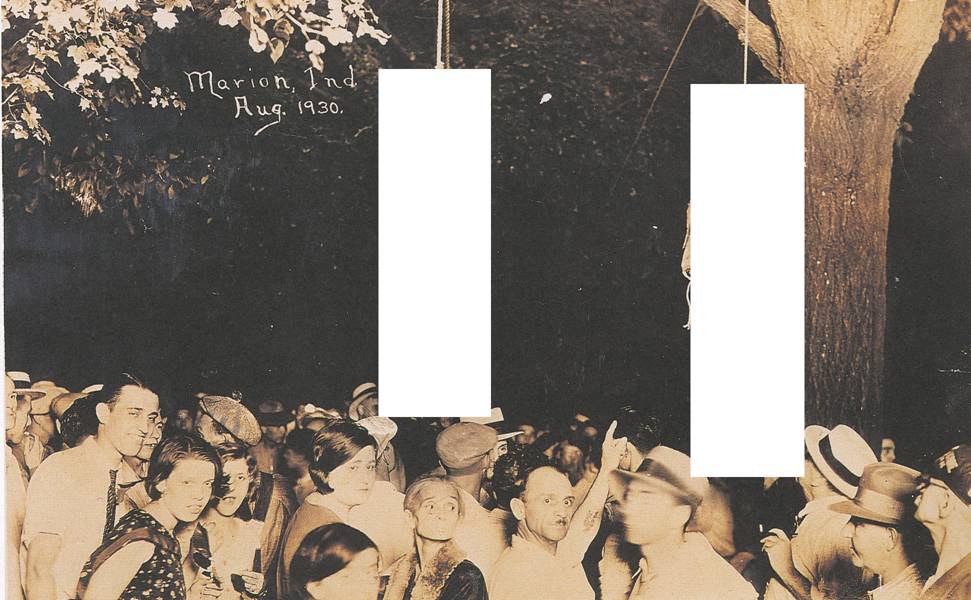

The blanked out parts of the pictures are, of course, the victims of lynchings (all African-American) in early 20th-century United States. I won't risk the sensibilities of readers any more than I already have by describing the details of the corpses, but to put it blandly, in the first and third pictures especially, they are grotesquely mutilated.
I post these pictures not (I hope) from any motive of voyeurism, but to share with you my sense that they powerfully raise one of the most important issues in moral psychology: the emotions of perpetrators of evil. Though it's a bit hard to see in these small pictures (the maximum size Blogger allows), I hope it's nonetheless evident that most of the lynchers look relaxed and happy -- though they're only feet from a freshly murdered corpse. It was not uncommon to bring small children along to lynchings, to collect souvenirs, to take photos and sell them as postcards. (These pictures are from a collection of just such postcards: James Allen's Without Sanctuary.)
Although I'm attracted to a roughly Mencian view of human nature, according to which something in us is deeply revolted by evil, when that evil is nearby and "in one's face" as it were, I find pictures like this somewhat difficult to reconcile with that view. Are these people inwardly revolted, under their smiles?
(The old comments and replies are here.)
Monday, April 02, 2007
Against "Appearances"
Chisholm (1957) and Jackson (1977) distinguish an epistemic from a phenomenal sense of the word "appears".
The epistemic sense: If I say "It appears the Democrats are headed for defeat", normally I'm expressing a kind of hedged judgment. I'm expressing the view that the Democrats are headed for defeat, qualified with a recognition that my judgment may be wrong. I'm not saying anything in particular about my "phenomenology" or stream of experience. I'm not claiming for example, to be entertaining a mental image of defeated Democrats or to hear the word "defeat" ringing in my mind in inner speech.
The phenomenal sense: If I say, looking at a well-known visual illusion, "The top line appears longer", I'm not expressing a judgment about the line. I know the lines are the same length. Instead, I'm making a claim about my phenomenology, my visual experience.
These senses sometimes come together in perception: If I say, looking at two peaks in the distance, "The one on the left appears higher", I might be saying something about the peaks, or I might be saying something about my experience, or (more interestingly) I might be saying something about the peaks by way of saying something about my experience. I might be saying: "My visual experience is a left-looking-higher kind of visual experience; based on that I tentatively conclude that the left peak is higher."
Now how often do we actually do that last type of thing? If not in conversation with others, in our own cognition? How often, that is, do we reach judgments about outward objects on the basis of our knowledge of our own experience?
Traditional "veil of perception" views of perception (e.g., Descartes and Locke, on standard interpretations) suggest that that is what we do all the time in perception. We know outward things only by knowing our own minds first (and better), in particular by knowing our inner experiences of those things. What we know directly is our own sensory experience; our knowledge of the outside world is derivative of that. (Thus, it is as though our sensory experience stands like a veil between us and the world, preventing direct contact with things as they are in themselves.)
I worry that the word "appearance", as philosophers of perception typically use it, invites something like this view, by blurring together the phenomenal and the epistemic senses of "appears". I worry that it invites the view that our judgments about the things we see -- the real, physical objects around us -- are grounded in facts about how those objects are experienced phenomenally. I worry it invites the view that when I say "It (visually) appears that there is a coffee cup on the table" I mean both that I (visually) am inclined to judge that there is a coffee mug on the table and that I am having a visual experience of a certain sort -- a coffee-muggish experience; and that these two events are integrated in a certain way, as different aspects of the "appearance" perhaps. It's because I have the visual experience that I reach the visual judgment.
But here's the question: Do we reach judgments about the properties of objects based on the sensory experiences they produce in us? Or is the visual experience we have of an object the product of, or something created in parallel with, our judgments about the object? If I'm right that talk of "visual appearances" tends to invite the former view, that's reason to be wary of it, if the latter view has merit.
Friday, March 30, 2007
The Dark Laozi
Laozi (Lao Tzu) and Kongzi (Confucius) are the best-known and most admired ancient Chinese philosophers. Yet -- with apologies to Laozi enthusiasts (including many of the students in my Asian Philosophy classes) -- I myself find Laozi's philosophy hateful. And I don't think the secondary literature has done a very good job of exposing what is hateful in him.
Consider Laozi's views on government (all translations from P.J. Ivanhoe):
Ch. 3:
... sages bring things to order by opening people's hearts [or "emptying people's minds"] and filling their bellies.
They weaken the people's commitments and strengthen their bones;
They make sure that the people are without knowledge or desires;
And that those with knowledge do not dare act....
Ch. 80:
Reduce the size of the state;
Lessen the population.
Make sure that even though there are labor-saving tools, they are never used.
Make sure that the people look upon death as a weighty matter and never move to distant places.
Even though they have ships and carts, they will have no use for them.
Even though they have armor and weapons, they will have no reason to deploy them.
Make sure that the people return to the use of the knotted cord [i.e., that they abandon writing].
Make their food savory,
Their clothes fine,
Their houses comfortable,
Their lives happy.
Then even though neighboring states are within sight of each other,
Even though they can hear the sounds of each other's dogs and chickens,
Their people will grow old and die without ever having visited one another.
Ch. 5:
Heaven and earth are not benevolent;
They treat the myriad creatures as straw dogs [i.e., ceremonial offerings treated with respect during the ceremony but discarded and defiled afterward].
Sages are not benevolent;
They treat the people as straw dogs....
It is hard to imagine a more elitist and patronizing attitude than that expressed in these passages.
Laozi is also a devotee of what I take to be cheap paradox:
Ch. 1:
A Way that can be followed is not a constant Way.
A name that can be named is not a constant name....
Ch. 36:
What you intend to shrink, you must first stretch.
What you intend to weaken, you must first strengthen.
What you intend to abandon, you must first make flourish.
What you intend to steal from, you must first provide for....
Ch. 45:
...Great straightness seems crooked;
Great skillfulness seems clumsy;
Great speech seems to stammer....
Once one gets the hang of it, it is easy to generate Laozi-esque paradoxes: The darkest intention is the most benevolent. The oldest man seems the youngest. What is steady is unstable. To achieve certainty, you must be ignorant. The greatest toothbrush is the one that brushes least!
This is, it seems to me, sham profundity. It requires and reveals no deep thought or special insight. (See also my post on the "profound" in philosophy.) In fact, sham profundity perfectly fits Laozi's elitist and explicitly obfuscatory agenda: It baffles and frustrates the mind, destroys good thinking, and establishes Laozi as an authority whose insight one can't achieve or challenge.
(The other leading ancient "Daoist" (Taoist), Zhuangzi (Chuang Tzu), is another matter entirely, by the way. Where Laozi is authoritarian, self-satisfied, arrogant, and superficial, Zhuangzi is self-deprecating, anti-authoritarian, and his paradoxes seem to reflect genuine puzzlement and self-questioning.)
Wednesday, March 28, 2007
Doing Good Philosophy on a Blog?
Most philosophers, I suspect, doubt that blogs are a good medium for philosophy. Even Brian Leiter --
the blogosphere a bit too ephemeral, and its attention-span too short, to feel like it is the right forum for serious philosophical writing (TPM).
-- not to mention your average tenured tweedy grayhair!
To Leiter's objection: Face-to-face conversation is even more ephemeral and wandering, but it is an excellent medium for philosophy. Consider Socrates!
The blog is intermediate in duration, formality, and interactivity between philosophical conversation and published articles. It would be odd if the two extremes were suitable for philosophy but not the middle; I see no reason to think so. Now, of course, many blog posts are bad -- as are many philosophical conversations and formal essays. The reasons for this are obvious and have nothing to do with the medium.
Different media differently balance virtues and tolerate vices. Blogging has one virtue that I've come to think very important to philosophy: It forces you to distill an idea to a clear, communicable core.
I'm increasingly suspicious of incomprehensible, "difficult" philosophy. The human mind, when facing abstractions, can barely deal with "unless X, not Y", much less page after page of Hegel. If you build your philosophy on a tower of technical concepts and complex arguments, it will topple with a poke. By being insufficiently clear, you can avoid decisive refutation (see my post on "profound" philosophy); but the way of integrity is to make each piece plain and simple, able to stand on its own. Posting your thoughts on a blog -- that is, making your thoughts brief and comprehensible to a general audience who may not have read previous posts -- is thus a form of intellectual discipline.
Some more specific advice to fellow philosophy bloggers. (This advice applies only to posts, not to comments.)
* Post only on matters to which you've given considerable thought. If you're a leading expert on X, your reflections on X are much more likely to be worth something than are miscellaneous ramblings on matters that have left no deep tracks in your mind.
* Write to entice the reader. The title invites the reader to consider a topic. If the title is inviting, you have the reader for about two sentences; things had better be cooking.
* If a post takes more than two minutes to read or confuses the reader with jargon or complexity, then reading it becomes a project, rather than a casual pleasure. Few readers will continue.
* Each post should have at least one thing novel, of interest to the specialist. If you write outside your area of expertise, it is difficult to judge whether you are only saying what is obvious to those more expert than you.
(Now if only I would follow all this excellent advice myself!)
Monday, March 26, 2007
Distinguishing Theories vs. Background Conditions (by guest blogger Joshua Rust)
John Searle endorses "external realism", the view that there exists a mind-independent reality, in spite of the fact that our access to that reality is necessarily mediated by conscious experience.
The thesis of external realism is in some sense not a theory at all, but rather a presupposition of our being able to have theories in the first place.
One can show that this or that claim corresponds or fails to correspond to how things really are in the 'external world,' but one cannot in that way show that the claim that there is an external world corresponds to how things are in the external world, because any question of corresponding or failing to correspond to the external world already presupposes the existence of an external world to which the claim corresponds or fails to correspond. External realism is thus not a thesis nor an hypothesis but the condition of having certain sorts of theses or hypotheses (Searle, 1995, 178).
External realism isn't a thesis or representation but rather a "background condition" for having a thesis in the first place. Why? The idea seems to be that very idea of truth or falsity seems to imply a mind-independent reality.
Rather than evaluate the merits of Searle's argument, I will rather presuppose my own version of the distinction between theories and background conditions.
Following Bas van Fraassen, explanations are answers to why-questions. Theories help us adjudicate plausible answers to why-questions from implausible answers. In a Sherlock Holmes story, a prized racing horse has been stolen. Why is the horse missing? Answer: The trainer stole the horse. Holmes is able to infer this from "the curious incident of the dog in the night-time"— the dog did not bark. The argument in favor of the explanation, of course, rides on a tacit theory: namely, that guard-dogs bark at strangers. This theory helps the trainer-story explain the missing horse. Notice that if dogs were more like cats in this respect, Holmes inference would be bunk.
I want to suggest that external realism is a background condition rather than a thesis because there is no why-question it can be called on to help answer. We cannot exhaustively specify the background understanding that goes into the evaluation of even simple why-questions, such as the one Holmes is addressing. Reasons for or against one a rival explanation can thus only be expected to supplement someone's understanding just enough to get them on board with the speaker. It's difficult to imagine a situation where pointing out the existence of a mind-independent reality would be sufficient bridge the gap in understanding which separates speaker and interlocutor; indeed, in a Monty Python parody of investigation, Holmes' pointing out the existence of a mind-independent reality could only serve to underscore the unbridgability of the interlocutor's world-views.
My claim is that theories have to be able to make a difference to the selection of rival possible explanations. Background conditions—including the claim there exists a mind-independent reality—are factors which do not make a difference to the adjudication of rival answers to a request-specification. These conditions change from explanatory puzzle to explanatory puzzle, and depending on who the audience is, but there certain things that will almost never be helpfully said—unless one is wishing to end the conversation.
Friday, March 23, 2007
"Reliability" in Epistemology
There are two ways of being unreliable. Something, or someone, might be unreliable because it often goes wrong or yields the wrong result, or it might be unreliable because it fails to do anything or yield any result at all. A secretary is unreliable in one way if he fouls up the job, unreliable in another if he simply doesn't do it. A program for delivering stock prices is unreliable in one way if it tends to misquote, unreliable in another if it crashes. Either way, they can't be depended on to do what they ought.
Contemporary epistemologists tend to classify only the first sort of failure as a failure in reliability. Here's Alvin Goldman, probably the world's leading "reliabilist":
An object (a process, method, system, or what have you) is reliable if and only if (1) it is a sort of thing that tends to produce beliefs, and (2) the proportion of true beliefs among the beliefs it produces meets some threshold, or criterion, value (1986, p. 26).
We can easily liberalize this definition to accommodate the stock quote program: The stock quote program is "reliable" on this definition if most of its quotes are right, no matter how much it crashes or how rarely it successfully delivers a quote when asked.
This peculiarity serves a purpose: For reliabilists, knowledge and justification require (something like) reliability -- and what matters in knowing or being justified, it seems, is that you're not likely to err. Regardless how glitchy the stock quote program is, if whenever it does happen to give a quote it gives the right quote, you can have knowledge and justification from it (setting aside some complexities).
Yet I wonder if epistemologists haven't lost something valuable in giving up on the ordinary notion of reliability. In cognition -- for example in introspection -- the difference between failing to reach a judgment about whether you have (e.g.) very detailed current imagery or not and reaching the wrong judgment about that is sometimes vague and cognitively minor. Either way, introspection (like the secretary or stock quote program) has failed to deliver what one might reasonably hope it should. There's often no firm line between guesses, conjectures, impressions, and definite opinions, and whether one expresses oneself hesitantly, unhesitantly, or not at all -- to oneself or aloud -- may depend more on context and temperament than anything else. These different ways of failing must of course be distinguished -- yet drawing too sharp a distinction between them, and giving them vastly different roles in our epistemology, is artificial and misses something important.
So: When I say introspection is unreliable, I mean that in the broad, ordinary sense of "unreliable". It is no objection to my pessimism, but rather supports it, if the reader or general population fails to reach introspective judgments about their experience -- as long as it's a case where it seems like introspection should be able to deliver results, like a basic and pervasive aspect of currently ongoing conscious experience patiently considered.
Wednesday, March 21, 2007
Is Perception Always Experiential? (by guest blogger Joshua Rust)
In an earlier post, Eric asked the question, "Is There an Experience of Thinking?". In this post I would like to look at a related question—is perception always experiential?
Given the amount of philosophical ink spilled on this question, I think it will be more helpful to proceed indirectly by reframing it as an interpretive question.
First, some background: if the question concerns the role phenomenal properties play in perception, there are two broad classes of answer. On one hand, phenomenalists argue that phenomenal properties are necessary for perception (Chalmers, Pitt, Siewert, G. Strawson). On the other hand, representationalists argue that a phenomenal experience is not necessary for sensory experience (Dennett, Brandom, McDowell, Rey, Sellars), or else is reducible to perception's intentional content (Dretske, Lycan, Tye). For more background see Pitt's excellent entry on mental representation in the Stanford Encyclopedia of Philosophy (especially sections 3-5).
Now, the interpretive puzzle: Pitt includes John Searle within the phenomenal camp. He claims that Searle thinks that phenomenal properties are necessary in determining the content of sensory experience. While there is much in Searle which supports Pitt's characterization of Searle, I have recently come across a passage in Intentionality which suggests Searle's considered view is otherwise: while phenomenal conscious properties are "characteristic" of perception, for Searle, they are not necessary.
Searle is clear that beliefs need not have phenomenal experience. But perceptions are different: (A) "States such as beliefs and desires need not be conscious states. A person can have a belief or desire even when he is not thinking about it and he can be truly said to have such states even when asleep. But visual and other sorts of perceptual experiences are conscious mental events" (Intentionality, 45).
He then goes on to assert that, (B) "Someone who claimed that there was a class of beings capable of perceiving optically, that is, beings capable of visual perception but who did not have visual experiences, would be making a genuine empirical claim" (Intentionality, 46).
Given what he says in (B), one would expect that Searle would then cite empirical evidence which would buttress his claim in (A), that in order to percieve one must have some sort of conscious, phenomenal experience. He does go onto cite empirical evidence, but it doesn't appear to justify the claim made in (A).
(C) "Weiskrantz, Warrington and their colleagues have studied how certain sorts of brain lesions produce what they call 'blind sight'. The patient can give correct answers to questions about visual events and objects that he is presented with, but he claims to have no visual awareness of these objects and events. Now, from our point of view the interest of such cases derives from the fact that the optical stimuli the patient is subjected to apparently produce a form of Intentionality. Otherwise, the patient would not be able to report the visual events in question. But the Intentional content produced by their optical stimulation is not realized in the way that our presentational contents are realized. For us to see an object, we have to have visual experiences of a certain sort. But, assuming Weiskrantz's account is correct, the patient can in some sense 'see' an object even though he does not have the relevant visual experiences. He simply reports a "feeling" that something is there, or makes a "guess" that it is there. Those who doubt the existence of visual experiences, by the way, might want to ask themselves what it is that we have that such patients seem to lack" (Intentionality, 47)
To my ear, Searle appears to misconstrue the significance of the 'blind sight' evidence. If blind sight tests show that we can see without having certain phenomenal experiences (C), given that Searle holds that phenomenal experiences must be present in order to see is an empirical claim (B), then the blind sight test seems to contradict his claim in (A) that perceptual experience is a conscious mental event.
Questions: are there are alternative readings of these passages which saves Searle from incoherence? Given (C), is Pitt wrong to characterize Searle as a phenomenalist about visual experience in the SEP article? More generally, is a phenomenal experience necessary for perception? If so, is there any way for the phenomenalist to make sense of the Weiskrantz "blind sight" findings?
Monday, March 19, 2007
On Not Seeking Pleasure Much
When I was a graduate student, a girlfriend asked me what, of all things, I most enjoyed doing. Eschewing the obvious and half-clever reply, I answered skiing -- thinking of those moments of breathing the cold, clean air, taking in the mountain view, then expertly carving a steep, lonely slope. But how long had it been since I'd gone skiing -- maybe three years? My girlfriend suggested that if has been three years since I've done what I most enjoyed doing, then maybe I wasn't living wisely.
Well what, I asked, did she most enjoy? Getting back massages, she said. Now the two of us had a deal at the time: If one gave the other a back massage, the recipient would owe a massage in return the following day. We exchanged massages occasionally, but not often, probably about once every few weeks. I pointed out to her that she, too, might not be perfectly rational: She could easily get much more of what she most enjoyed by simply giving me more back massages. And surely the displeasure of giving me a back massage couldn't outweigh the pleasure of getting the thing she most enjoyed in the world? Or was pleasure for her so tepid a thing that even the greatest pleasure was hardly worth getting, so that the combination of getting and receiving a back massage would for her be a hedonic negative?
I suspect at the root of both these cases is the same thing: Avoiding displeasure is, for her and me and most people, intrinsically more motivating than gaining pleasure, so that even our top pleasures (skiing, back massages) aren't motivating enough to overcome only moderate displeasures (organizing a ski trip, giving a massage). Is this rational? Is displeasure more unpleasant than pleasure is pleasant? Or is this like the economic irrationality of doing much more to avoid a loss than to secure an equivalent gain?
If avoiding displeasure is more motivating than seeking pleasure, this also might explain certain strands in Stoicism and Buddhism.
Friday, March 16, 2007
Difficulties with Davidson's account of action (II): What is the force of the "because" that links action and desire? (by guest blogger Joshua Rust)
It is worth drawing attention to the flexibility of the subordinating conjunction, "because". I can think of at least three importantly different senses of the word. It can flag a causal explanation: "my car stopped because it was out of gas." It might indicate an inferential relation: "My car must be out of gas because it stopped." Finally, it can denote a clarificatory relation: "He is a bachelor because he is an unmarried male" or "He was precious because of his skills and experience." In both of these cases, we are specifying what is meant by, or what counts as, "bachelor" or "precious." We are not inferring his preciousness, nor do his skills or experience cause him to be precious.
Davidson is concerned to explicate sentences like, "He flipped the switch because he wanted to turn on the light." In what sense is the word "because" being used here, where turning on the light is an action? Indeed, he frames his own project in these terms: "Central to the relation between a reason and an action it explains is the idea that the agent performed the action because he had the reason. Of course, we can include this idea too in justification; but then the notion of justification becomes as dark as the notion of reason until we can account for the force of that 'because'" (Davidson 1963, 691).
The orthodox reading of Davidson sees the subordinating conjunction which links reason and action as exclusively causal. Reasons, Davidson says, "rationalize" or "causally explain" action.
But, if as I argued in the previous post, actions are defined in terms of their causes (primary reasons), it doesn't seem as though these same causes can then be cited as a causal explanation of that action.
What, then, is the force of that 'because'? It is obviously not inferential. We don't come to know that he flipped the switch because of his beliefs and desires. But I think a case can be made for the subordinating conjunction which links reason and action as being clarificatory.
Consider the case of motion sickness, which is also defined in terms of its causes. If I asked "why am I experiencing motion sickness?," you cannot answer "because of the motion." If you did answer in this way, your answer might rightly be construed as a rejection of the question—"what else," you might be wondering, "did you want to know, that you didn't already know?!" Now consider the following response to the same why-question: "because of the movement of the boat." This seems like a perfectly good response to the same question. But notice that boat-movement is just a kind of movement. Why would citing a kind of movement be a good answer to the question, when citing movement in general is not? In fact, I don't think it is an answer to the why-question at all. It's rather an informative rejection of the question. Why-questions are answered when we cite some event in the causal stream leading up to explanandum, which is not already specified by the explanandum (see Woodward's non-triviality requirement in the previous post). Since the sickness is already known to be caused by motion, saying that motion is, further, boat-motion doesn't satisfy this requirement. What the response is doing is not causally explaining the motion sickness, but rather clarifying for the interlocutor what kind of motion sickness he/she has—boat or seasickness. The subordinating conjunction in the claim, "I am experiencing motion sickness because of the movement of the boat," is clarificatory rather than causally explanatory. It says what I mean by motion sickness in this instance—seasickness.
Back to Davidson: If I ask, "why did you flip the switch?," when I already know the body movement to be an action, you may not explain this action by saying that you had primary reasons. This much is already entailed by its being an action, if actions are defined in terms of their causes—primary reasons, consisting of beliefs and desires. But you may nevertheless respond, quite appropriately, "Because I wanted to turn on the light". This is not a causal explanation; if I already knew the body movement stemmed from a desire (=action), in telling me what kind of desire you have you are not citing a cause that falls outside the scope of the explanandum, as required by the non-triviality requirement. But have nevertheless learned something: the flipping of the switch is an instance of turning on the light, and not alerting a prowler. This is analogous to your telling me that my motion sickness is, moreover, seasickness. But notice that the "because" which links my desire to turn on the light and my flipping the switch is not causally explanatory at all, but rather clarificatory.
I don't think that Davidson would agree to my characterization of his view. He clearly thinks that desires rationalize or causally explain action. But as my first post indicates, I'm not sure this view is tenable. But Davidson also says of his view that "The defense no doubt requires some redeployment, but not more or less complete abandonment of the position, as urged by [Anscombe, Hampshire, etc.]". These authors, I think, would be sympathetic to the idea that the "force of the 'because'" is more clarificatory than causally explanatory.
Wednesday, March 14, 2007
Knowing Your Own Thoughts
Readers familiar with my research will know that I'm pretty pessimistic about the reliability of introspection, even of currently ongoing conscious experience -- e.g., ongoing visual experience, imagery, emotion. Regarding our own thoughts, though, you might think it's plausible to suppose that our introspection is excellent.
I'm not so sure.
It's not clear that, even if we reach accurate judgments about our on-going thoughts, the accuracy of those judgments is due to a genuinely introspective process -- if we take introspection essentially to involve something like detection. Rather, the accuracy may be more a matter of self-attributions of thoughts being self-fulfilling, as statements like "I'm saying 'blu-bob'" are self-fulfilling. Or, similarly, our self-knowledge of our thoughts might be like the driver's knowledge of whether he'll be going left or right at the coming intersection (to borrow an example from Tori McGeer) -- knowledge we have as a result of our capacity to shape our behavior, or thoughts, to accord with our judgments about what our behavior or thoughts will be. Or maybe (with Dorit Bar-On and others) the accuracy of our self-attribution of thoughts is due to the fact that our self-attributions are simply expressions of our thoughts (like "that hurts" is an expression of pain, no more introspective than "ow!"). What all these accounts have in common is that our accuracy in self-attribution is not due to accurate detection in an introspective sense.
But there's something left out here, too. For it seems that sometimes we have accurate knowledge of recently past thoughts. Because the purported thoughts are in the past, our accuracy can't be due to self-fulfillment or self-shaping or self-expression. Of course, it's not clear that it's due to introspection exactly, either -- since ordinarily we think of introspection as a means of detecting what's currently ongoing in our minds, not what happened in the past. But the fact remains, whether we call it introspective or not, we do seem to have some accurate knowledge of recently past thoughts.
But how accurate, I wonder? I'm feeling pretty confident that about a minute ago I was thinking about getting some tea. But should I trust this confidence? People are also pretty confident in their judgments about imagery, dreams, visual experience, etc., even when they are quite plausibly mistaken. We are never proven wrong in our self-attribution of past thoughts, and maybe that underwrites our confidence -- but we have no test for the accuracy of such self-attributions, so of course we won't be proven wrong, no matter how wrong we actually are! Is there really some basis for thinking that our memories of our recent thoughts do generally accord with the thoughts themselves?
Tuesday, March 13, 2007
Monday, March 12, 2007
Difficulties with Davidson's account of action (I): On explaining something in terms of the very causes by which it is defined
(by guest blogger Joshua Rust)
It is not uncommon to find philosophers defining otherwise problematic entities in terms of their causes. A plausible reading of Davidson, for example, sees him as defining action as a body movement which is caused by certain beliefs and desires. If the body movement is not caused by these attitudes, it does not count as an action. This is Davidson's answer to Wittgenstein's puzzle—when I raise my arm what is left over when I subtract the fact that my arm has gone up? (Philosophical Investigations, I-621) If the arm-raising is a genuine action, its causes are what remain following the subtraction.
Defining something in terms of its causes is not, of course, limited to philosophical discourse. Motion sickness is, perhaps, a certain queasy feeling that is caused in the right way. If one has the same feeling, but is on otherwise stable ground, that feeling does not count as motion sickness.
Here is my worry: if we define something in terms of its causes, it seems as though we are precluded from then explaining that thing by appeal to those same causes. This is manifestly clear in the case of motion sickness. If explanations are answers to why-questions, I may not cite motion in answer to the question, "Why am I experiencing motion sickness?" Why not? Because a condition of something's being an explanation is that it is genuinely informative. James Woodward, for example, says that a scientific explanation aims to "draw attention to further considerations the relevance of which is not apparent from [the why-question's] original characterisation of the explanandum under investigation" (Woodward 1979, 61; see also Mumford 1998, 139-41, and Braithwaite 1953, 320).
Davidson opens "Actions, Reasons, and Causes" with the following claim: "What is the relation between a reason and an action when the reason explains the action by giving the agent's reason for doing what he did? We may call such explanations rationalizations, and say that the reason rationalizes the action" (Davidson 1963, 685). But given Woodward's non-triviality requirement placed on a causal explanation, if actions are defined in terms of their causes (primary reasons = beliefs and desires), is Davidson then correct to say that a reason causally explains or rationalizes an action? That is, if (action = body movement caused by reason), we may not answer "Why (body movement caused by reason)?" by citing a reason. Reasons are not causal explanations of actions. This seems like a serious flaw with Davidson's account of action.
One possibility is that I've misconstrued Davidson's account of action; he does not define actions in terms of their causes. What is his solution to Wittgenstein's puzzle? Or what are the grounds by which he rejects this puzzle? Another possibility is that Davidson has something different in mind by explanation than does Woodward. But Davidson goes on to say "that rationalization is a species of ordinary causal explanation" (Davidson 1963, 685). As far as I can tell, actions aren't rationalized or causally explained by primary reasons—if anything, only a body movement is so explained. In the next post I will exploit this flaw to offer a non-standard reading of Davidson's account of action.
While this post is nominally about Davidson's account of action, I'm principally interested in leveraging the issue for metaphilosophical purposes. Any author which defines x in terms of its causes may not, if I am correct, then go on to claim that he or she has causally explained x by appeal to those same causes. Searle, for example, defines an institutional fact as a brute fact which has had some function intentionally imposed on it. He cannot, if I am right here, thereby go on to claim that institutional facts are causally explained by the said intentional imposition of function.
Friday, March 09, 2007
The Pinch Test for Dreaming
"Pinch me, I must be dreaming!" What assumption about dreaming lies behind this saying? I see two main candidates:
(1.) If I'm dreaming and someone in the dream pinches me, I will wake.
(2.) If I think I might be dreaming and someone in the dream pinches me, I'll be able to tell whether I'm dreaming or not.
The more dominant and more plausible view, I suspect, is (2). The thought presumably is this: In dreams, we don't have tactile sense experiences, or pain experiences, or we do have such experiences but they're different from waking tactile experiences in a way discernible to a dreamer.
A plausible assumption, I said. And appealing, I think, to many contemporary Americans. But is it right? Let me mention one reason to think it might be, two reasons for doubt, and two questions.
Reason to think it might be: I've read a lot of dream reports in the course of my research on dreams (e.g. here), and indeed it's not unusual to remark on the absence of tactile and pain sensations in dreams. For example, someone might report dreaming of being stabbed in the stomach and seeing blood come out, but without feeling any pain.
Reason for doubt #1: Traditional theories of dreams, like Descartes's, as well as most contemporary theories of dreams, don't give us much reason to suppose that we'd experience vision and hearing in dreams (or have visual and auditory imagery) but not other senses.
Reason for doubt #2: In the 1950s, people thought they dreamed in black and white. Both before and after the 20th century, people generally report dreaming in color. The best explanation for this, I think, is not that our dreams themselves changed from color to black-and-white and back again, but rather that our reports about our dreams assimilate them too much to the dominant media of our culture. (There was even a brief period when some psychologists said our dreams were generally silent, like Charlie Chaplin films!) Hence I suspect that if the dominant media involved tactile sensations, our dream reports would include them.
Question 1: I know there is considerable cortical activity in visual areas during REM sleep (including in regions associated with color experience). Is there a lower level of activity in brain regions associated with pain and tactile sensation?
Question 2: Is the "pinch me" thing primarily just American, or anglophone, or confined to Western cultures, or is something like it widely cross-cultural? If we don't have tactile and pain experiences in sleep, one might suppose that the reasons for that would apply cross-culturally.
Wednesday, March 07, 2007
On the connection between moral reasoning and emotion (by guest blogger Joshua Rust)
I have been recently listing to a series of lectures on the psychology of human emotion, distributed as a podcast from the UC Berkeley website. In lecture 22, Professor Dacher Keltner argues that the Western/Platonic propensity to distinguish emotion and reasoning is peculiar and, to some extent, pernicious.
For example, On Lawrence Kohlberg's theory of moral development, children start as emotional and thus immoral. It is only once they are able to contain these emotions to the point that they can take on other people's perspectives that they are able to achieve some degree of moral clarity.
Keltner argues that emotions are central to most of our day-to-day decision making and reasoning. To illustrate this, he presents a thought experiment to the class (formulated by John Haidt, 2001) which is intended to draw out our intuitions as to how emotions fit into our moral judgments. By way of warning, the thought experiment is disturbing (by design). From the podcast:
Does this person deserve to be punished or not? A guy goes to the supermarket and he decides he is going to cook himself some chicken. He get some organic chicken that is plucked and packaged in cellophane, he takes it home, he shuts his curtains, he unwraps the chicken, he has sex with the chicken, cooks it and eats it. Do we punish that guy?
Your emotional response, much like my own and that of the class to which Keltner is lecturing, is immediate and visceral—revolting disgust (perhaps followed by the sense of relief that comes with the realization that we philosophers only have to subject our students to the relatively tame trolley examples).
But the question remains: should this person be morally punished? (community service, jail, etc.) The kaleidoscope of emotive responses followed by a set of rational deliberations concerning privacy and rights manifests, in sequence, upon the faces of Keltner's students. In spite of overt disgust exhibited by Keltner's class, not one of them thought that he should be morally reprimanded. Moreover, when the chicken example is presented to psychology undergrads across the country no more than 20%-30% of the students recommend that he be punished (it's not just Berkeley students).
Haidt presented the chicken example to a wide cross-section of the world's population. Against that contrast, the data shows that the typical American undergraduate response is extremely unusual. In many other places the visceral emotional response isn't countervailed by a belief in rights, freedom, and personal privacy; in places such as Brazil upwards of 70-80% of those surveyed thought that this individual should be punished.
Haidt takes this as evidence that our emotions figure prominently in our moral decision making.
The survey's results are interesting. But does does Haidt's conclusion follow? Has he shown a connection between emotional and moral judgment, undermining a Platonic tendency to drive a wedge between the emotional and the rational, and then locate moral judgments on side of the side of reason?
One reading of the evidence does not appear to undermine Kohlberg's theory but support it. The judgment not to punish the man is a moral judgment; and is one that is seemingly arrived at in spite of strong a emotional force to the contrary. My partner pointed out that it is the ability of reason to swim against the current of emotion that allows, for example, someone supporting equal rights for homosexuals in spite of, perhaps, being repulsed at the thought of gay sex. The fact that the considered judgment comes after the immediate emotional response, further suggests that traditional philosophers are right to distinguish reason from emotions.
Nevertheless, I think that Haidt is right to suggest a deeper connection between our emotional capacities and our moral judgments. Against the above Kohlbergian reading, it is important to see that the study only shows that American students don't think the man should be punished. The link between punishment and moral judgment is a contingent one. It seems to me perfectly coherent to think that he has done something wrong, say from the point of view of Virtue Ethics, but nevertheless also hold that he should not be punished. Perhaps what the survey shows is that American undergrads feel as though we ought to reserve the institution of punishment for the most heinous violations.
Along these lines, MacIntyre distinguishes between the Aristotelian virtues on the one hand and a "morality of law" on the other. As a first approximation, virtues are skills—qualities of mind or character—that bring about a shared end, most generally characterized as the good. The phronimos or expert has the skill to both discriminate and respond appropriately to a variety of unique situations. A morality of law, however, is primarily a set of prohibitions on injurious actions (murder, theft, etc.) that intolerably undermine the possibility of the good (After Virtue, 151-2). Perhaps we don't think of the action as violating a morality of law, but nevertheless use our emotional response as a guide to moral evaluation concerning his character. On such a distinction, our disgust is deeply connected to a moral evaluation, even if we don't think that the man's action justifies punishment.
Monday, March 05, 2007
The Motivation of Ethicists: A Seven-Year-Old's Thought
Regular visitors will know I post quite a bit on what I call The Problem of the Ethics Professors -- the fact (if it is a fact) that ethicists seem to behave no better than non-ethicists. Does this suggest that philosophical moral reflection is largely impotent to improve behavior? I hope not, but I'm not entirely comfortable with any of the obvious resolutions.
A couple weeks ago, I posed the question to my seven-year-old son Davy. I told him that there's some evidence that people who talk a lot about the importance of behaving in good, moral ways don't seem to behave any better than anyone else. What did he think of that? Did that sound right to him?
Davy said that he has noticed that the kids who talk most about about being nice and sharing are the ones who want you to be nice to them and share with them. We then agreed that these kids might not themselves be any better behaved than other kids when the tables are turned, and may even in some cases be more greedy and demanding than average.
It's an obvious thought, in a way; and it may well be too cheap a shot -- not really true, or even if true of seven-year-olds, not very well connected with the motivations for studying ethics among adults. But I was at least struck by Davy's insightfulness. I can't say that exactly that thought had occurred to me before, either on my own or in any of my many conversations with other philosophers about the matter. (Maybe someone raised it, but Davy's way of putting it stuck with me better?)
Let me emphasize that I don't think this is very plausible as a full explanation of the motivations of professional ethicists. I think most ethicists genuinely want to turn their standards on themselves and maybe even do so as their first and primary sort of ethical reflection, outside the abstract context of argumentative philosophy. Yet I wonder: What makes us turn to ethics in the first place? What makes it the case that some of us are fascinated with right and wrong, fair and unfair, praise and blame, while others are left comparatively cold by such issues? Ontogenetically, I wonder if Davy mightn't actually be so far off....
Friday, March 02, 2007
Flow and the Not-So-Skillful Zhuangzi?
If you've been reading much psychology recently, you've probably heard about Mihaly Csikszentmihalyi's concept of "Flow". Flow is characterized as a state of complete, undistracted immersion in skillful activity. Csikszentmihalyi (and often his subjects) regards such experiences as positive and fulfilling. Imagine the pianist completely immersed in a brilliant performance or a basketball player completely attuned to the events on the court, responding skillfully and spontaneously to every move. There's no denying that there's something cool about that!
(On the other hand, I'm not sure there's anything so intrinsically wonderful in being so immersed in driving or in your customary work -- two of the most common "flow" activities in ordinary life, according to Csikszentmihalyi -- that time flies by without your seeming to notice. The "flow" of data entry isn't maybe quite as romantic as the flow of the concert pianist.)
Standard interpretations of the ancient Chinese philosopher Zhuangzi (Chuang Tzu) -- most notably, that of A.C. Graham, but also of P.J. Ivanhoe and many others -- would make him the greatest early advocate of "flow": The life one should strive for, according to Graham's Zhuangzi, is one of spontaneous, skillful reactivity, like that of an artisan in the flow of his work.
The standard passage in support of this view is in Zhuangzi chapter 3, on the butcher cutting up an ox:
A butcher was cutting up an ox for Lord Wenhui. Wherever his hand touched, wherever his shoulder leaned, wherever his foot stepped, wherever his knee pushed -- with a zip! with a whoosh! -- he handled his chopper with aplomb, and never skipped a beat. He moved in time to the Dance of the Mulberry Forest, and harmonized with the Head of the Line Symphony. Lord Wenhui said, "Ah, excellent, that technique can reach such heights!"
The butcher sheathed his chopper and responded, "What your servant values is the Way, which goes beyond technique. When I first began cutting up oxen, I did not see anything but oxen. Three years later, I couldn't see the whole ox. And now, I encounter them with spirit and don't look with my eyes. Sensible knowledge stops and spiritual desires proceed. I rely on the Heavenly patterns, strike in the big gaps, am guided by the large fissures, and follow what is inherently so. I never touch a ligament or tendon, much less do any heavy wrenching! A good butcher changes his chopper every year because he chips it. An average butcher changes it every month because he breaks it. There are spaces between those joints, and the edge of the blade has no thickness. If you use what has no thickness to go where there is space -- oh! there's plenty of extra room to play about in. That's why after nineteen years the blade of my chopper is still as though fresh from the grindstone.
"Still, when I get to a hard place, I see the difficulty and take breathless care. My gaze settles! My movements slow! I move the chopper slightly, and in a twinkling it's come apart, crumbling to the ground like a clod of earth! I stand holding my chopper and glance all around, dwelling on my accomplishment. Then I clean my chopper and put it away."
Lord Wenhui said, "Excellent! I have heard the words of butcher and learned how to care for life!" [Kjellberg trans., in Ivanhoe & Van Norden 2001/2005, p. 224-225]
Csikszentmihalyi cites this very passage in his 1990 book Flow. And how can one resist? Who'd have known butchery was so wonderful? (The butcher at the local Ralph's debones my trout: Whoosh! In a single fluid movement, all the bones are gone, a perfect skeleton in his hand. Now he's spiritually fulfilled!)
Setting aside the question of whether this is really spontaneous skillful activity, beyond words and conscious thought, or genuine flow -- maybe it is, but that might turn on nuances in interpreting the penultimate paragraph -- I have some doubts about the centrality this passage is often given in interpreting Zhuangzi's positive vision of life.
(1.) Although there are other passages celebrating skillful executing of mundane activities in the Zhuangzi, this is the only clear and substantial one in the Inner Chapters, the authentic core of the book.
(2.) In the Inner Chapters, Zhuangzi criticizes what might seem to be flowing, skillful activity at least as much as his praises it:
Zhuangzi said, "Haven't you seen a weasel? It bends down then rises up. It springs east and west, not worrying about heights or depths -- and lands in a snare or dies in a net. Now the yak is so big he looks like clouds hanging from Heaven. He sure can be big, but he can't catch mice. You have a big tree an are upset that you can't use it. Why not plant it by a nothing-at-all village in a wide empty waste? You could do nothing, dilly-dallying by its side, or nap, ho-hum, beneath it. It won't fall to any axe's chop and nothing will harm it. Since it isn't any use, what bad can happen to it?" [Kjellberg trans., p. 213]
This sounds almost like the opposite of the message of the butcher: The weasel has the skill of catching mice, but because it becomes completely absorbed in that activity, it loses track of the big picture and dies. And, indeed, isn't this exactly the danger of undistracted skillful activity? -- that one becomes so absorbed in it, so purely reactive to just a narrow range of pre-defined goals set by that activity, that one risks losing sight of the big picture, or of things one should be distracted by (including lunch, one's home life, or even the fire alarm)? Indeed, the context of the weasel example is Huizi's not knowing what to do with a huge gourd that resists the ordinary uses of gourds but invites unconventional uses. What would the butcher do with a 40-foot ox? Could he see past his usual methods and think instead of riding its shoulders through the impassable swamp?
Note also:
The Way is lost in the glorification of right and wrong. The Way is lost in the completion of love. But are there such things as loss and completion? Or are there no such things as loss and completion? Loss and completion -- that's Master Bright Works playing his lute. No loss and no completion -- that's Master Bright Works not playing his lute. Bright Works playing his lute, Shi Kuang holding his baton, Huizi leaning on his desk: the knowledge of these three masters was almost perfect, and they passed their successes on to later years. What they liked they tried to set apart from other things. What they liked they tried to illuminate. But they only succeeded in illuminating the other things and so ended in the gloom of "hard and white" [that is, meaningless logical distinctions]. Their followers ended up tangled in the string of works and were incompete their whole lives. If this counts as completion, then we are all complete, too. If this doesn't count as completion, then none of us have ever been complete. So the torch of slippery doubt is what the sage steers by. Don't insist, but lodge in the usual: this is what I mean by throwing things open to the light. [Kjellberg trans., p. 218-219]
A difficult passage! But if anything is clear, it's that the Way is lost (if anything can be lost, if there is such a thing as loss) in the skillful activities of Master Bright Works on the lute, etc. There is no praise here of skillful activity as the secret of caring for life.
(Indeed maybe it's the commitment to caring about success and failure -- "right" and "wrong" -- that is the root of the problem. The Zhuangzi of Chapter 2 might not praise the butcher who takes pride in his accomplishment, and who presumably would be disappointed if he broke his knife and ruined the ox, or even became only an average butcher -- which most butchers must of course be.)
(3.) Zhuangzi (for example in the weasel passage) praises "doing nothing". Although the idea of doing nothing (wu wei) has received enormous attention in the secondary literature in classical Chinese philosophy and has come to seem to mean something very different from its surface meaning (something like spontaneous, skillful reactivity, in fact), I don't really see much of a textual basis for this in the Inner Chapters of the Zhuangzi. He seems simply to praise literally doing nothing (or very little), like the yak. To the extent Zhuangzi does, here and elsewhere, praise uselessness and doing nothing, that seems the opposite of praising skillful accomplishment.
So I think we must re-evaluate standard interpretations of Zhuangzi's view of skill. And, indeed, I think Zhuangzi contains the seeds of a critique of the idea of "flow" as a central aim of life.
Wednesday, February 28, 2007
A Priori Metaphysical Possibility (by guest blogger Jonathan Ichikawa)
Some philosophers think that we can't know any propositions to be possible a priori. One way to argue that we can't do this might go something like this: at best, you can only know something to be conceptually possible a priori; but conceptual possibility doesn't entail real (metaphysical) possibility, for which armchair investigation isn't enough. This is because, as Kripke demonstrated, some conceptual possibilities are metaphysically impossible.
(Hesperus is not Phosphorus is metaphysically impossible because 'Hesperus' and 'Phosphorus' refer rigidly to the same object something that requires empirical investigation to establish. But it seems in some sense conceivable. We might call this a mere conceptual possibility.)
I agree that not all conceptual possibilities are metaphysical possibilities. But I think that, given a priori access to conceptual possibility and conceptual impossibility, we can get some a priori access to metaphysical possibility. Because I think there is an a priori link between conceptual and metaphysical possibility.
Here's a principle that might be true and a priori:
For any proposition q, if q is conceptually possible but metaphysically impossible, then there is some conceptually possible proposition p such that p -> []~q is conceptually necessary. (That's a material conditional and the box of metaphysical necessity.)
Why believe this principle? For one thing, for any such q, ~q is an a posteriori necessity, and a posteriori necessities follow a priori from empirical facts and concept possession. Since all empirical facts are conceptually possible, this is sufficient to prove the principle.
This principle gives us an a priori test for metaphysical possibility. (I'm assuming a priori conceptual modality.) Take some conceptually possible proposition q. If it is conceptually impossible that some conceptually possible proposition p is such that p conceptually entails necessarily not-q, then q is genuinely metaphysically possible.
For instance, it is conceptually possible for the Bears to have won the 2007 Super Bowl. Furthermore, there is no conceivable proposition p such that it is a priori that if p, then it is metaphysically impossible for the Bears to have won the 2007 Super Bowl. Therefore, it is metaphysically possible for the Bears to have won the 2007 Super Bowl.
If this is right, then one upshot is that it's worth getting clear on what conceptual possibility amounts to, and how it works.
I'd like to thank Eric for the opportunity to guest-blog for the past few weeks, and to thank everyone who's read and offered valuable comments. I hope and believe that this has helped get me back into the habit of philosophical blogging I'll be continuing back at my own blog, There is Some Truth in That. I hope to see some of you there.
[And from Eric: Thanks so much, Jonathan, for your thought-provoking posts!]
Monday, February 26, 2007
Is Philosophy Ever Profound?
I can't recall ever having had the inclination to call a bit of philosophy "profound". I've been wondering recently what's behind attributions of profundity.
The opposite of profound might be "superficial". I do think some philosophy is superficial. For example, if one critiques Descartes's Meditations by complaining that he ignores somatic sensations in the gut, that critique is superficial (unless one draws something interesting and general from that observation). But it doesn't seem to follow that any critique of the Meditations that fails to be superficial is consequently profound.
Is profundity a matter of striking at the core of an issue? Berkeley strikes at the core of our conception of "material objects" in his suggestion that there are none such, but only minds and their experiences, co-ordinated by God. Ayer strikes at the heart of ethics when he says there are no moral facts. Yet these thinkers are not, I believe, the sort often labeled profound. Nor are those who give straightforward responses to their arguments in defense of mainstream opinion. Perhaps their views are too clear and comprehensible to be profound?
A philosopher writes about a matter of considerable importance; it's hard entirely to understand what he is saying, but you get hints and glimmers; any attempt to express it in familiar terms (or in newly-invented but clearly articulated terms) seems to fall short; straightforward objections seem to miss the mark, because they depend on exactly what the text does not provide, a plain interpretation that cannot plausibly be shifted to accommodate difficulties. If you are prone to philosophical trust -- if you believe that there is an elusive truth behind the text that you don't quite understand and that plain-speaking philosophers always (even necessarily?) miss -- then perhaps you will consider the text profound. Kant, Hegel, Heidegger, Wittgenstein invite this sort of attitude. In contemporary "analytic" circles, maybe Davidson and McDowell do (among devotees).
If I think no philosophy is profound, then maybe that's because I am not much prone to philosophical trust, and because I am doubtful that there are any important philosophical truths so complex that they cannot be clearly stated in 400 pages.
Or, maybe, emitting evocative hints and glimmers that defy clear interpretation and engender interesting thoughts in others -- maybe that just is profundity?
Friday, February 23, 2007
Dreaming, Belief, and Emotion (by guest blogger Jonathan Ichikawa)
Colin McGinn thinks that we believe what we dream. In his book Mindsight, McGinn raises lots of questions about dreaming and imagination, but only briefly considers the suggestion that we "no more believe our dreams than we believe our daytime reveries." That's my view. He rejects it on the grounds that without invoking belief, we cannot explain our emotional involvement with dreams. Here's a quote:
The sure test that dreams are suffused with belief is their ability to generate emotions that are conditional on belief, such as fear and elation—with which dreams are full. (p. 112)
The problem for the imagination model, then, can be stated thus:
(1) When I dream that p, I experience fear, elation, and other emotions of a certain type.
(2) Emotions like fear and elation, arising from an attitude that p, can only arise from a belief that p. Therefore,
(3) When I dream that p, I believe that p.
This argument strikes me as pretty bad. This parallels a puzzle in the philosophy of literature involving emotional responses to fictions. Fictions arouse emotions in us without causing belief; we seem to be happy that p, even though we do not believe that p. This is what philosophers of literature call the "Paradox of Fiction," and it takes the form of an apparently-inconsistent triad:
(1') When I read in a fiction that p, I experience fear, elation, and other emotions of a certain type.
(2) Emotions like fear and elation, arising from an attitude that p, can only arise from a belief that p. Therefore,
(3') When I read in a fiction that p, I do not believe that p.
It is generally accepted that (3') is true, so philosophers of fiction agree that it is either (1') or (2) that has to go. We may, with Kendall Walton, deny that we really experience fear and elation, but rather experience different, similar states, which he calls quasi-fear and quasi-elation. Or, we may say with Derek Matravers and others that belief isn't really necessary for fear; imagination can also play the role that belief often plays in fear, and likewise for the other emotions. I prefer the latter option, but I think it's obvious that one of these has to be right.
If we take the latter option to solve our puzzle about fiction, then we have also directly avoided the problem for the imagination model by denying the shared premise (2). If, on the other hand, we insist that these emotions include a cognitive element, denying instead that fictions really generate these emotions, then we may very well ask whether dreams really generate them either. It will be, perhaps, more plausible if we qualify our denial of emotional involvement in dreams thus: dreams don't involve emotions, except in the way that fictions do.
