Showing posts with label aesthetics. Show all posts

Friday, February 13, 2026

The Intrinsic Value of Diversity

Moral diversity, Olivia Bailey and Thi Nguyen say (in a draft paper shared with Myisha Cherry's Emotion and Society Lab), is valuable. It's good that people have different ethical personalities, opinions, and concerns. (Within reason: Nazis not welcome.)

Why? Their reasons are instrumental. Society benefits when people care intensely about different things. This allows us collectively to achieve a wide range of goals -- curing cancer, helping the homeless, protesting unjust government. Society also benefits if some people explore the ethical possibility space, developing unusual moral visions, most of which will be mistaken but a few of which might eventually be recognized as genuine moral advances (think of the first slavery abolitionists). And individuals benefit from the liberty to adopt moral priorities that fit their skills and temperaments: Some people thrive in battle, others in caregiving, others in solitary work.

But is moral diversity also intrinsically valuable -- that is, valuable for its own sake, independent of these good consequences? I think so. I think so because diversity in general is intrinsically valuable, and there's no good reason to treat moral diversity as an exception.

How does one argumentatively establish the intrinsic value of diversity? The only way I know is to reveal, through thought experiment, that you already implicitly accept it -- and then to ward off objections.

Bailey and Nguyen briefly cite Alexander Nehamas on diversity of aesthetic opinion. Nehamas writes:

I think a world where everyone liked, or loved, the same things would be a desperate, desolate world -- as devoid of pleasure and interest as the most frightful dystopia of those who believe (quite wrongly) that the popular media are inevitably producing a depressingly, disconsolately uniform world culture. And although I say this with serious discomfort, a world in which everyone liked Shakespeare, or Titian, or Bach for the same reasons -- if such a world were possible -- appears to me no better than a world where everyone tuned in to Baywatch or listened to the worst pop music at the same time (Nehamas 2002, p. 58-59).

Why is aesthetic diversity valuable, according to Nehamas? Because style and taste require originality and are bound up with what is distinctive about your life, interests, and sensibility. Without distinctiveness, style and taste collapse -- an aesthetic disaster.

Should we say, then, that diversity, including moral diversity, is valuable aesthetically? That its value lies primarily in its beauty, in its capacity to inspire awe, or some other aesthetic feature? Indeed, diversity is beautiful and awesome (imagine the world without it!) but I don't think this exhausts its intrinsic value. Aesthetic value requires a spectator, at least a notional one, whose appreciation is the point. The intrinsic value of diversity is not, or not primarily, mediated through the hypothetical reaction of an aesthetic spectator.

My favorite approach to thinking about intrinsic value is the Distant Planet Thought Experiment. Imagine a planet on the far side of the galaxy, blocked from view by the galactic core, a planet we'll never see or interact with. What would we hope for on this planet, for its own sake, independent of any potential value for us?

Would you hope that it's a sterile rock, completely devoid of life? I think not. If you do think a lifeless rock would be best, I have no argument against you. For me this is a starting place, a bedrock judgment, which I expect most readers will share.

Suppose, then, that you agree a planet with life would be intrinsically better than one without. Would you hope that its life consists entirely of microbes? Or would you hope that it teems with diverse life: reefs and rainforests, beetles and bats, squid and bees and ferns and foxes -- or rather, not to duplicate Earth too closely, their alien analogues, translated into a different key? I think you'll hope that the planet teems with diverse life.

Would you hope that no life on this planet has humanlike behavioral sophistication -- language, long-term planning, complex social coordination? Would you hope that nothing there could contemplate the meaning of life, the origin of the stars, or its own ancient history? Would you hope that nothing there could create art, or engage in athletic competition, or invent complex games and tricks and jokes? I invite you to join me in thinking otherwise. The planet would be better if it included some beings with that richness of thought and activity.

Would you hope for uniformity of intellectual, aesthetic, and ethical opinion -- that everyone shares the same values and ideas? Or would you hope for diversity? I think you'll join me in thinking that the world would be better, better for its own sake, if it were diverse rather than uniform. Different entities would have different skills, preferences, passions, and ideas. They'll fight and disagree (not genocidally, I hope), sometimes value their differences, sometimes dismiss others as completely wrongheaded, sometimes cluster into shared projects, sometimes collaborate across deep disagreement, sometimes be drawn to opposites, sometimes feel kinship with the like-minded, play within and across divides, pursue an enormous variety of projects, explore a vast space of possible forms of life.

That is what I hope for on this distant planet -- not for instrumental reasons (not, for example, because it will maximize happiness), and not merely because it would strike a hypothetical spectator as beautiful and awesome (though it should). Rather, just because it would be valuable for its own sake. An empty void has little or no value; a rich plurality of forms of existence has immense value, no further justification required.

I have not argued for this. I have only stated it vividly, hoping that you already accept it.

Is ethical opinion an exception? Should we prefer unity and conformity in ethics, even while welcoming diversity elsewhere? I think not, for two reasons.

First, ethics is open-textured, indeterminate, and full of tragic dilemmas. Often there is no one decisively best answer on which everyone should converge. Diversity within at least the bounds of reasonable disagreement should be permitted.

Second, ethical values are inseparable from our other values and ways of life. A philosophy professor, a civil rights lawyer, a professional athlete, and a farmer will value different things. There is, I think, no point in attempting to cleanly separate their differing values into distinct types, some of which are permitted to vary and others of which may not. The ethical, prudential, epistemic, and aesthetic blur together. These distinctions are not as clean as philosophers often assume. Normativity is a mush.

Oh, some of you disagree? Good!

[the cover of my 2024 book, The Weirdness of the World, hardback version]

Friday, May 16, 2025

The Awesomeness of Bad Art

I love bad art.

Gather some friends and create some bad music. Cruise in a car covered with graffiti doodles. Hand a five-year-old crayons and free time and see what weirdness emerges.

Something worth celebrating happens. Although the art is "bad" in one sense -- it will win no prizes and astound no critics -- it wonderfully enriches the world. How?

[I can swim like a grasfl dolphin can you? by my daughter Kate, at age six]

[Angel and moonbug, by my son Davy, circa age five]

The awesomeness isn't due to impressive technique, honed by years of craft, like Rembrandt. It's not due to intrinsic beauty and color-mad insight, like Van Gogh. It's not due to challenging conventional interpretability and the boundaries of artistic tradition, like Picasso.

Nick Riggle argues that art draws most of its aesthetic value from shared aesthetic engagement, and I agree that's some of the sorcery. A Vengefull Kurtain Rods song, a Vogon poem, or a Mystical Anarchist "motorized cathedral" art car is a social act, deriving value from the connections it fosters and the shared practice of aesthetic valuing -- including, in the case of Vogon poetry, the shared practice of aesthetic loathing. Parents and children bond over the child's emerging abilities and tastes.

But I don't think that Riggle has quite struck to the heart of it. When I improvise on the piano alone at home, relishing the quirky turns of my intermediate jazz piano skills, the ghost of my old piano teacher Matt Dennis may hover nearby, but my minor participation in the social tradition of jazz creation is only part of the story. Similarly for grandma painting seascapes in the eldercare facility -- kitschy, flawed, excruciatingly hers. Similarly for the strange abstract doodles I sometimes sketch when bored at a faculty meetings, which I aesthetically enjoy probably more than I should.

It helps to consider why five-year-olds are better artists than eight-year-olds. Eight-year-olds draw conventional stick figures, conventional houses with two neat windows, a door, and a triangle roof with chimney, a standard rainbow, a standard sun. Four-year-olds have only an inkling of these conventions, invent their own weird solutions -- people as heads on towering legs with too many toes, cars that look like falling toast. At five and six and seven, they shape themselves more toward the generic. Kate's swimmer is generic, but her dolphin is wild and long -- and are those hills or waves or rainbows in the background? Davy's houses look standard, but the grass is sunflower tall, the chimneys jut precariously sideways, his angel's wings are small, and he hasn't figured out how to draw conventional nighttime stars.

Preschoolers and early elementary schoolers show more individuality in their art. It dances barefoot across your expectations. Their lines reflect distinctive aesthetic attempts. This distinctiveness is harder to discover in the more conventional art of later childhood and needs to be rediscovered later. Similarly for grandma, if she hasn't consumed too much Bob Ross. If her seascapes are generic, in one sense they are more competent and less "bad" than untrained attempts, but they have less point and are less valuable than a heartfelt effort that finds a different solution.

Bad art manifests the raw signature of the individual eye. It shows a mind grappling with an aesthetic challenge. If the artist judges it a failure and crosses it out, then their vision hasn't been realized. But if it is beloved in its strangeness -- if the creator affirms it as a successful completion of their artistic intention, then it's a distinctive achievement that reflects the mind and hand of the moment.

Our planet -- amazingly, awesomely, wondrously, beautifully, stunningly (to any aliens who might happen upon it amid the dark blandness of space) -- hosts five-year-olds who draw bugs on the moon and six-year-olds who draw impossibly long dolphins, teenagers doodling on cars, friends collaborating on goofy songs. If no one else would have done it the same way, then the work reflects your distinctive aesthetic encounter with the world. It's a piece of you made visible. Especially (but not only) for those who care about you, it's your individual eye, voice, and values that ignite its meaning.

Bad art can fail in two ways: When it's so generic that the artist vanishes or when the artist disowns it as failing to capture their aesthetic vision. If it passes the sibling tests of distinctiveness and affirmation, it is valuable.

A world devoid of weird, wild, uneven, wonderful artistic flailing would be a lesser world. Let a thousand lopsided flowers bloom!

Friday, September 27, 2024

How to Improve the Universe by Watching TV Alone in Your Room

Old age can be a silent tribute to beauty.

I imagine my own case. Maybe I live the tail end of my life alone in elder care. My wife, six years older than me, is already gone. My children are living full lives in distant towns. What will I be doing? I've always been a writer, a teacher, a worker, but maybe 89-year-old me will lack the creative energy or the cognitive capacity for much of that.

Still, unless I'm very far gone, I could watch TV. I could play Candy Crush. I could listen to Paul Simon and This American Life, enjoy cute cat photos, savor a chocolate cherry, appreciate the oak tree outside my window. In each of these activities, I add to the beauty of the universe -- for beauty is amplified by having a receiver. Beauty is fullest as a partnership between the beautiful thing and a person who appreciates that thing.

The appreciator might be entirely solitary, the appreciation an end unto itself with no further fruit. The creator (if there is a creator) needn't know, might even be long dead. Last weekend, when the rest of my family was away, I played a Scott Joplin rag on our piano. I played clumsily, with no audience and no long-term effects of any sort (let's suppose) -- but in that moment I invigorated and extended the beauty of his compositions. It's as though I reached back in time to make Joplin's work more enduring and influential, his life more meaningful.

Similarly, one special pleasure of reading obscure 19th century academic writing, as I sometimes do, is the sense that I have brought some forgotten scholar's impact into the 21st century. Someday, I too will be a forgotten scholar! I imagine some 22nd-century archivist happening upon something I've written and liking it. It will thereby have a spark of continuing life, more so than if it had been preserved but entirely unread.

The partnership between artist and appreciator or creator and consumer needn't be as energetic as that between composer and player or scholar and interpreter. Nor need the beauty be as exotic as a ragtime composition or antique essay. Every person who enjoys a rerun of I Love Lucy or who savors a bag of M&M's extends and enlivens their beauty. The universe grows fuller every time a TV somewhere reanimates the silliness of Lucille Ball. The smoothness, bright colors, and sweetness of M&M's resonate deeper into the world every time someone pauses to appreciate them.

I hope that even alone in my eldercare facility, past the time when I feel able to create for others, I will find life to be overall a joy. But maybe I won't. The value of aesthetic partnership isn't just a matter of finding joy. Even simple aesthetic appreciation directly adds significance and value to the work and the creator, renders it a more impactful cultural artifact, makes it truer of our time and group that “we” still value it. We can all contribute to the beauty of the universe, even silently, secretly, and alone in our rooms -- almost magically -- simply by appreciating beautiful things. I might die the next minute. If I laugh alone at I Love Lucy, my reception still enriches the world.

This is the comfort I reach for when I ponder the eventual loss of my creative abilities. This is the comfort I reach for, also, when I walk through an elder care facility and see so many people alone with their televisions. I am trying to see this -- can I see this? -- as a beautiful thing.

[image source]

Wednesday, July 03, 2024

Color the World

My teenage daughter's car earns a lot of attention on the street:


People honk and wave, strangers ask to add their own art, five-year-olds drop their toys and gawk.  A few people look annoyed and turn away.  (Kate describes her car as a "personality tester".)

A couple of years ago, I had promised my 2009 Honda Accord to Kate when she earned her driver's license.  But knowing that Kate cares about appearances -- stylish clothes and all that -- I promised that I'd have it repainted first, since the paint jobs on these old Hondas age badly in the southern California sun.  But when I saw the cost of a proper paint job, I was shocked.  So I suggested that we turn it into an art car, which she and her friends could decorate at will.  (In the 1980s, a few of my friends and I did the same with our old beater cars, generating "Motorized Cathedrals of the Church of the Mystical Anarchist" numbers 2 through 4 -- number 1, of course, being Earth itself.)  She accepted my offer, we bought paints, and voila, over the months the art has accumulated!

I'm not sure exactly what makes the world intrinsically valuable.  I reject hedonism, on which the only intrinsically valuable thing is pleasure; I'm inclined to think that a diversity of flourishing life is at least as important.  (Consider what one would benevolently hope for on a distant planet.  I'd hope not that it's just a sterile rock, but richly populated with diverse life, including, ideally, rich societies with art, science, philosophy, sports, and varied cultures and ecosystems.)

Multitudinous brown 2009 Honda Accords populate the roads of America.  What a bland, practical car!  The world is richer -- intrinsically better -- for containing Kate's weird variant.  She and her friends have added color to the world.

We might generalize this to a motto: Color the World.

It doesn't have to be a car, of course.  Your creative uniqueness might more naturally manifest in other forms (and it's reasonable to worry about resale value).  It might be tattoos on your body, unusual clothing, the way you decorate your office, house, or yard.  It might be your poetry (even secret poetry, seen by no one else and immediately destroyed, timelessly enriches the fabric of the world), your music, your philosophical prose, your distinctive weirdness on social media.  It might be the unusual way you greet people, your quirky manifestation of the rituals of religion or fandom or parenthood, your taste in metaphor, the way you skip down the street, your puns and dad jokes, your famous barbecue parties.

It would be superhuman to be distinctively interesting in all these domains at once, and probably narcissistic even to try.  Sometimes it's best to be the straight man in boring clothes -- a contrast against which the dazzlingly dressed shine more brightly.  But I think most of us hold back more than we need to, for lack of energy and fear of standing out.  Hoist your freak flag!

I see three dimensions of excellence in coloring the world:

(1.) Your color must be different than the others around you, in a way that stands out, at least to the attentive.  If everyone has a brown Honda, having the only green one already adds diversity, even if green is no intrinsically better than brown.  If baseball hats are abundant, adding another one to the mix doesn't add color; but being the one baseball hat in a sea of fedoras does (and vice versa of course).

(2.) Your color should ideally express something distinctive about you.  While you might choose a baseball hat to contrast with the fedoras simply because it's different, ideally you choose it because it also discloses an underlying difference between you and the others -- maybe you are the ragingest baseball fan in the group.  Your moon-and-cat tattoo isn't just different but manifests your special affection for cats in moonlight.  Your dad jokes wink with a je ne sais quoi that your friends all instantly recognize.

(3.) Your color should ideally arise from your creative energy.  A baseball cap from the merch store might (in some contexts) be color -- but a cap modified by your own hand is more colorful.  Let it be, if it can, your own artistic endeavor, your paint and brush, your own selection of words, your own decisions about how best to embody the ritual, organize the party, structure the space.  If it's prepackaged, put it together a little differently, or contextualize or use it a little differently.

Can I justify these subsidiary principles by appeal to the ideal of diversity?  Maybe!  Diversity occupies a middle space between bland sameness and chaotic white noise.  By grounding your difference in your distinctive features and your creative inspiration, you ensure the structure, order, and significance that distinguishes meaningful diversity from random variation.

I imagine someone objecting to Color the World by counterposing the motto Walk Lightly.  I do feel the pull of Walk Lightly.  Don't make a big fuss.  Let things be.  No need to scratch your name on every tree and upturn all the sand on the beach.  Walk Lightly, perhaps, manifests respect for the color that others bring to the world.  Fair enough.  Make good decisions about when and where to color.

Goodbye for today!  Time to drive my own bland car home.  When I walk in my front door, I'll ritualistically confirm with my wife and daughter that they abided by my usual morning advice to them: (1.) no barfing, and (2.) don't get abducted by aliens.

Thursday, May 04, 2023

Philosophy and Beauty and Beautiful Philosophy

guest post by Nick Riggle

One of the things I love about philosophy is its beauty. Philosophical works contain beautiful ideas, arguments, systems, and essays. And beautiful minds are expressed via these—beautifully creative, thoughtful, sensitive, powerful, insightful minds. For me it’s the wonderful oeuvre of Barry Stroud. It’s Kit Fine’s essay “Essence and Modality”. It’s Iris Murdoch’s The Sovereignty of Good and Frege’s Grundlagen. Plato’s Symposium and Apology. Friedrich Schiller’s Letters on the Aesthetic Education of Mankind. Jorge Portilla’s “Fenomenología del relajo”. It’s J. David Velleman’s Self to Self, Richard Moran’s The Philosophical Imagination, and Sarah Broadie’s work on Aristotle and Plato. Even when I don’t agree, or don’t know whether I agree, I love being attuned to a wonderful system, a beautiful idea, a stunning essay, a philosophically brilliant mind.

When I try to understand why I find some philosophy beautiful, I think about the way these works are constructed, the insight they contain, the big-picture views or systems they develop, the care, sensitivity, and thoughtfulness they embody, the soaring affirmation of intellectual life, the creative and transformative perspectives they offer up. As a philosopher, they inspire me, I want to share these works, understand them better and better, and talk about them. I want them to animate and inform the work I develop and share.


[Dall-E (left) and Midjourney (right) outputs for the prompt "beautiful philosophy"]

*

What is the beauty of philosophy? I want that question to have an obvious answer: the beauty of philosophy is just that, beauty, aesthetic goodness. But philosophers have a penchant for making that obvious answer unavailable. By far the most influential theory of aesthetic value is aesthetic hedonism: aesthetic value is the capacity to cause pleasure (or valuable experience more generally) in an appropriately situated individual.

I have had a lot of complaints about aesthetic hedonism, but one of the things that bugs me the most about it is the difficulty it has accounting for the beauty of philosophy. Philosophy doesn’t smell nice, and it doesn’t look like anything. But aesthetic hedonism weds aesthetic value to experience, and even the latest attempts to defend the view tie aesthetic experience to sensory properties. So if a thing cannot be sensed, perceived, intuito-perceived, or whatever, then it cannot be beautiful.

Some philosophers embrace the implication and deny that philosophy (and math, proofs, theories, logic, etc.) can be beautiful. But to me, denying the beauty of mathematics and logic is a nonstarter. And what’s to recommend a philosophical theory of beauty incapable of capturing the beauty of philosophy? I guess you’d have to think that there was nothing aesthetically special about philosophy to shrug your shoulders at that question. But to me the question sticks, and the answer is obvious.

*

Philosophers know that it is easier to tollens a ponens than it is to come up with a whole new premise. Is there a way of understanding the nature of aesthetic value that can capture the beauty of philosophy? The idea that philosophy and aesthetic value are both sources of pleasure barely touches the surface of their parallels. I think it helps to appreciate how deep the parallels run. I’ll look at three: viewpoint convergence, self-expression, and community.

Viewpoint Convergence: Here’s a lesson we just learned (yet again) about philosophy: convergence among philosophers about their various views and positions is hard to come by. Some philosophers even argue that (at least some) ideal philosophical communities are incompatible with significant viewpoint convergence. If philosophers tended to converge, then we would tend to miss argumentative nuances, overlook subtle distinctions, and ignore alternative ideas and perspectives. In other words, tending to converge tends to mean being bad at philosophy.

Something similar can be said about aesthetic valuing, the proud paradigm of the failure to converge. We generally value rather different things in our aesthetic lives, and our aesthetic disagreements often persist, even to happy effect. Aesthetic divergence is widespread, and while many have argued that convergence is the aim of aesthetic discourse, I doubt that’s right. If artists tended to make and adore the same stuff, or if lovers of beauty all tended to love the same things, they would tend to be bad at aesthetic valuing.

Self-expression: One reason for this is surely that our aesthetic lives are self-expressive. I mean three things by this. First, at the core of our aesthetic lives are beloved aesthetic attachments—to certain novels, bands, poems, comedians, films, styles of dress, cuisines. These attachments are personally significant. They capture something about who we are as individuals and what matters to us. Second, beyond this core of aesthetic attachment lies myriad discretionary choices we make to value one thing rather than other in our aesthetic lives. And in making these choices we cultivate our individualities, our sense of humor, our eye for design, our particular connection to music—our sense of taste in the varied realm of aesthetic value. Third, we use aesthetic media to make our individualities known, to express ourselves. We design out our living spaces. We share a good novel. We wear our favorite band’s t-shirt (or emulate our favorite influencer). Given the self-expressiveness of aesthetic life, it should be no surprise that viewpoint convergence is not a big concern.

Philosophy can also be self-expressive, and for many philosophers I suspect it is. Where one philosopher is drawn to ruly and rigorous analytic metaphysics, another is drawn to playful and creative aesthetics, introspective and subtle phenomenology, or to the idea of doing good by doing ethics. Something deep and variable in each of us can color and tweak our tendencies to do the many things we do in philosophy: read, think, explore, inquire, imagine, write, articulate, share, speak, reason, revise, and respond. Divergence in philosophical views also spurs these activities further. We encounter another thinker who has developed their views on a similar topic in a very different direction. We are driven to engage, and we read, think, explore, inquire, imagine, write, articulate, share, speak, reason, revise, and respond. As Kieran Setiya puts it: “I don’t need to agree with [philosophers] to love the worlds they have made for themselves.”

Community: Pursuits that call for the development and expression of an individual point of view face the obvious threat that the “worlds we make for ourselves” will be nothing more than that—some single person’s favored point of view with no claim on or connection to anyone else. The problem is exacerbated in practices that also exhibit a lack of viewpoint convergence. In the everyday work of philosophy and aesthetic life there is always a background hum whose tone is captured by the desperate voice of Rilke’s “First Elegy”: Who, if I cried out, would hear me among the angels’ / hierarchies? Or who, if I published this, would care? This background hum is an ever-present threat of loneliness or misunderstanding, of lacking a sympathetic interlocutor or audience, as if all our efforts might be met with the perfect indifference of The Dude: Well, you know, that’s just like, uh, your opinion man.

The practice of aesthetic valuing solves this problem by encouraging and rewarding social aesthetic valuing. It is a practice that enjoins us to share with others, imitate their products and styles, invite them to appreciate our views and inventions. Hey, check this out. We reach the heights of aesthetic goodness by reaching together. And to do all of this well, we need to cultivate an openness to other aesthetic worlds—to the people and products of other sensibilities. In flourishing aesthetic life, there is a lively cadence of invitation and uptake. Aesthetic goods keep this pulse thumping because aesthetic value is what is worthy of the social practice of aesthetic valuing. But aesthetic valuing is not simply a matter of having special experiences of pleasure. It is a social practice wherein we imitate aesthetic agents and goods, share aesthetic goods with each other, and express ourselves in ways that spur us to imitate, express, and share in turn.

Isn’t philosophy similar? From Socrates provoking his willing Athenian peers in the agora to a current-day professor testing their thesis at the colloquium talk. Even the solo thinker in an armchair imagines their audience (an intrigued, mildly dickish opponent, for me at least). In philosophy we need each other. Together we lurch toward understanding answers to deep and difficult questions about reality, knowledge, morality, and beauty. The goodness of philosophy is marked by this communal effort—I can “love your world” whether or not I agree. Among the best philosophy is the stuff that propels the practice and engages the group—deepening insights, spurring helpful distinctions, meriting responses, and generating ideas that deepen, spur, merit, and generate in turn.

*

With these similarities in mind we can say this about both: philosophy and aesthetic life involve people cultivating their discretionary perspective and expressing it to other practitioners doing the same in way aimed to elicit engagement and keep the practice going.

In this light, it shouldn’t be too surprising if one and the same thing that helps one participatory practice flourish also helps another. To value something both as philosophy and as beautiful is to value it as both promoting the kind of understanding and engagement philosophers seek and, at the same time, as worthy of aesthetic valuing: as promoting aesthetic community by expressing an individual style, a wonderfully shareable point of view, opening our valuing selves up to each other and helping us see new avenues of thought and action. Surely pleasure flits around in there, doing its thing, but we needn’t hitch our ride to it.

Thursday, April 27, 2023

New Voices in Philosophy

guest post by Nick Riggle

Philosophy is a famously rigid and complex discipline full of daunting and difficult prose. As a sign of this, people have wondered whether philosophy is literature. Literature is creatively ambitious, figurative and fun, wildly imaginative and associative. Philosophy, in contrast, is often hyperbolically literal, formulaic, painstakingly logical, tortuous and so often unfun.

But even in a tradition as strict as analytic philosophy, fun can be had, imaginations can run wild, and style can reign. If there is anything true in the complaint that philosophy lacks the quality of literature, it is that philosophy often lacks voice.

What does it mean for a “voice” to be present in works of philosophy? Voice is a vague concept in literary theory and it is often defined in a way that is indistinguishable from the typical definition of literary style. Here is how an expert defines voice: “A writer’s voice is the way his or her personality comes through on the page, via everything from word choice and sentence structure to tone and punctuation.” And here is philosopher Jenefer Robinson’s influential definition of literary style: “I shall argue that style is essentially a way of doing something and that it is expressive of personality. …what count as the verbal elements of style are precisely those elements which contribute to the expression of personality.” If you’d rather not take a philosopher’s word for it, here is poet Frank O’Hara: “Style at its highest ebb is personality.”

But voice and style are not the same. Literary style is the expression of the ideals the writer has for their writing. The writer who values economy of expression and rhythm has a different literary style from the writer who values complexity of thought and detailed emotional insight. Writing that follows strict formulae or rules of composition (e.g. writing legal contracts or instruction manuals) has difficulty achieving style because the rules crowd out the expression of literary values. Trying to inject one of these anti-style genres with style is a recipe for literary disaster. Or worse: witness WeWork’s failed IPO filing.

Voice comes from the perspective the writer inhabits as a writer. A writer’s voice is that of a single mother in Southern California expressing the difficulties of raising two children. She might do this through a poetic economy of expression or through a complex and emotionally nuanced account. A writer’s voice is that of a Zoomer navigating romance through DMs and dating apps, or a bank executive worried about the economy. Literary voice is, in this way, personal, where literary style is artistic.

Of course voice and style are not entirely separate. They can interact and influence each other. A writer’s artistic ideals might be informed by the perspective that drives their voice, and a writer’s voice can be shaped and inflected by their style. Some aesthetic writing practices encourage the former (rap, or romantic poetry with its ‘spontaneous overflow of passionate feelings’) and others tend toward the latter (Flaubert, Proust, Ernaux, French Writing in General?).

But there is an important difference between voice and style when comes to connecting with a reader. While style can captivate and impress, voice is a locus of love. By conveying the specificity of a perspective, literary voice forges connections and grounds affection between reader and writer, where people can communicate elusive truths about the world and their experiences. In doing so, voice has the power to create literary intimacy.

Although style and voice can interact in mutually supportive ways, when it comes to philosophy, style and voice tend to conflict. Philosophers are encouraged to adopt an ideal of philosophical writing that inhabits an impartial or impersonal perspective. Philosophers abstract from all real-world roles and particular perspectives and write from the place that Thomas Nagel called “the view from nowhere”—speaking from a general ‘we’, making claims about what ‘one’ does, structuring the prose by the general strictures of logic, writing to a faceless opponent.

If literary voice comes from inhabiting in writing a particular role and perspective, then a common ideal of philosophical writing amounts to aspiring to a kind of voicelessness, where everyone tries to write (and read) from the placeless perspective of a General Philosopher. Philosophy thus tends to lack that source of writer-reader connection and affection, and so it often overlooks those elusive truths we can communicate by developing literary intimacy.

The ideal of voiceless writing is a kind of style, and since style and voice interact, the philosophical ideal of writing can be quite literally self-sabotaging—trying to bring a voiceless self forward in writing in ways that clearly present a vocal self. Often that voice is simply a product of its time—the way that Kant, for example, comes across as a very specific dude in a very specific set of circumstances—revealed in various time-stamped expressive devices, e.g. the strategies the philosopher deploys to attain voicelessness.

When we suppress the power of voice in philosophical writing, we tilt philosophy toward voiceless questions that ask for perspective-free answers, and in doing so we encourage philosophers to lose their voices. This is an expressive problem in itself, but the problem is exacerbated when we also care about making philosophy a more diverse practice. Simply gaining membership to an elite club does not mean you can really speak your mind. And a philosopher’s particular identity can deeply influence their philosophical concerns without shifting their writing voice an inch out of the view from nowhere. Without diversifying voice in philosophical writing, we risk losing a source of the intimacy that can communicate the important and elusive truths philosophers possess. To bring voice into philosophy, we need to be able to step out of the view from nowhere and land somewhere, in our own bodies, times, and lives.

History has shown that philosophy can inhabit a wide range of literary forms in the service of voice—novels, letters, memoirs, dialogues, confessions, plays, and poetry [as I was editing this piece Helen De Cruz posted this]—and past philosophers have effectively developed voice in their works. Unfortunately, perhaps the most famous and widely taught example is Descartes’s Meditations on First Philosophy, where, to me at least, he at best semi-convincingly deploys the voice of a man desperate for knowledge to encourage the reader to cultivate their own doubt. There are more effective examples in Montaigne, Emerson, de Beauvoir, Arendt, Cavell, and others. In Either/Or, Kierkegaard writes from the perspective of two radically different worldviews to get his readers to inhabit them and appreciate their differences. Sor Juana’s The Answer and Friedrich Nietzsche’s entire oeuvre scream with voice.

Some contemporary philosophers have tiptoed outside of the confines of academic writing. Most recently, Kieran Setiya’s Life is Hard adopts the voice of a man who suffers chronic pain and of a philosopher who wants to understand the place of pain in a life well lived. Chloe Cooper Jones’s Easy Beauty combines a philosopher’s discernment with deeply personal, beautiful, and humorous insights into her own disability. Olúfẹ́mi O. Táíwò’s impassioned voice in Elite Capture is blazing with his own sense of care and conviction. My recent book This Beauty develops the voice of a man who had a challenging childhood, who is becoming a father, and who sincerely wants to understand what, if anything, makes life worth living so that he has something sincere and thoughtful to say to his sons. Philosophers like John Kaag, Anthony Appiah, Agnes Callard, and Alexander Nehamas prove that philosophers can write from places of pain, oppression, loss, joy, need, and love. And in doing so they show how philosophy can handle deep and difficult issues in ways that bring to the fore the humanity they have forged by living and confronting life in the actual world as unusually reflective and intelligent people.

Let’s unleash the literary power of philosophy and let our voices sing.

[image source]

Thursday, April 20, 2023

Power Clashing and the Structure of Practices

guest post by Nick Riggle

Some things just go together. Medjool dates and salted cashews. Hot pink and cyan. Unagi and oloroso. Sunshine and grass. Put these together and please enjoy your happiness. Other things not so much: manspreading and crowded subways, espresso and cottage cheese...

Zebra stripes and plaid?

Fashion is an aesthetic practice full of rules and restrictions: navy and brown yes, but no navy and black. No socks with sandals. No denim on denim (boooo). The long history of fashion provides a background of formalities and traditions whose dictates guide us in often unseen ways.

What, if anything, justifies these rules? In poetry, rules tend to serve other values, e.g. the value of complex and powerful prose. The strict rules of a pantoum key us into subtle changes in the meaning of a repeated and repurposed line, amplifying the power of the line and of the poem and poet in turn. The basic rules of pop song construction (~3 minutes, 4/4 time, no key changes, intro-verse-chorus-verse-chorus-bridge-chorus structure) provide a kind of sonic public playground, an accessible template for fun and endless variation.

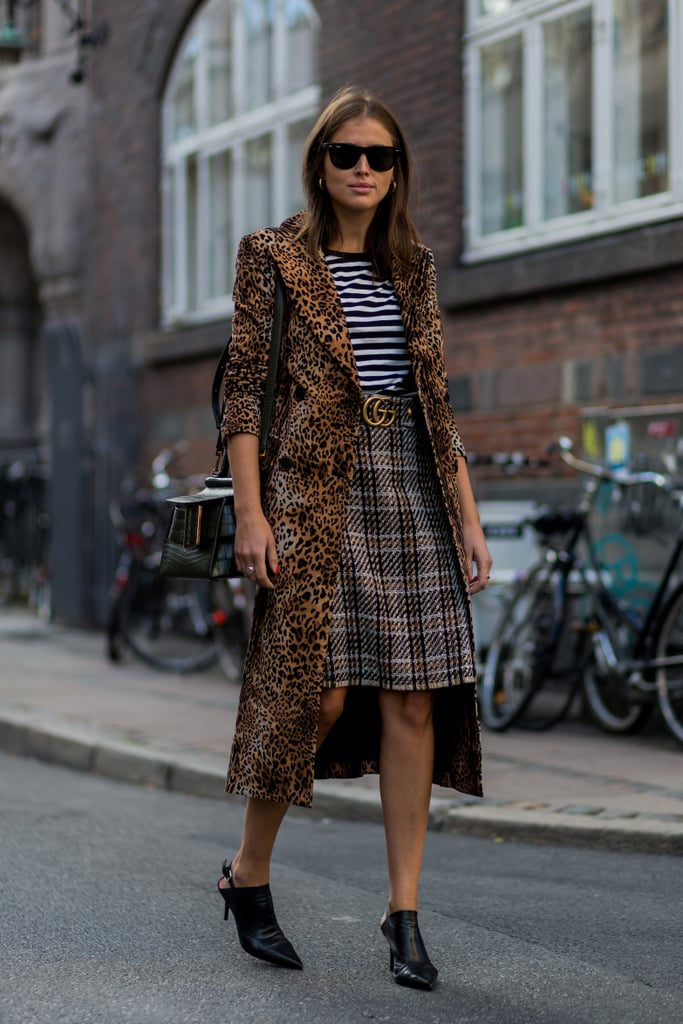
In the case of mixed patterns the justification seems simple: mixed patterns clash. You don’t mix zebra stripes and plaid because you don’t mix visually conflicting prints and patterns, perhaps especially when one is a South African animal print and the other is Scottish tartan. They do not look good together. It seems that the rule couldn’t be easier to justify, since fashion is a practice that cares about aesthetic value. Mixed patterns are visually confusing and displeasing. Fashion is about looking good. No mixed patterns. QED.

That might seem easy, simple, and true. But it is a wildly superficial account of the practice.

[image source]

*

Aesthetic practices are full of rules that cannot be justified by such simple appeals to aesthetic value. A recent paper by Guy Rohrbaugh discusses the example of  Western classical music performance, where score compliance is strictly necessary. The rule, play all and only the notes of the score, is so forceful that it does not matter if playing a different note would have greater aesthetic value. Playing other notes might sound better, be performatively expressive, or shock the audience—none of that matters because one must play all the notes. Why is there such a rule? And why is it so forceful?

Drawing on work by Aron Edidin, Rohrbaugh argues that there are indirect aesthetic reasons for the rule. First, some works have a complexity of thematic repetition, inversion, and sonic play that cannot be realized improvisationally—for their value to be realized they have to be written down and played as written. (This of course is not to say that improvisational works cannot be extremely complex.) Second, writing the music down and playing it as written allows for repetition and dissemination—more people can hear it, and everyone can hear it again. Third, this allows people to develop and deepen their understanding and appreciation of the work. And fourth, performers can bring this understanding and appreciation to bear on their performances in ways that realize different expressive, performative, and appreciative values.

The rule cannot be justified by individual-level evaluative considerations, but it can be justified at the wider practice level. The rule helps realize the goods of collective aesthetic life—sharing complex aesthetic value, deepening our understanding and appreciation of it, and expressing that understanding in our performances, experiences, and interpretations of the work. And since these goods structure aesthetic practices in general, our individual aesthetic actions must bend to them.

*

There is a kind of uber-value in fashion that mirrors this, generating various individual-level rules. Fashion is an art of self-expression. As such, anything goes, as long as it works, and what works is what captures something about who one is in a way that communicates with one’s audience. In this way, fashion goes hand-in-hand with style, where style is the expression of ideals. But expressing yourself and having style through clothing are not easy. So it helps to have more and less stringent rules addressed to individuals who, by following them, can’t go too far astray—guardrails that keep people on track and the group more or less together.

To use an entirely random example, it might befit a philosophy professor to wear cargo pants, t-shirt, and unbuttoned button-down shirt every day. The rules approve. The professor can make some limited choices within that general look – a colorful or a black tee, maybe with some philosophy reference on it, or a plaid overshirt that’s a bit ‘90s Seattle/lumberjack. The look conveys a lot; people have an easy time putting the professor in the right social group, noting a thing or two about their sensibility. The professor can rest assured that they don’t look too bad, but expression trumps looks: it matters that this look is self-expressive—a beautiful and expensive Italian suit would look great but it wouldn’t work.

To see this even more clearly, enter the power clasher—my favorite example of expression trumping looks in fashion. Power clashing has been around for some time, long enough, at least, for future Jack Donaghy (“Alterna-Jack”) to brag about his mastery of it. Power clashing is about clashing boldly—wearing animal prints with tartan and throwing naval stripes in there for good measure. Clashing patterns are primally visually confusing—hence the rule against—but visual confusion can ground expressive power and expressive power always wins. The power clasher says Yeah, I’m shining a flashlight in your eyes—what are you gonna do about it? The hope of fashion is that you shine back in your own way.

The individual-level rules of fashion are not ultimately justified by appeal to visual appeal. They typically help us look good, true, but more importantly they help us meet minimal conditions of self-expression. Power clashers prove that an apparently ruly practice can be deeply unruly at its heart, because the practice’s heart is the powerful and elusive value of self-expression through dress. We should think of the rules of fashion not as strict rules—ones that obviously change all the time anyway—but as communal notes on how to realize the practice’s governing value.

*

This makes me wonder about philosophy, which is full of stringent norms and standards, and full of people ready to enforce them—implicit and explicit norms of logic, form, voice, argument, address, and interaction. There are so many that our vigilance in observance of them threatens to make our essays and books oppressive to write and exhausting to read, as if we always had to wear formal dress lest we be regarded as unserious at best, dumb at worst. Is it too easy to forget that philosophy can be done without adhering to such norms? Like poetry, the beauty of philosophy can shine through and because of its rules, but poetry has embraced its ‘free verse’. I sometimes wonder if we collectively lost our sense of philosophy’s potential for literary creativity.

The sad truth is that philosophers can be extremely dismissive of those who fall out of line with philosophy’s conservative standards of writing, painting Wittgenstein as a charlatan, Nietzsche as a madman, the novels of Iris Murdoch as irrelevant, the dialogue as a lost genre, or anything outside of the standard form professional publication as lesser. I don’t know whether we can literally power clash in philosophy but I wouldn’t mind a few more flashlights in my face.

Thursday, April 06, 2023

Sexiness and Love Island

guest post by Nick Riggle

Sexiness can seem straightforward. Everyone knows what it’s like to want and respond to it—in oneself, in others—and I’d venture that most people do indeed want it one way or another. But the ease of feeling might flow in the other direction. Rod Stewart reminds us that sexiness more than flirts with objectification: If you want my body and you think I’m sexy… The desire for sexiness seems to include the desire for bodies as such, and so its aesthetic value seems to flirt too directly with ethical disvalue. It is difficult to know how to feel: aesthetically attracted, ethically repulsed.

* 

One response to the sexiness problem is what I call the Prince Strategy. In his song “Sexy M.F.” Prince solves the problem by transforming sexiness from sexual to mental attractiveness.

We need to talk about things, tell me what cha do
Tell me whatcha eat, I might cook for you
See it really don't matter 'cause it's all about me and you
Ain't no one else around
I'm movin' with the blindfold, gagged and bound
I don't mind, see this ain't about sex
It's all about love being in charge of this life and the next
Why all the cosmic talk?
I just want you smarter than I'll ever be
When we take that walk

You seem perplexed I haven't taken you yet
Can't you see I'm harder than a man can get
I got wet dreams comin' out of my ears
I get hard if the wind blows your cologne near me
But I can take it, 'cause I want the whole nine
This ain't about the body, it's about the mind

Prince emphasizes that true sexiness is ‘about the mind’. This conceptual engineering gives him the best of both worlds. As he sings later in the song, “I'm happy to change my state of mind for this behind.”

[Midjourney rendition of Prince cooking eggs for a sexy woman]

As many philosophers have pointed out, sexiness is bound up with patriarchy and its attendant restrictions on women’s autonomy. The Prince Strategy tries to sidestep the connections between sexiness, women’s bodies, and patriarchy by replacing sexual, bodily attractiveness with mental attractiveness. This is an appealing strategy, for under patriarchy it is not enough to agree with Martha Nussbaum’s point that objectification means many things (7 by her count) and it is not always ethically wrong. Under patriarchy it often is, and that’s one reason why the Prince Strategy can seem attractive in this extremely nonideal world.

The problem with the Prince Strategy is not that minds cannot be sexy—obviously they can, says this philosopher—it’s that it seems to deny that bodies can also be sexy. Having watched more than a few seasons of Love Island UK I can report: obviously they can. Should we simply ignore that fact? I should clarify that watching Love Island UK is not my only evidence.

*

Sheila Lintott and Sherri Irvin develop another response by intervening in the patriarchal culture of sexiness that encourages women to embrace a notion of sexiness that conforms to the male gaze. On their view, we should retain the link between sexiness and sexual desire but revise the concept of sexiness to construct one that is respectful of all persons: “To find a person sexy in this sense is to see their body as infused with an expression of self and animated by their own sexual identity. … Respecting sexiness involves seeing others not (only) as sex objects but necessarily as sexual subjects: human beings who are in charge of their sexual agency.” (p. 305)

Call this the Embodiment strategy: sexiness is the attractiveness of a person’s embodied sexuality. A sexy person expresses their sexuality in their look, demeanor, composure. To find someone sexy is to be attracted to their embodied sexuality.

*

Now consider: the Love Island Phenomenon. If you’ve watched as much Love Island UK as I have, then you have witnessed the following phenomenon many times over: You meet someone and find them very sexy. But over time you come know more about them: their personality, their values and goals (or lack thereof), their interests and style. And, like magic, their sexiness disappears.

Nothing need change about how they embody their sexuality, so what could explain the change in sexiness? And while the Embodiment strategy seems unable to capture the change, the Prince strategy can’t capture the initial attraction, for initially we know almost nothing about their minds and quite a lot about their bodies.

It seems that Love Island UK spells trouble for all.[1]

One response that Lintott and Irvin might offer is to say that the Love Island Phenomenon is best described not as a change in sexiness but as a change in attractiveness. What changes is not the person’s sexiness but your being attracted to it. Their sexiness is neutralized by your awareness of their unattractive traits. But this response makes me wonder why, if sexiness is embodied sexuality, information about the person’s non-sexual character should change how I feel about their sexiness.

*

Here is another proposal, call it Prince’s Synthesizer: Maybe the sexy truth lies in a synthesis of the Prince and Embodiment strategies: sexiness is more than embodied sexuality—it is embodied mind, where the features of mind that matter are any features we might find hot. Humans are extremely creative in finding hotness. Some of these features can shine as and through embodied sexuality: the embodiment of confidence, quirkiness, sexual poise, self-possession, boldness, and so on. But others shine in other ways: a person’s sexy intelligence, sincerity, drive, resilience, grit, creativity, worldliness, or…the way they eat falafel, or curl their lip, or smell a certain way.

Prince’s Synthesizer makes better sense of the idea that when (or at least often when) we find someone sexy, we are attracted to their style, or the way they embody their personal ideals—the way their dreams and aspirations manifest in their ways of living. Sexual aspiration generates style as much as intellectual or athletic aspiration. Eros wends its way through each. We might catch a glimpse of a person’s style in getting a sense of their sexuality, but that is only part of a bigger stylistic picture, which, when it comes into full view, along with the minds that bodies embody, might reveal something…not hot. Love Island UK Season 9 now streaming!

-----------------------------------------------------

[1] Big thanks to the students in my Fall 2022 Aesthetics and Ethics class for a great discussion about this.

Thursday, March 30, 2023

Wearing Band T-Shirts of Bands You Don’t Know

guest post by Nick Riggle

A recent trend has teens and twenty somethings wearing band t-shirts of bands they don’t know. You can know that they don’t know the band because you can ask them: Are you a fan of AC/DC, Nirvana, Metallica, Guns N’ Roses, The Doors, Slayer, Led Zeppelin? They will respond with breathtaking nonchalance: Huh? Oh, this shirt?

They wear it for the look.

Could the look be flattering? For Millennials, and most certainly for Gen-X, there might be no clearer example of a negative volitional necessity that generates the unthinkable. Thou shalt not wear a band t-shirt if thou knowest not the band. No thought is so bold, so unafraid of rejection, as to cross the Millennial and Gen-X mind.

But to them it’s edgy. It’s street. It’s rock n roll. It’s Kendall Jenner.

*

Who knows where it started (perhaps Ghesquière for Balenciaga in 2012), but everyone knows that Jenner slays. Long an influencer in the glammed-up band t-shirt game (along with her sisters), Jenner has been spotted wearing, among others, Metallica, Kiss, AC/DC, ZZ Top, and Led Zeppelin shirts, but when it comes to concerts she favors Harry Styles, Taylor Swift, and Fleetwood Mac. Philosophers have wondered whether you should be consistent in your personal aesthetics. Jenner seems unconcerned. When the metal band Slayer’s guitarist Gary Holt wore a t-shirt that read “Kill the Kardashians” on the band’s farewell tour in 2019, Jenner responded with classic Kardashian shade. She rocked a Slayer shirt that said “RIP” and (probably) helped bump the legacy band’s merch sales up to 10 million dollars that year.

*

Is it wrong to wear band t-shirts of bands you don’t know? In one sense it is obviously a mistake. I find it useful here to think about the groundbreaking theory of aesthetic value that Dominic McIver Lopes develops in his 2018 book Being for Beauty. Lopes argues that aesthetic value is metaphysically tied to the rules and norms of specific aesthetic practices. Your aesthetic reasons for acting one way rather than another when it comes to e.g. pulling an espresso shot are tied to the specific norms and achievements of the practice of pulling espresso. In the practice of band fandom that produces and distributes band t-shirts, one of the rules is crystal clear: wear a band shirt only if you love the band. If you wear one without knowing the band, then you’re not very good at the practice. You are not responding to the reasons the practice generates.

But Lopes’s theory allows for a single non-aesthetic property (or set of such) to ground different aesthetic properties in different practices. Different practices have different ‘profiles’, mapping different movements, shapes, colors, images, and so on onto different aesthetic values. The same contours and colors that are lively in minimalism are subdued abstract expressionism; the same sequence of movements that is beautiful in tap dance is awkward in ballet; a few perfect poetry verses make for a few terrible rap verses.

Maybe Kendall Jenner (and whoever else) established a new aesthetic practice of wearing band shirts as a non-fan. Wearing the shirt will potentially have different aesthetic values in each practice. Wearing one as a fan is metal, dark, unruly. As a non-fan it is edgy, indie, street, and…Kardashianesque.

*

There are many aesthetic practices that cast the products of another aesthetic practice in a new role. In bad cases it is ignorant cultural appropriation. In good cases it is brilliant fusion or avant-garde innovation. Even with billionaire influencers involved, wearing band t-shirts of bands you don’t know seems less like Ikea selling “jerk chicken” (bad) or sushirritos (good) and more like Jim Stark, the rebel without a cause, the jobless teen wearing work boots. Some aesthetic practices are freeloaders. Some other practice imbues the band shirt, the boots, the jeans with meaning. Outsiders detect that meaning, are somehow attracted to it, they latch onto and repurpose it without contributing to the original practice. In a sense they have to repurpose it because they don’t really know what it is. But it seems cool or interesting or irresistible and so whatever they do with it is unlikely to be the aesthetically right thing according to the practice. But being moved and inspired in this way is just part of what it is to aesthetically value something—it is to want to imitate it, incorporate it into your life, make it yours and share it with others. And in a sense they are not wrong: Band t-shirts are obviously cool.

*

If wearing band t-shirts of bands you don’t know is a new aesthetic practice, then there is ignorance on each side. From the fan’s point of view, the Kendall Jenner imitators are brazenly ignorant and disrespectful, flippantly adopting a mere ‘look’ by exploiting something deeply personal. From the Jenner point of view, the fans are at best overly protective, at worst plain pretentious. It’s just a t-shirt, after all, and look how dope it looks with jeans, heels, and the right jewelry!

But these freeloader practices are sure sources of confusion and letdown. Fan shirts are a quick path to aesthetic community. As a fan, you might get excited to see the youth—or perhaps billionaire influencers—in your fan club. You give a knowing nod to the unusually cool-looking person wearing an ‘80s Megadeath shirt and they return a cold stare. You say what a proper fan might say: Endgame was surprisingly good huh? To which they respond: Oh, the shirt? I don’t really know this band, I just like how it looks.

If the aesthetic goods in the non-fan’s practice piggyback on the goods in the fan’s practice, then surely the fan is owed something: Deference? Recognition? Respect? This suggests a rule that structures aesthetic practices in general: aesthetic freeloaders should orbit and defer to their source practice; they should not spin away in an attempt to create their own orbit.

What could justify this rule? It’s not that bad to ignorantly wear band t-shirts—it just kind of sucks—so the idea that it’s morally wrong seems off. And if specific aesthetic practices are practical worlds unto themselves, then it’s not immediately obvious what resources Lopes’s theory has to make good on the wrongness. But here is a thought: the aesthetic value of band t-shirts lies in the way they promote aesthetic community. They anchor individuality, express it to others, and occasion community. The t-shirt freeloader misunderstands the aesthetic value of their clothes. Doing so is apt to produce confusion and missed connection, and so some deference to the aesthetic goods of a source practice is called for.

When the right deference, recognition, or respect is not forthcoming, one might be tempted to respond with contempt at the failure of aesthetic connection, at the disrespect for the norms of a good practice. But just beyond the confusion and let down is a social opening—an opportunity for these different individuals to bond. The failure of communication is an opportunity for enlightenment: “Well you should check out Rust in Peace. “Tornado of Souls” is my favorite song.” That might take a little extra swagger on the part of the true fan. All the more reason to do it. Boldly opening up can create a bridge between worlds, and venturing into each other’s different aesthetic worlds can both expand and refine our own.

Bridges go both ways. As it turns out, Gary Holt’s encounter with the Kardashians made him a lot more Kardashianesque. Although he wore the “Kill the Kardashians” shirt because he wanted to “kill their careers”, they seem to have rubbed off on him. He now sells a lot of those t-shirts online and has expanded his collection of merch to include a range of anti-Kardashian graphics and products. A bona fide influencer.

One of my brothers is a deep player in the niche sneaker world. Like, Pizza Hut branded Reebok Pumps deep. And he got me a pair of niche sneakers that I wear now and then. I barely understand what I own. My main relationship with the shoes is that they are by far the most comfortable pair I have ever worn. So I rock them gladly, and almost every time I do some stranger comments: Nice kicks; dope shoes; fire *whatup headnod*. I happily reap the communal benefits of a practice I don’t understand.

The older I get, the more I get used to being ignored in public. Increasingly rare is the lovely random encounter, sparked by whatever, lighting up the day. Maybe I’ll buy half a dozen random band t-shirts, wear them around town, and see who I meet.

[image source]

Tuesday, December 07, 2021

Uncle Iroh Is Discernibly Wise from the Beginning (with David Schwitzgebel)

My son David and I have been working on an essay about the wisdom of Uncle Iroh in Avatar: The Last Airbender. (David is a graduate student at Institut Jean Nicod in Paris.)

If you know the series, you'll know that Uncle Iroh's wisdom is hidden beneath a veneer of foolishness. He is a classic Daoist / Zhuangzian wise fool, who uses apparent stupidity and shortsightedness as a guise to achieve noble ends (in particular the end of steering his nephew Zuko onto a more humane path as future ruler of the Fire Nation). See our discussion of this in last week's post.

Since Iroh disguises his wisdom with foolishness, we thought it possible that ordinary viewers of Avatar: The Last Airbender would tend to initially regard Iroh as actually foolish, while more knowledgeable viewers would better understand the wisdom beneath the guise.

For example, in Iroh's very first appearance in the series, Zuko sees a supernatural beam of light signaling the release of the Avatar, and Iroh reacts by dismissing it as probably just celestial lights, expressing disappointment that chasing after the light would interrupt a game he was playing with tiles. It would be easy to interpret Iroh in this scene as self-absorbed, lazy, and undiscerning, and we thought that naive viewers of the series, but not knowledgeable viewers, would tend to do so. We decided to test this empirically.

Our approach fits within the general framework of "experimental aesthetics." A central aesthetic property of a work of art is how people respond psychologically to it. Those responses can be measured empirically, and in measuring them, we gain understanding of the underlying mechanisms by which we are affected by a work of art. If Iroh is perceived differently by naive versus knowledgeable viewers, then the experience of Avatar: The Last Airbender changes with repeated viewing: In the first view, people read Iroh's actions as foolish and lazy; in the second view, they appreciate the wisdom behind them. If, in contrast, Iroh is perceived as similarly wise by naive and knowledgeable viewers, then the series operates differently: It portrays Iroh in such a manner that ordinary viewers can discern from the beginning that a deeper wisdom drives his apparent foolishness.

We recruited 200 participants from Prolific, an online source of research participants commonly used in psychological research. All participants were U.S. residents aged 18-25, since we wanted an approximately equal mix of participants who knew and who did not know Avatar: The Last Airbender and we speculated that most older adults would be unfamiliar with the series. We asked participants to indicate their familiarity with Avatar: The Last Airbender on a 1-7 scale from "not at all familiar" to "very familiar." We also asked six multiple-choice knowledge questions about the series (e.g., "What was the anticipated effect of Sozin's Comet?"). In accordance with our preregistration, participants were classified as "knowledgeable" if their self-rated knowledge was four or higher and if they answered four or more of the six knowledge questions correctly. Full methodological details, raw data, and supplementary analyses are available in the online appendix.

Somewhat to our surprise, the majority of respondents -- 63% -- were knowledgeable by these criteria, and almost none were completely naive: 95% correctly answered the first (easiest) knowledge question, identifying "Aang" as the name of the main character of the series. Perhaps this was because our online recruitment language explicitly mentioned Avatar: The Last Airbender. It is thus possible that we disproportionately recruited Avatar fans or those with at least a passing knowledge of the series.

Participants viewed three short clips (about 60-90 seconds) featuring Iroh and another three short clips featuring Katara (another character in the series), in random order, with half of participants seeing all the Iroh clips first and the other half seeing all the Katara clips first. The Iroh clips were scenes from Book One in which Iroh is superficially foolish: the opening scene described above; a scene in which Iroh falls asleep in a hot spring instead of boarding Zuko's ship at the appointed time ("Winter Solstice, Part 1: The Spirit World", Episode 7, Book 1); and a scene in which Iroh "wastes time" redirecting Zuko's ship in search of gaming tile ("The Waterbending Scroll", Episode 9, Book 1). The Katara clips were similar in length; they were clips from Book One, featuring some of her relatively wiser moments.

After each scene, participants rated the character's (Iroh's or Katara's) actions on six seven-point scales: from lazy to hard-working, kind to unkind, foolish to clever, peaceful to angry, helpful to unhelpful, and most crucially for our analysis wise to unwise. After watching all three scenes for each character, participants were asked to provide a qualitative (open-ended, written) description of whether the character seemed to be wise or unwise in the three scenes.

As expected, participants rated Katara as wise in the selected scenes, with a mean response of 1.85 on our 1 (wise) to 7 (unwise) scale, with no statistically detectable difference between the naive (1.95) and knowledgeable (1.80) groups (t(192) = 1.35, p = .18). (Note that wisdom here is indicated by a relatively low number on the scale.) However, contrary to our expectations, we also found no statistically significant difference between naive and knowledgeable participants' ratings of Iroh's wisdom. Overall, participants rated him as somewhat wise in these scenes: 3.04 on the 1-7 scale (3.08 among naive participants, 3.02 among knowledgeable participants, t(192) = -0.35, p = .73).

For example, 81% of naive participants rated Iroh as wise (3 or less on the 7-point scale) in the scene described near the beginning of this post, where Iroh superficially appears to be more concerned about his tile game than about the supernatural sign of the Avatar. (Virtually the same percentage of knowledgeable participants describe him as wise in this scene: 83%.) The naive participants' written responses suggest that they tend to see Iroh's calm attitude as wise, and several naive participants appear already to discern that his superficial foolishness hides a deeper wisdom. For example, one writes:

I actually believe that though he appears to be childish and foolish that he is probably very wise. He comes off as having been through a lot and understanding how life works out. I think he hides his intelligence.

And another writes:

I am not familiar with the character, but from a brief glance he seems to be somewhat foolish and unwise. For some reason however, it seems like he might be putting on a facade and acting this way on purpose for some alterier [sic] motive, which would mean that he actually is very wise. I do not have any evidence for this though, it's just a feeling.

Although not all naive participants were this insightful into Iroh's character, the similarity in mean scores between the naive and knowledgeable participants speaks against our hypothesis that knowledgeable participants would view Iroh as overall wiser in these scenes. Nor did naive participants detectably differ from knowledgeable participants in their ratings of how lazy, kind, foolish, peaceful, or helpful Iroh or Katara are.

Although these data tended to disconfirm our hypothesis, we wondered whether it was because the "naive" participants in this study were not truly naive. Recall that 95% correctly identified the main character's name as "Aang". Many, perhaps, had already seen a few episodes or already knew about Iroh from other sources. Perhaps knowledge of Avatar: The Last Airbender is a cultural touchstone for this age group, similar to Star Wars for the older generation, so that few respondents were truly naive?

To address this possibility, we recruited 80 additional participants, ages 40-99 (mean age 51), using more general recruitment language that did not mention Avatar: The Last Airbender. In sharp contrast with our first recruitment group, few of the participants -- 7% -- were "knowledgeable" by our standards, and only 28% identified "Aang" as the main character in a multiple-choice knowledge question.

Overall, the naive participants in this older group gave Iroh a mean wisdom rating of 3.00, not significantly different from the mean of 3.08 for the naive younger participants (t(139) = -0.43, p = .67). ("Hyper-naive" participants who failed even to recognize "Aang" as the name of the main character similarly gave a mean Iroh wisdom rating of 2.89.) Qualitatively, their answers are also similar to those of the younger participants, emphasizing Iroh's calmness as his source of wisdom. As with the younger participants, some explicitly guessed that Iroh's superficial foolishness was strategic. For example:

I'm not familiar with these characters, but I think Iroh is (wisely) trying to stop his nephew from going down "the path of evil." He knows that playing the bumbling fool is the best way to give his nephew time to realize that he's on a dangerous path.

And

He comes off a as [sic] very foolish and lazy old man. But i have a feeling he is probably a lot wiser than these scenes show.

We conclude that ordinary viewers -- at least viewers in the United States that can be accessed through Prolific -- can see Iroh's foolish wisdom from the start, contrary to our initial hypothesis.

#

In Book One, Iroh behaves in ways that are superficially foolish, despite acting in obviously wise ways later in the series. There are three possible aesthetic interpretations. One is that Iroh begins the series unwise and learns wisdom along the way. Another is that Iroh is acting wise, but in a subtle way that is not visible to most viewers until later in the series, only becoming evident on a second watch. A third is that, even from the beginning, it is evident to most intended viewers that Iroh's seeming foolishness conceals a deeper wisdom. On a combination of interpretive and empirical grounds, explored in this blog post and last week's, the third interpretation is the best supported.

To understand Iroh's wisdom, it is useful to look to the ancient Daoist Zhuangzi, specifically Zhuangzi's advice for dealing with incompetent rulers by following peacefully along with them, unthreateningly modeling disregard for fame and accomplishment while not being too useful for their ends. Since Zhuangzi provides no concrete examples of how this is supposed to work, we can look to Iroh's character as an illustration of the Zhuangzian approach to political advising. In this way, Avatar: The Last Airbender -- and the beloved uncle Iroh -- can help us better understand Zhuangzi in particular and the Daoist tradition in general.

-----------------------------------

Full draft essay available here. Comments and suggestions welcome! It's under revise and resubmit, and we hope to submit the revised version by the end of the month.

[image source]

Monday, July 19, 2021

The Philosophy of Art is the Philosophy of Technology

Guest post by C. Thi Nguyen

People keep asking me why I work in both the philosophy of art and social epistemology. I guess it must seem like an especially weird stew. But for me, they’re intellectual soulmates. Social epistemology studies how we work together to understand things — how we pass information around and intellectually collaborate. And art is one of our most important techniques for communication and connection. It is a key method for recording subtle emotions, complex perspectives, and rich ways of seeing the world.

[image from the video game Braid {source}]

Most importantly: the philosophy of art — at least my favorite parts of it — is deeply concerned with the technology of communication. My favorite aesthetics stuff is obsessed with the tiny details how each medium has its own particular communicative strengths and weaknesses. It’s obsessed with the deep difference between photography and painting, between comics and film, between movies and video games. It’s interested in how tiny shifts in the technical medium can open the door to vastly different expressive potentials and social patterns. Oil paints, photography, film, sound recording technology, video games — each of these involves some new technology which yields new expressive potentials. Seen from a certain angle, the history of art is a history of technological shifts and their social impact. It’s the history of artists, and artistic communities, mining every new technology for some fresh communicative potential.

And sometimes these medium shifts are quite subtle. Here’s one of my favorite examples: Stanley Cavell thinks that the medium of film changed essentially in the sixties.[1] Before the mid-sixties, you didn’t go to a movie; you went to the movies. As in: there were no published schedules of movie times. You went to the theater, paid an entrance fee, and just sat down and watched whatever was showing, for as long as you wanted. So filmmakers were making films catering to that viewing environment: people walking in the door and watching whatever was playing.

But in the mid-sixties, movie theaters started publishing specific showing times for specific films, and people started showing up for specific films. According to Cavell, this apparently tiny social shift essentially changes the relationship between filmmaker and audience. Because an audience member can now think of themselves as being interested in a particular kind of movie — action, horror, Westerns, art-house. And filmmakers can start making films, not for a generic audience, but for an audience of self-conceived fans of a particular genre. So the publishing of film schedules splinters the film-going and film-making world into channels and sub-communities. Cavell thinks that this constitutes a deep change in the core artistic medium of film itself.

This observation teaches us a few things. First: what’s most important about a medium for communication often isn’t in the raw material at the center, but in its social embeddedness. Much of what is crucial to the medium of film isn’t just in the images and sounds — it’s in the social process of theater-going. It’s in the fact that showtimes are, or aren’t, published in the newspaper. Second: tiny changes in the medium can have enormous social repercussions and shift the whole pattern of how people relate to an artform.

In the social epistemology world, I’ve been working a lot on the technology of communication — like about how social media structures the motivation of its users. As I’ve been working my way through these projects, I keep looking to traditional philosophical work on epistemology and finding it mostly unhelpful. But I keep finding bits of aesthetics and the philosophy of art incredibly useful, in a thousand unexpected ways. My theory, now, is that philosophical epistemology has mostly tended to think about communication in a vacuum. Philosophical work on the nature of testimony, for example, largely tends to seek invariant and universal conditions for the transmission of knowledge. It’s looking at underlying similarities between different communicative modes. That kind of approach is certainly useful for all sorts of projects. But if you’re trying to understand the impact of specific technologies of communication, then the universalizing tendency will lead you away from the grit and texture and particularity of different communicative mediums.

The philosophy of art, on the other hand, is obsessed with grit and texture and specificity. Traditional epistemology, as I was brought up to do it, de-materializes communication, ripping it from its social and technological context. But the philosophy of art is obsessed with the material nature of communication, and the impact of the specific details of different social practices of communication. It cares about the specific way that photographs transmit information, as opposed to paintings. It cares about the communicative difference between a secured painting in a museum and a piece of street art that’s out there in the public, vulnerable to modification by any passer-by. The philosophy of art cares about how a dancer and a non-dancer have deeply different experiences when watching a dance. It cares about how the concrete physicality of monuments changes their meaning — and about how the context of display shapes that meaning.

I spent some of last month writing something about the impact of Twitter’s length constraint — about how enforced shortness shapes how people connect on that platform. I couldn’t find anything in the philosophical literature on testimony that helped me grapple with the impact of enforced brevity. But what I did find incredibly useful was Ted Cohen’s beautiful little book on the aesthetics of jokes. Cohen’s theory is that the shortness of jokes evokes intimacy between joke-teller and joke-hearer, because the hearer must fill in all the information that can’t fit in the joke. And that thought unlocked, for me, the peculiar magical — and dangerous — feel of Twitter.

In retrospect, this should have been entirely unsurprising. Because where are you going to kind really deep thinking about what it means to communicate under extreme limitations of shortness? And where will you find studies of what happens when speakers try to actually embrace that shortness, to turn it from a limitation into a virtue? It won’t be in some abstract theory about testimony. It’ll be in the work of people who have spent an enormous time thinking about jokes, or haiku, or sonnets. It’ll be in the art critics, the art historians, and the philosophers of art, where people think obsessively about how the specific details of peculiar formats and media and social context shape the nature of communication.

---------------------------------------------

[1] I found out about this bit of Cavell from the philosopher of art Daniel Wack.