Showing posts with label imagery. Show all posts

Wednesday, August 28, 2013

The Experience of Reading: Imagery, Inner Speech, and Seeing the Words on the Page

(by Alan T. Moore and Eric Schwitzgebel)

What do you usually experience when you read?

Some people say that they generally hear the words of the text in their heads, either in their own voice or in the voices of narrator or characters; others say they rarely do this. Some people say they generally form visual images of the scene or ideas depicted; others say they rarely do this. Some people say that when they are deeply enough absorbed in reading, they no longer see the page, instead playing the scene like a movie before their eyes; others say that even when fully absorbed they still always visually experience the words on the page.

Some quotes:

Baars (2003): “Human beings talk to themselves every moment of the waking day. Most readers of this sentence are doing it just now.”

Jaynes (1976): “Right at this moment… as you read, you are not conscious of the letters or even of the words, or even of the syntax or the sentences, or the punctuation, but only of their meaning.”

Titchener (1909): “I instinctively arrange the facts or arguments in some visual pattern [such as] a suggestion of dull red… of angles rather than curves… pretty clearly, the picture of movement along lines, and of neatness or confusion where the moving lines come together.”

Wittgenstein (1946-1948): While reading “I have impressions, see pictures in my mind’s eye, etc. I make the story pass before me like pictures, like a cartoon story.”

Burke (1757): While reading “a very diligent examination of my own mind, and getting others to consider theirs, I do not find that one in twenty times any such picture is formed.”

Hurlburt (2007): Some people “apparently simply read, comprehending the meaning without images or speech. Melanie’s general view… is that she starts a passage in inner speech and then “takes off” into images.”

Alan and I can find no systematic studies of the issue.

We recruited 414 U.S. mechanical Turk workers to participate in a study on the experience of reading. First we asked them for their general impressions about their own experiences while reading. How often -- on a 1-7 scale from "never" to "half of the time" to "always" -- do they experience visual imagery? Inner speech? The words on the page? (We briefly clarified these terms and gave examples.)

The responses:

[Note: For words on the page, we asked: "How often do you NOT experience the words on the page as you read? Example: your mind is filled with the ideas of the story and not the actual black letters against the white background". We have reversed the scale for presentation here.]

Now, if you're anything like me, you'll be pretty skeptical about the accuracy of these types of self-reports. So Alan and I did several things to try to test for accuracy.

Our general design was to give each person a passage to read, during which they were interrupted with a beep and asked if they were experiencing imagery, inner speech, or the words on the page. Afterwards, we asked comprehension questions, including questions about visual or auditory details of the story or about details of the visual presentation of the material (such as font). Finally, we asked again for participants' general impressions about how regularly they experience imagery, inner speech, and the words on the page when they read.

The comprehension questions were a mixed bag and difficult to interpret -- too much for this blog post (maybe we'll do a follow-up) -- but the other results are striking enough on their own.

Among those who reported "always" experiencing inner speech while they read, only 78% reported inner speech in their one sampled experience. Think a bit about what that means. Despite, presumably, some pressure on participants to conform to their earlier statements about their experience, it took exactly one sampled experience for 22% of those reporting constant inner speech to find an apparent counterexample to their initially expressed opinion. Suppose we had sampled five times, or twenty?

For comparison: 9% of those reporting "always" experiencing visual imagery denied experiencing visual imagery in their one sampled experience. And 42% did the same about visually experiencing the words on the page.

Participants' final reports about their reading experience, too, suggest substantial initial ignorance about their reading experience. The correlations between participants initial and final generalizations about reading experience were .47 for visual imagery, .58 for inner speech, and .37 for experience of words on the page. Such medium-sized correlations are quite modest considering that the questions being correlated are verbatim identical questions about participants' reading experience in general, with an interval of about 5-10 minutes between. One might have thought that if people's general opinions about their experience are well-founded, the experience of reading a single passage should have only a minimal effect on such generalizations.

Monday, March 04, 2013

The Spatial Location of Inner Speech

Last night, my six-year-old daughter Kate told me she had a song "in her head". I asked her if it was really inside her head, and she said yes it was. I asked her how big it was. At first she said she didn't know, but when pressed she agreed that it was larger than a pea but smaller than a dog, and she spread her fingers a few centimeters apart.

Most of the people I've interviewed are willing to attribute a spatial location to their experience of inner speech and imagined tunes -- and that location is virtually always inside their heads, not in their tummies or their toes or out in the environment, unless it's a hallucination or a case in which they're not sure whether the origin is some subtle environmental sound. Why, I wonder, this uniformity of report?

You might say -- as my 13-year-old son Davy said later last night, when I interviewed him -- that it's experienced as in the head because its origin is in your brain, and your brain is in the head. But that argument can't work without some supplementation. Phantom-limb pain, for example, is experienced as spatially located outside the head, even if its origin is in the head (or in peripheral nerves closer to the center of the body). Visual experience is a product of the brain but not normally described as located in the head. Visual imagery, too, although often described as "in the head", is sometimes experienced as out in the environment. For example, I might imagine a demon crouching in the corner of my office as I now look into that very corner. Also -- somewhat surprisingly to me! -- when I interview people about their visual imagery experiences, about 25% describe their visual imagery as spatially located a few inches in front of the forehead. In contrast, I have never heard anyone describe their inner speech as transpiring a few inches in front of their forehead!

You might say that it's because the origin of our outwardly verbalized speech is our head, so we're used to locating our speech inside our heads. But that doesn't quite work either. When I speak, the spatial origin of the sound, it seems to me, is my mouth. Although that's part of my head, most people, when they locate their inner speech, locate it not in their mouths but in the interior of their cranium.

You might think that it makes sense that we would imagine music as transpiring in our cranium, since that's where it seems to be when you're listening with headphones. But that doesn't quite work either, I think, since people with limited exposure to headphones (like Kate), who hear most of their music from exterior sources, still report tunes as spatially interior. (I'd wager one finds this "inside the head" phenomenological positioning, too, if one looks at phenomenological reports in Anglophone culture pre-stereophonics, but I haven't done the search on that (yet).)

A more interesting possibility is this: Sometimes imagery is experienced as environmentally positioned -- like that demon in the corner of my office. We might imagine a representation like this {demon with properties a,b,c; egocentric location x,y,z}. But most of the time we don't visually imagine things as environmentally located, so the representation is just {demon with properties a,b,c}. Without an environmental position explicitly represented, we might default to representation at our subjective center -- either actually experiencing it as there or erroneously thinking we experience it as there. And maybe our subjective center is inside our cranium. But even if so, the view has problems accounting for visual imagery reported as in front of the forehead, and with reports of inner speech as moving around inside one's head (as some of Russ Hurlburt's interviewees report).

So I'm left still wondering....

Thursday, February 03, 2011

Imagery in Front of One's Forehead

I posted briefly on this in 2006, but I continue to be struck by the following fact: When I interview people about their imagery they often report their images as seeming to be located in front of their foreheads. Often when people say this, they give me a slightly embarrassed look, as though this report surprises them too. Only a minority of subjects report imagery in front of their forehead, but it's a pretty healthy minority (rough estimate: 25%).

I don't think that I am forcing this report on subjects: At first, such reports surprised me, too. Antecedently, I would have thought the most likely possibilities to be: (1.) the image occurs nowhere in egocentric space, not seeming to be subjectively located at all; (2.) the image is subjectively experienced as inside the head; (3.) the image is subjectively experienced as before the eyes. Subjects do sometimes report (1)-(3), though not appreciably more often than in front of the forehead.

As far as I know, there is no serious study of the subjectively experienced location of imagery, including its conditions and variations. Some questions that arise:

(1.) Do people's differences in report about the subjective location of their imagery reflect real differences between people in how they experience imagery, or is the subjective location of imagery, or lack of subjective location, more or less the same for everyone but for some reason difficult to report accurately?

(2.) Can one control the subjective location of imagery? Suppose I am imagining Napoleon vanquished at Waterloo, and it seems to me that that imagery is transpiring inside my head. Can I take that very same imagery and make it transpire, instead, in front of my forehead? (Obviously, I am not talking about where the brain processes occur, but where it seems to me, subjectively, that the imagery is happening, if it seems to me that it is happening somewhere.) Can I make the image transpire down by my right toe? Can I move it over into the next room? Across town? Is there some limit to this?

(3.) Is there a difference between visually imagining an object as being some place relative to you and having one's image of that object transpiring in a particular subjective location? Getting clear on this distinction (if it is a valid distinction) seems essential to answering (2) accurately. So, for example, can I have an image in my head, or an image unlocated in subjective space, of someone sitting in the empty chair that I am (really) looking at across the room? If this distinction is hard to conceptualize, consider pictures as an analogy: I can have a picture *in my hand* of myself sitting *in that chair over there*. The picture is located in my hand; its representational content is that I am sitting in that chair over there. Is the same kind of split possible for imagery? I can imagine a mini-Napoleon engaged in a battle near my right toe, while I gaze down at my foot, but that is rather different -- isn't it? -- than having an ordinary image of Napoleon's defeat that is experientially located as transpiring by my right toe. If my imagery is experienced as inside of my head, it's not like I am imagining that little mini-Napoleon having climbed into my head, I think.

(4.) Is there interference between visual perception of outward objects from some location and the subjective location of one's imagery? So, for example, if your image is subjectively experienced as in the upper right quadrant of your visual field, are you less likely to detect an object that subtly appears in that location? (I have a vague feeling that someone has tested this, though maybe not with the distinction I articulate at (3) clearly in mind. Reminders/references appreciated. [I don't just mean Perky 1910, though that seems relevant.])

(5.) Why would in front of the forehead be a more common location in subjective space than, say, down by the cheeks? Does this reflect some cultural supposition about where images must be? (But if so, where in the culture?) Does it reflect some real phenomenon, perhaps some cognitive efficiency gained, by representing one's imagery experiences as positioned there?

Thursday, November 19, 2009

On Measuring People Twice

Lots of psychological studies involve measuring people twice. For example, in the imagery literature, there's a minor industry that seeks to relate self-reports about imagery to performance on cognitive tasks that seem to involve visual imagery, such visual memory tests or mental rotation tasks.

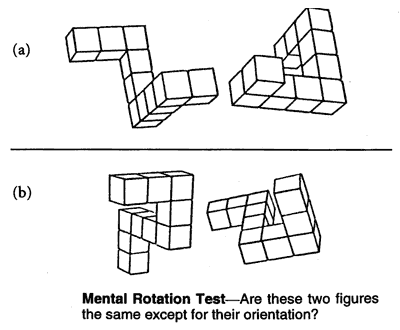
(A typical mental rotation task presents two line drawings of 3-D figures and asks if one is a simple rotation of the other, for example:Image from http://www.skeptic.com here.)

Participants in such studies thus receive two tests, the cognitive test in question and also a self-report imagery test of some sort, such as the Vividness of Visual Imagery Questionnaire (VVIQ), which asks people to form various visual images and then rate their vividness. Correlations will often -- though by no means always -- be found. This will be taken to show that people with better (e.g. more vivid) imagery do in fact have more skill at the cognitive task in question.

This drives me nuts.

Reactivity between measures is, I think, a huge deal in such cases. Let me clarify by developing the imagery example a little farther.

Suppose you’re a participant in an experiment on mental imagery – an undergraduate, say, volunteering to participate in some studies to fulfill psychology course requirements. First, you’re given the VVIQ, that is, you’re asked how vivid your visual imagery is. Then, immediately afterward, you’re given a test of your visual memory – for example, a test of how many objects you can correctly recall after staring for a couple of minutes at a complex visual display. Now if I were in such an experiment and I had rated myself as an especially good visualizer when given the VVIQ, I might, when presented with the memory test, think something like this: “Damn! This experimenter is trying to see whether my imaging ability is really as good as I said it was! It’ll be embarrassing if I bomb. I’d better try especially hard.” Conversely, if I say I’m a poor visualizer, I might not put too much energy into the memory task, so as to confirm my self-report or what I take to be the experimenter’s hypothesis. Reactivity can work the other way, too, if the subjective report task is given second. Say I bomb the memory (or some other) task, then I’m given the VVIQ. I might be inclined to think of myself as a poor visualizer in part because I know I bombed the first task.

In general, participants are not passive innocents. Any time you give them two different tests, you should expect their knowledge of the first test to affect their performance on the second. Exactly how subjects will react to the second test in light of the first may be difficult to predict, but the probability of such reactivity should lead us to anticipate that, even if measures like the VVIQ utterly fail as measures of real, experienced imagery vividness, some researchers should find correlations between the VVIQ and performance on cognitive tasks. Therefore the fact that some researchers do find such correlations is no evidence at all of the reality of the posited relationship, unless there's a pattern in the correlations that could not just as easily be explained by reactivity.

In the particular case at hand, actually, I think the overall pattern of data positively suggests that reactivity is the main driving force behind the correlations. For example, to the extent there is a pattern in the relationship between the VVIQ and memory performance, the tendency is for the correlations to be higher in free recall tasks than in recognition tasks. Free recall tasks (like trying to list items in a remembered display) generally require more effort and energy from the subject than recognition tests (like “did you see this, yes or no?”) and so might be expected to show more reactivity between the measures.

The problem of reactivity between measures will plague any psychological subliterature in which participants are generally aware of being measured twice -- including much happiness research, almost any area of consciousness studies that seeks to relate self-reported experience and cognitive skills, the vast majority of longitudinal psychological studies, almost all studies on the effectiveness of psychotherapy or training programs, etc. Rarely, however, is it even given passing mention as a source of concern by people publishing in those areas.

Wednesday, September 30, 2009

Visual Imagery of Sensory Impossibilities

There was a time when I could visualize the obverse, and then the reverse. Now I see them simultaneously. This is not as though the Zahir were crystal, because it is not a matter of one face being superimposed upon another; rather, it is as though my eyesight were spherical, with the Zahir in the center.

– Jorge Luis Borges (1949/1962)


My mental field of vision is larger than the normal one. In the former I appear to see everything from some commanding point of view, which at once embraces every object and all sides of every object.

– a questionnaire respondent in Galton (1880)

In conversation, a couple people have told me that they can visually imagine four spatial dimensions -- a hypercube, for example. (Probably someone has said this in print, too, but I can't recall any instances. Pointers welcome.)

I find this rather hard to imagine, and (I confess) believe. But maybe that's just my own narrowness? If there are or could be four actual, physical spatial dimensions, then presumably there are or could be aliens who could see (and thus presumably visually imagine) in all those dimensions. The unpicturability of such imagery by me doesn't imply its impossibility. Maybe the dimensionality of some people's visual imagining outruns the dimensionality of their vision. (I assume here that no human being can actually outwardly see in four dimensions or with such apparently impossible points of view. At least I've heard no such reports.)

Such impossibilities of visual perspective, if they are possible in visual imagination, appear to strain against two common claims about imagery. One is Hume's "faint perceptions" view, according to which images are just faint copies of ordinary sensory impressions. (One needn't of course be a fully orthodox Humean on this point -- even Hume probably wasn't -- to think that visual imagery is very structurally similar, experientially, to visual sensation.) Another is Stephen Kosslyn's view, related to Hume's, that imagery differs from perception mainly in being the activation of visual brain areas and visual representational forms by central cognitive causes rather than from peripheral sensory stimulation. The visual image, Kosslyn says, is a "simulation" or "emulation" of what we visually perceive. Though not perhaps impossible, it would be odd, on such a view, if the imagistic simulation could have radically different perspectival and spatial properties from the perceptions simulated.

So probably: Either visual imagery of such sensory impossibilities is itself impossible, despite some people's reports, or Hume and Kosslyn (and lots of other people) are wrong. Is there a way to go about settling this?

Thursday, March 26, 2009

Perplexities of Consciousness, Ch. 3: Galton's Other Folly

... is now up in draft on my homepage.

Here's an abstract:

In the 1870s, Francis Galton asked people to describe their visual imagery experiences when recalling their breakfast table as they sat at it in that morning. Apparently ordinary people gave very different reports, spanning the full range from claiming that imagery was entirely unknown to them to saying that their imagery was as clear and detailed, or even more so, than ordinary vision. Since then, a long history of attempts to correlate differences in subjective report of imagery experience with performance on presumably imagery-facilitated tasks (like mental rotation, mental unfolding, visual memory, and visual creativity) has largely failed. Given the ease with which most people can be brought to uncertainty about the character of their imagery experience (its richness of detail, its stability, its coloration, etc.), and given the history of debates in psychology and philosophy about the phenomenal character of imagery (e.g., the "imageless thought" debate, the Locke-Berkeley debate about abstract ideas), it shouldn't be too surprising that people's reports about their imagery experience don't reliably reflect real differences in their underlying experience. Hence, the disaster of Galton's subjective methodology.
As always, comments warmly welcomed (here on this post or by email). The title and framing around Galton are new. (Previously it was "How Well Do You Know Your Own Visual Imagery?", without section i and with less focus on Galton throughout.) I'm inclined, today at least, to think the shift makes the chapter livelier; but I could easily see changing my mind about that.

Friday, January 25, 2008

Consciousness While Reading -- Is It Visual? Imagistic? Auditory?

Some people say they speak silently to themselves when they read; others say they don't do that, but do entertain visual imagery. Others claim to do neither but rather only to see the page and take it in. Melanie, whom Russ Hurlburt and I interviewed at length in our recent book about conscious experience, reports no visual experience of the written page at all; rather, she experiences only the images, thoughts, and emotions that the text creates in her. (No visual experience of the page whatsoever? Wow, that's hard for me to imagine!)

Maybe people are very different in how they experience reading. If so, I know of no systematic studies. (Of course there are plenty of studies of differences in reading skill, in the use of the eyes on the page, on the sorts of errors people make, etc., but that's quite different.) If there is such variation, it could potentially be very useful to reading teachers (and poets?) to take advantage of it.

Or maybe people differ mainly in their reports about how they read, while their experiences are all very broadly speaking the same. (We do have, I think, false general impressions about our stream of experience quite often.) So it would be neat, before going too far out on a limb here, to get some external corroboration for the reports.

It's easy to think up cute experiments:

* People who speak silently to themselves while reading would tend, I'd think, to have strong impressions about how to pronounce unusual names they find in the text (it's GOLL-um, dammit, not GOAL-um!); people who are more strictly imagers may not. Experimenters could pronounce a name in an unusual way and measure (a) likelihood of being corrected by the subject, (b) skin conductance (a measure of stress), or (c) attentional blink (poor performance on an immediately subsequent task).

* People who say they hear the text aloud sometimes claim to hear it mostly in their own voice; others claim to hear the author's (imagined) voice or the characters' voices. The latter sort of reader, but not the former, may show additional facility or impairment when an external voice or sound is presented that matches or mismatches the characteristics of the author's or characters' voices.

* People who visually experience the page may have better memory for visual details of the text than people who do not.

Etc.

If the results of such measures align neatly with people's self-reports, great! There may really be a phenomenon here worth studying.

So many experiments, so little time!