... a new essay of mine, available here. I first presented this essay at a conference in Fullerton organized by JeeLoo Liu and Heather Battaly in 2009. (See here for a YouTube video of the original talk.)
This is a (relatively) short paper arguing that we have poor knowledge of our stream of conscious experience, of our morally most important attitudes, of our evaluatively loaded personality traits, and of our overall moral character.
It sacrifices depth and detail for breadth and readability, but I suppose that isn't always a bad thing.
Comments welcome, as always, either by email or on this post.
Wednesday, July 28, 2010
Self-Unconsciousness
Monday, July 26, 2010
Young Female Philosophers Must Feel Bad About All That Meat They Eat
Regular readers may recall that in 2009 Josh Rust and I surveyed several hundred philosophers and non-philosophers on their opinions about various moral issues; we also asked survey respondents to describe their own behavior on those same issues. Some preliminary results of the study are here, here, here, here, here, and here.
The biggest divergences in moral opinion concerned our question about "regularly eating the meat of mammals such as beef and pork". 60% of ethics professor respondents rated mammal-meat consumption as morally bad, compared to 45% of non-ethicist philosophers and just 19% of non-philosophers. Opinion also divided by gender and age. Women were about 1.5 times as likely to condemn mammal-meat consumption (55% of women rated it bad vs. 37% of men). There was a similar shift of opinion with age: 55% of respondents born in 1960 or later condemned mammal-meat consumption, compared to 35% born before 1960. One might expect a compound effect for young female philosophers, and indeed it was so: Fully 81% of female philosophers born in 1960 or later said it was morally bad to regularly eat the meat of mammals. To put this degree of consensus in perspective: In last year's PhilPapers survey of philosophical opinion, only 82% of philosophers endorsed non-skeptical realism about the existence of an external world. (No word, so far, on how philosophers who deny the existence of an external world feel about seeming to consume meat.)
People often do things they think are a little morally bad. For example, I think eating meat is slightly morally bad (on par with driving a gas-guzzling car or being somewhat neglectful of emails from undergraduates), and yet for lunch today I had a salami sandwich. Apparently, a substantial proportion of young female philosophers think and act as I do: 38% of them reported having eaten the meat of a mammal at their previous evening meal -- a rate not statistically different from the 39% reported rate among respondents overall. (Caveat: The total number of female philosopher repondents born 1960 or later was small -- twenty-six -- so the exact percentage should be interpreted cautiously.) Similarly, despite the difference in normative view, there was no statistically detectable difference in the mean age of respondents who said they had eaten the meat of a mammal at their previous evening's meal: mean birth year 1954.3 for those who said they had vs. 1955.1 for those who said they hadn't.
Our survey doesn't call into doubt the relationship between normative ethical view about meat-eating and strict vegetarianism: 78% of those who reported that they never eat mammal meat said eating mammal meat is bad, compared to 32% of those who reported sometimes eating meat. However, it seems that among non-vegetarians there is little if any relationship between normative ethical view and actual meat consumption: If you don't think eating meat is bad enough to warrant strict vegetarianism, but you still think it's somewhat bad, you're just as likely as anyone else, it seems, to have a salami sandwich for lunch. Conscience and behavior go separate ways.
Monday, July 19, 2010
Yosemite
Apologies for being slow in posting and replying to comments recently. I spent last week on vacation in Yosemite.
In Yosemite, I heard two bears (on two different occasions), each within about 20-30 feet, but I saw neither. For some reason, this is vastly more disappointing than had I seen two bears at the same distance but not heard them. Why is that? I don't think it's just that visual information is much richer than auditory information -- for I would have been happy even with a fleeting glimpse, even if that glimpse contained no more information than I received by hearing the crashing sounds through the underbrush.
It is also quite likely that light from those bears was reflected into my eyes and made some difference to my visual experience, despite the fact that I was unable to discern its bearish source. This also is disappointing, for some reason. In some sense, I probably saw both bears -- I just didn't see that they were bears. Seeing that is just much cooler.
In about 20 miles of hiking the trails of Yosemite, I noticed only two pieces of litter. I find that quite remarkable given that some of these trails get 10,000 hikers a day.
Wednesday, July 07, 2010
John Stuart Mill on the Value of Moral Disagreement
I have been thinking lately about the value (or disvalue) of philosophical moral reflection, and I find myself reading, yet again, Mill's On Liberty. I love the prose in that book. Here is what Mill says about the value of moral disagreement:
We often hear the teachers of all creeds lamenting the difficulty of keeping up in the minds of believers a lively apprehension of the truth which they normally recognise, so that it may penetrate the feelings, and acquire a real mastery over the conduct. No such difficulty is complained of while the creed is fighting for its existence: even the weaker combatants then know and feel what they are fighting for, and the difference between it and other doctrines; and in that period of every creed's existence, not a few persons may be found, who have realised its fundamental principles in all the forms of thought, have weighed and considered them in all their important bearings, and have experienced the full effect on the character which belief in that creed ought to produce in a mind thoroughly imbued with it. But when it has come to be an hereditary creed, and to be received passively, not actively -- when the mind is no longer compelled, in the same degree as at first, to exercise its vital powers on the questions which its belief presents to it, there is a progressive tendency to forget all of the belief except the formularies, or to give it a dull and torpid assent, as if accepting it on trust dispensed with the necessity of realising it in consciousness, or testing it by personal experience, until it almost ceases to connect itself at all with the inner life of the human being. Then are seen the cases, so frequent in this age of the world as almost to form the majority, in which the creed remains as it were outside the mind, incrusting and petrifying it against all other influences addressed to the higher parts of our nature; manifesting its power by not suffering any fresh and living conviction to get in, but itself doing nothing for the mind or heart, except standing sentinel over them to keep them vacant.You go, baby!
Thursday, July 01, 2010
The Nature of Attitudes
I've written extensively on belief (e.g., here, here, and here), but very little on other attitudes like desire, intention, and love (though see here on love). (I regard desire and intention as "propositional attitudes" in the philosopher's sense, but not love.) Here's the summary version of my current thinking:
(1.) Attitudes are dispositional. To believe that there's beer in the fridge is to be disposed to act, react, and cognize in certain ways. It is not a matter of what you're currently doing or thinking. So, for example, your attitudes don't change simply by virtue of your falling unconscious. To believe that there's beer in the fridge is to be disposed to go to the fridge if you decide to have a beer, to say "yes" if someone asks you if there is beer in the fridge, to feel surprise were you to open the fridge and find no beer, to conclude "I will win a million dollars!" if you're told that you will win a million dollars if there is beer in your fridge, etc. Such dispositions are, of course -- like virtually all dispositions -- subject to defeaters or excusing conditions (for example, you might not tell the truth if you want to keep the beer a secret). Similarly: To want to complete your dissertation is to be disposed to feel good if it seems that you're making progress on your dissertation, to favor actions that promote completion of the dissertation over other actions all else being equal, to think to yourself "completing that dissertation would be a good thing to do", etc. To love someone is to be disposed to prioritize that person's well-being in your choices, to feel especially bad when bad things happen to that person, to value having a connection with that person, etc.
(2.) But attitudes also have an occurrent face. In fact, they have two occurrent faces. (By "occurrent" here I mean having to do with events that transpire at particular moments of time.) Attitudes can manifest, that is, the disposition can be activated. You can actually go to the fridge to find the beer, do something to further your dissertation work, choose something reflecting your prioritization of the welfare of someone you love. And attitudes can form (or disappear). A minute ago, perhaps, you had no desire for the chicken sandwich vs. the roast beef. You hadn't started thinking about it yet; sometimes you choose one, sometimes the other. You look at the menu and make a choice, forming a desire for the chicken.
Forming an attitude can be nonconscious, if it happens underground, as it were, or it can involve dedicating attention or consciousness. The conscious formation of a belief -- or the conscious reinforcement of that belief, if it was already present -- we can call a "judgment". The conscious formation of an intention we can call a "choice". We don't have natural names for some of the other conscious attitude formation episodes. ("Falling in love" isn't quite what I have in mind as the conscious formation of love; judging that something is good isn't quite the same as forming a desire for it -- though perhaps judging good and forming/reinforcing a desire are close enough to explain why we don't have separate terms for them.) Of course, sometimes the judgments and choices don't stick and the attitude isn't actually formed. You choose to exit the freeway at the next offramp, for example, but then forget. You say to yourself, and quite sincerely judge, that death is not bad while failing to form the dispositional profile appropriate to that attitude. (I have a paper about such cases here.)
(3.) Attitudes are not discrete entities; rather they overlap. This is true both within and between attitude types.
First, within attitude types: I do not have one ball in my "belief box" for "my cat is in the tree" and another separate ball for "Waterball [the name of my cat] is in the tree" and yet another separate ball for "Waterball is in the oak" and yet another for "our only pet is in that tall plant right there", etc. I believe all those things, more or less, but not via discretely held contents. What I have is a cluster of dispositions such that all of these things are approximately true to say of me -- though possibly some are more apt than others (for example, if I'd be disposed to call the tree an elm rather than an oak if asked).
Second, between attitude types: The dispositional profile for thinking that it would be good to finish your dissertation largely overlaps with the dispositional profile for wanting to finish your dissertation, such that probably you have both or you have neither. But the dispositional profiles come apart enough that in some cases one way of putting things can be more apt: Intellectual acceptance is more central to the belief-good profile and emotionality is more central to the desire profile so that if you are prone to form pro-dissertation-completing intellectual judgments that leave you cold, it might be more apt to describe you as believing-good than as desiring (though still, in a way, you desire or half-desire), and vice versa if you're more prone to desirous emotionality than intellectual endorsement. But let me be clear: On my view this is not a matter of the attitudes being ontologically distinct and causally connected; rather it's a matter of their having partly overlapping dispositional profiles with different dispositions closer to the center. Similarly for hating vs. loathing, appreciating vs. being thankful, resentment vs. anger vs. feeling wronged vs. thinking you've been wronged, etc.
Lots of cool things follow from this approach to the attitudes, such as weak motivational internalism; the avoidance of puzzles about the countability of beliefs and of problems in drawing the line between implicit and explicit beliefs, an appealing gradualism about attitude change (including learning and forgetting), the lack of a need for a discrete type of cognitive token for every attitude verb, and a nicely moderate position about the relationship between desiring and believing good.
Thursday, June 24, 2010
Psychology of Philosophy: The Strong Program
Why do you endorse Platonism about numbers, or idealism, or skepticism, or consequentialism, or any other a priori justified (you think) philosophical opinion? I suggest that you look not to the philosophical truth of that view, with which you are somehow better in touch with than those with whom you disagree. Rather, look to your own biases, personality, and background.
The "strong program" in sociology of science holds as a methodological precept that in explaining the rise and fall of scientific theories one may not appeal to the truth or falsity of those theories. So also, I recommend, in thinking about the origins of your own and others' philosophical views, you would do well not to think about the truth of those views. You would also do well not to think in other terms that imply success or insight, such as "seeing the weaknesses" in a predecessor's view, or "recognizing" troubles or advantages of a substantive, philosophical sort, or "proving" or "establishing" anything.
Where philosophy blurs into science or math, this constraint becomes blurry. I say this because I think -- unlike the cartoon version of sociologists of science -- that in science and math features of the world (or of mathematical structures) start to apply strong pressures on views. The farther toward a priori philosophy, the less influence from such pressures. The farther toward concrete science or formal mathematics, the more the influence from such pressures.
No a priori claim is so patently false that no philosopher would endorse it. No constellation of views is so bizarre and self-contradictory that no philosopher would sign up for those views, were her background motivations and culturally-given assumptions right. If there are any a priori philosophical truths among the factors influencing our philosophical theorizing, their influence is modest.
Friday, June 18, 2010
Call for Papers: Workshop on Ethics and Mind at the University of Miami
... keynote speaker John Doris.
Submissions are invited for the 3rd annual Mind and Ethics [Graduate Student] Workshop at the University of Miami, November 20th-21st 2010. Proposals are due September 1st. We encourage submissions of finished works or works in progress (5,000-10,000 words) addressing issues at the intersection of philosophy of mind and ethics. Please send papers prepared for blind review to ethicsandmind@gmail.com.
Thursday, June 17, 2010
The Winner of the Sound-Color Qualia Inversion Contest
... is Edmond Wright.
The aim of the contest was to find a published discussion of the possibility of sound-color qualia inversion, that is, the possibility of someone linguistically and behaviorally practically indistinguishable from normal people but who has auditory experiences when stimulated by light and visual experiences when stimulated by sonic vibrations. Several satisfactory citations were submitted in the comments thread and by email, so the contest rules required that I select what I judged to be the best example (as of the June 14 deadline). This was, I thought, Edmond Wright's article in Synthese (1993, vol. 97, p. 365-382, esp. p. 370-371), which Wright himself mentioned in an email to me. Per the terms of the contest, I owe Wright a drink of his choice next time we are in the same town.
Honorable mention goes to Jeremy Goodman, both for being the first to mention Adam Wager's excellent 1999 article in Philosophical Psychology (vol. 12, p. 263-281, esp. p. 269) and for his insightful comments and references throughout the discussion thread.
If you saw the original post announcing the contest, you may recall that the contest was prompted by Saul Kripke's claim, made twice in a two oral presentations at U.C. Riverside, that no philosopher had ever suggested the possibility of sound-color qualia inversion. If only it were always so easy to definitely refute what Kripke says!
Monday, June 14, 2010
Do Metaethicists Really Behave Worse Than Other Ethicists?
On Friday, I presented data suggesting -- contrary to common opinion -- that deontologists behave no worse than virtue ethicists and consequentialists. Another opinion I've often heard from philosophers is that metaethicists -- that is, philosophers who focus on the most abstract general questions about ethics (such as whether there are moral truths at all and if so what their metaphysical grounding is) -- behave, on average, less well than do other ethicists, perhaps especially applied ethicists. The same data set provides evidence on this question too.
At the center of the dataset is a survey Josh Rust and I sent to hundreds of professional philosophers. Near the end of the survey we asked respondents, "If an ethics-related area is among your specializations, which of the following best reflects the level of abstraction at which you tend to consider ethical issues? (check all that apply)". Response options were "metaethics", "normative ethics" [i.e., theoretical debates about deontology vs. consequentialism, etc., an intermediate level of abstraction], "applied ethics", and "no ethics-related area among my specializations". 28% of philosophers claimed a specialization in metaethics, 45% in normative ethics, 32% in applied ethics (these three groups overlapping, of course), and 36% claimed no such specialization. Although there was a trend for the non-ethicists to be more male (78% vs. 72%) this was not statistically significant given our sample size (361 respondents). Non-ethicist respondents did tend to be a little younger (mean birthyear 1958 vs. 1954). We saw no gender or age differences by level of abstraction within ethics.
Looking at our various questions about respondents' opinions on various applied ethical issues, applied ethicists seemed to think it morally better to vote regularly than did the other groups; ethicists in general thought it morally worse than did non-ethicists not to keep in at least monthly telephone or face-to-face contact with one's mother; and ethicists asserted more of a duty to give to charity (13% of ethicists said it was not the case that the typical professor should donate to charity vs. 24% of non-ethicists). We saw no detectable differences among the groups on the morality of belonging to one's main disciplinary society (for philosophers, the APA), eating the meat of mammals, being an organ or blood donor, or responding to student emails.
The groups did not differ in their self-reported rates of dues-paying membership in the APA, but looking directly at APA membership lists, applied ethicists were less likely than were other groups actually to be members of the APA (61% vs. 75%). Metaethicists tended to report voting in fewer public elections than did applied ethicists, and actual voting data obtained from public records appeared to bear out that trend (an estimated 1.26 votes/year for applied ethicists, vs. 1.05 for metaethicists; I should clarify here that Josh and I "de-identified" the survey data so that we cannot make inferences about particular individuals' survey responses). Metaethicists also reported eating more mammal meat than did applied ethicists (mean 5.2 vs. 3.2 meals/week, and 50% vs. 31% reporting having eaten the meat of a mammal at the last evening meal). Meta-ethicists self-reported giving less to charity (mean 3.9% of income vs 5.2%, excluding one applied ethicist who claimed to have given 500% of his income to charity) and metaethicists appeared to be less motivated by the survey's charity incentive (half of survey recipients received a charity incentive, that is a promise by us (which we did fulfill) to give $10 to a charity of the respondent's choice among six major charities in return for the completed survey; 45% of returned metaethicists' surveys had the charity incentive vs. 57% of applied ethicists'). We found no differences in self-reported organ or blood donation, self-reported or actual responsiveness to undergraduate emails, overall rate of suspicious responding to the survey, or frequency of contact with one's mother (if living).
Obviously, there's room for difference of opinion about these measures, but my interpretation of the data is that they tend to weakly confirm the hypothesis that metaethicists behave not quite as morally well as do applied ethicists.
Friday, June 11, 2010
Do Kantians Really Behave Worse Than Other Ethicists?
As I noted in a previous post, Kantian ethicists seem to have a reputation among philosophers for behaving worse than other sorts of ethicists. But who has any systematic empirical data on this? Well, Josh Rust and I do!
Our data are based on a questionnaire Josh and I sent to hundreds of philosophers last year (more description and other results here, here, here, and here). The questionnaire asked first about the goodness or badness of theft from a friend, paying membership dues to the APA, voting in public elections, having regular conversations with your mother, eating the meat of mammals, being an organ donor, being a blood donor, responding to undergraduate emails, and donating to charity. Then, second, we solicited self-reports of these same behaviors (except for theft). In some cases we also have direct data about actual behavior. Near the end of the questionnaire, we asked about normative ethical view -- that is, about the philosopher's general theoretical approach to ethics. The response options were consequentialist, deontologist, virtue ethicist, skeptical, or no settled position.
(If you're not familiar with those terms: Consequentialists think, roughly, that one should act so as to produce the best expected consequences for everyone. Deontologists think, roughly, that one should act according to certain moral rules, such as don't lie or don't kill innocent people, even if you know that abiding by those rules won't produce the best consequences overall. Kant is currently the most eminent deontologist. Virtue ethicists think, roughly, that ethics is about having moral virtues like honesty, courage, and kindness.)
First, let's look at the general distribution of theoretical approach. Ethicists were more likely to be deontologists (29%) than consequentialists (10%), whereas non-ethicists were split about equally between those two positions (17% for both). One might wonder about causal direction here: Does seriously studying ethics tend to lead philosophers to abandon consequentialism? Or are consequentialists less likely to become ethicists? Or...? Rounding out the answers: 30% of ethicist and 27% of non-ethicist respondents espoused virtue ethics, 29% of ethicists and 33% of non-ethicists said they had no settled position, and 2% of ethicists and 6% of non-ethicists expressed skepticism. We detected no differences by age or gender.
There were two questions where I thought consequentialists, deontologists, and virtue ethicists would differ substantially in their normative opinions -- the meat question and the charity question. Consequentialists have a reputation for emphasizing the importance of charitable donation and vegetarianism (most famously Peter Singer). Surprisingly to me, however, the groups showed no difference in moral opinion on these questions. Only 52% of consequentialists rated "regularly eating the meat of mammals" toward the morally bad end of the scale, compared to 58% of deontologists and 53% of virtue ethicists -- well within statistical chance. Likewise, the mean percentage of income that respondents said that the typical professor should donate to charity was 7.5% (for consequentialists) vs. 7.4% (for both virtue ethicists and deontologists), again well within chance. Apparently, Singer's views aren't representative of consequentialists generally.
Virtue ethicists were less likely than others to say that it's morally bad not to be an organ donor (48% vs. 65% for consequentialists and deontologists) and that it's morally good to regularly donate blood (81% vs. 94% of consequentialists and 91% of deontologists). Virtue ethicists were also least likely to say it was good to pay membership dues to support one's main disciplinary society (59% vs. 80% of consequentialists and 74% of deontologists). Responses to the other normative questions seemed to be about the same for all groups.
Looking at self-reported and actual behavior: Virtue ethicists were least likely to belong to the APA (philosophers' main disciplinary society), based on our examination of the membership list: 58% vs. 65% of consequentialists and 74% of deontologists. However, they were just as likely to report being members (74% vs. 67% and 77%). Virtue ethicists were also least likely to report having an organ donor indicator on their drivers' license (58% vs. 78% and 70%). On the other hand, the deontologists were the ones who reported the longest lapse of time since their last blood donation (for eligible donors): 1994 vs. 2001 for consequentialists and 2000 for virtue ethicists. (Does this have anything to do with Kant's odd views on the matter?) And consequentialists appeared to be more responsive to the survey's charity incentive: Half of the questionnaires went out with a promise that we would donate $10 to a charity of the respondent's choice (among six major charities) when the survey was returned. 67% of the consequentialists' returned surveys were charity-incentive surveys, compared to 46% of deontologists' and 51% of virtue ethicists'.
We found no other differences in self-reported behavior, or in actual measured behavior -- including voting rate in public elections (based on actual voting records), responsiveness to sham undergraduate emails we had sent, or detected honesty or dishonesty in their survey responses.
In sum, we found no evidence that deontologists -- many or most of whom are presumably Kantians, broadly speaking -- behave any worse than professors who favor other normative theories.
Friday, June 04, 2010
Ethicists' vs Non-Ethicists' Honesty in Questionnaire Responses
In 2009, Josh Rust and I ran a survey asking hundreds of ethicists, non-ethicist philosophers, and comparison professors, first, a variety of questions about their views on ethical matters (e.g., vegetarianism, voting, staying in touch with one's mother) and second, about their own personal behavior on the same matters. (No identifying information was associated with the responses, of course.) Some previous posts on the survey are here and here and here.
Now one of the cool things about this study is that in some cases we also have data on actual behavior -- thus enabling a three-way comparison of normative attitude, self-reported behavior, and actual behavior (as you'll see in the links above).
Thus, a measure of honesty falls out of the questionnaire: How well are the self-reports related to the actual behavior? Actually, we have two different types of measures of honesty: For most of the topics on which we didn't have direct behavioral data we asked two behavioral questions, one vague and easy to fudge, the other concrete and more difficult to fudge without explicit deceptive intent. So, for example, we asked at how many meals per week the respondent ate the meat of a mammal (the fudgy question) and also whether she ate the meat of a mammal at her last evening meal not including snacks (the concrete question). If, hypothetically, half the respondents who reported eating mammal meat at 3 or fewer meals per week also reported having eaten it at the last evening meal, we could infer that that group of respondents were fudging their answers.
We created a composite of six types of suspicious (or demonstrably false) responses and we compared the rates of suspicious responding between the groups. The six measures were:
* comparison of self-reported number of votes since the year 2000 with actual voting records;We found that all three groups showed similar rates of suspicious responding: 50% of ethicists, 49% percent of non-ethicist philosophers, and 49% of comparison professors gave at least one suspicious response -- variation well within chance, of course, given the number of respondents. (Remember that on the second three measures a suspicious response is not necessarily a lie or even an unconscious self-serving distortion, but only an answer or pattern of answering that seems more likely to be false or distortive than another pattern would be, when aggregated across respondents.)
* comparison of claims to have voted in the Nov. 2008 U.S. general Presidential election with actual voting records;
* comparison of claims of 100% or 95% responsiveness to undergraduate emails with responsiveness to emails that we had sent that were designed to look as though they were from undergraduates (see here, and yes we got IRB approval);
* for philosophers only, comparison of claims of membership in the American Philosophical Association with membership records (excluded from the analysis in this post, but discussed here);
* comparison of a general claim about how often the respondent talks with her mother (if living) with a specific claim about date of last conversation;
* comparison of a general claim about how often the respondent donates blood (if eligible) with a specific claim about date of last donation;
* comparison of a general claim about meals per week at which the respondent eats the meat of a mammal with a specific claim about the last evening meal.
Thus, as in previous research we failed to find any evidence that ethicists behave any better than other socially comparable non-ethicists.
This is assuming, of course, that lying or giving distorted answers on surveys like ours is morally bad. Now, as it happens, we asked our respondents about that very issue, and 87% (89% of ethicists) said it was morally bad to answer dishonestly on surveys like ours. We also had a measure of how bad they thought it was -- a 9-point scale from "very morally good" through "morally neutral" to "very morally bad". As it turned out, there was no statistically significant relationship between normative attitude and rate of suspicious responding.
Near the end of the survey, we also explicitly asked respondents whether they had answered any of the questions dishonestly. Few said they did, and answers to this question appeared to be unrelated to rates of suspicious responding: Among respondents with no suspicious looking responses, 6 (2.2%) said they had answered dishonestly, compared to 7 (2.6%) of the respondents with at least one suspicious response.
Finally, we had asked the philosophy respondents whether they prefered a deontological, consequentialist, virtue ethical, or some other sort of normative ethical view. Deontologists are often portrayed as sticklers about lying -- Kant, the leading historical deontologist, was notoriously very strict on the point. However we detected no difference in patterns of suspicious responding according to normative ethical view. To the extent there was a trend, it was for the consequentialists to be least likely to have suspicious or false responses (47%, vs. 56% for deontologists and 58% for virtue ethicists; this analysis includes the APA question).
Thursday, June 03, 2010
An Opportunity to Collaborate with Psychologists on Experimental Philosophy Research
Jonathan Phillips writes:
The Experiment Month initiative is a program designed to help philosophers conduct experimental studies. If you are interested in running a study, you can send your study proposal to the Experiment Month staff. Then, if your proposal is selected for inclusion, we will conduct the study online, send you the results and help out with any statistical analysis you may need. All proposals are due Sept. 1.
For further information, see the Experiment Month website: http://www.yale.edu/cogsci/XM/
Monday, May 24, 2010
Qualia Inversion: Sound and Color (A Contest with a "Valuable Prize"!)
If you're the kind of person who reads philosophy blogs, you've probably heard of inverted qualia thought experiments. The most famous example is red-green inversion: The red-green invert is someone who has reddish color experiences when she looks at green things (grass, leaves) and has greenish color experience when she looks at red things (blood, ripe tomatoes). Since the invert, like the rest of us, learns the meaning of color terms by example, her language and behavior is entirely, or at least virtually, indistinguishable from anyone else's. She uses the English word "red" to refer to the color of blood and "green" to refer to the color of grass, despite the difference in her color experiences of those things.
In a talk at UC Riverside a couple of weeks ago, Saul Kripke asserted that no philosopher had ever suggested the possibility of sound-color qualia inversion -- that is, the possibility of a person who experiences sound qualia when stimulated by light and color qualia when stimulated by sonic vibrations. Let's be clear that Kripke was not denying the possibility of synaesthesia. He was not denying that people sometimes (for example) experience colors alongside sounds when stimulated by sounds. Kripke's claim, rather, was that no philosopher had contemplated a true sound-color qualia invert -- someone who normally experiences sound rather than color when stimulated by light and color rather than sound when stimulated by sonic vibration and whose language and behavior from the outside is indistinguishable from that of non-inverts.
Kripke said this twice. I told him I was pretty sure he was wrong and that I had read such a discussion. Kripke challenged me to send him the citation. After a little research, I turned up my source: an unpublished essay by one of my graduate students, Nathan Westbrook. When I asked Nathan whether he knew of any precedents, he said he didn't. I also tried asking someone who had recently published a review of the qualia inversion literature; he too said he didn't know of anyone who had advanced that type of example.
But given the huge number of philosophy articles published each year and the prominence of qualia inversion examples, I feel sure someone must have discussed this kind of case somewhere. Therefore, I offer a challenge: Find a published discussion of sound-color qualia inversion. The winner will receive a "valuable prize" -- hm, what can I offer? How about: a drink of your choice (coffee, beer, whatever) on me, next time we are in the same city. (Okay, maybe that's no so valuable.)
Rules:
* The contest is open until June 14th or until someone delivers a satisfactory example, whichever comes later.For the record, I lean toward thinking that sound-color qualia inversion is possible in a conceptual/metaphysical/pulling-it-out-of-my-a-priori-hindquarters-for-the-little-that's-worth sense of possibility.
* To be satisfactory, the discussion must be published in a reputable philosophy journal or press.
* To be satisfactory, the discussion need not ultimately endorse the possibility of color-sound qualia inversion, just take it seriously.
* If more than one satisfactory example is submitted, the person who submits the best example will be declared the winner, where I will judge "best" impressionistically, criteria including but not limited to: the length and quality of the discussion, the prominence of the writer or venue, and how seriously the possibility is taken.
* If more than one person submits the best example, the first person to submit the best example will be declared the winner.
* Submit your example as a comment on this post or by email to me.
Color experiences famously differ along three dimensions: hue, saturation, and lightness or brightness. They also differ in egocentric, subjective location. To work an inversion with sound, we need a one-to-one mapping of dimensions of variation. Subjective location would appear to be easy, since both colors and sounds have subjective location. Since brightness and saturation are both unidimensional, we might be able to map them one-to-one onto pitch and volume, which are also unidimensional. Hue varies in a bit more complex a way, with red-green as opposites and blue-yellow as opposites, but perhaps patterns in the overtone series could be used. Probably the hue-overtone series mapping would require some tweaking to work, but presumably human-like beings with a slightly different set of visual and auditory capacities could exhibit a clean mapping (e.g., if the beings were only capable of discriminating certain patterns in overtone variation). Another complication is our much higher sensitivity to variation in visual as opposed to auditory position. But I don't see why, for the purposes of the thought experiment, we shouldn't be liberal about such matters: The sound-color invert, for example, might be an invert only of a relatively poor-sighted person and/or might have an exquisite appreciation of subtle variations in the
Friday, May 21, 2010
55-Year-Old Philosophers vs. 55-Year-Old Scientists
I continue to be struck by my finding, last week, that great philosophers produce their most influential work at a very broad distribution of ages. (Nifty chart here; if it's blurry click a second time to enlarge.) Physicists and mathematicians, in contrast, are reputed to peak early. Einstein notoriously said "A person who has not made his great contribution to science before the age of thirty will never do so".
Stephan and Levin (1992) have compiled data on the age at which Nobel-Prize-winning scientists did the work leading to the Nobel Prize. (The data could use updating, admittedly.) Their data confirm that scientists do tend to peak fairly early (even if not as early as Einstein suggests) -- in their mid-thirties. The graph below contrasts the distribution of ages at which scientists did the work earning them the Nobel with the (approximate) distribution of ages at which leading philosophers born before 1920 did their most influential work (see the earlier post for my method; one tweak on that method: I used Google Scholar to break the two ties). Note that while chemistry, physics, and medicine all peak sharply in the 30s, philosophy distributes evenly across the 30s, 40s, and 50s. Note also that although there is almost no Nobel work done by scientists in their 60s or older (0.8%, according to Stephan and Levin), in my sample -- admittedly small, just 46 philosophers -- 8.7% of great philosophers' most-cited work was done at age 61 or older.
So take heart, my gray-haired friends!
Friday, May 14, 2010
Paul Hoffman
Yesterday, Paul Hoffman died of a heart attack. He was a great scholar and colleague. I will miss him terribly.
At a talk on Monday, John Fischer announced his own coming talk on why immortality might not be so bad, to be given Wednesday. Howie Wettstein said from the audience, "we should all live so long". We all heard it as a joke, of course. One of Paul's last acts as a philosopher was to argue during the question period after John's talk that he saw no impossibility whatsoever in the idea of enjoying continual bliss in a never-ending embodied life.
One of the wonderful things about Paul as a colleague was his immunity to groupthink, his ability to bring to discussion a different perspective and fresh set of considerations. I always enjoyed hearing what he had to say, especially when we disagreed. Paul's forthright independence of mind was also, I suppose, what made him such an interesting historian of philosophy.
Thursday, May 13, 2010
The Rise of Ethics and Feminism
A philosophical discussion arc, as I defined the term a couple weeks ago, is a curve showing changes over time the use of a name or a word as a "keyword" in philosophy books and articles listed in The Philosopher's Index (which dates back to 1940).
Previous posts showed discussion arcs of various prominent philosophers. But I've also been searching by topic and subfield. One striking general result I've found is the rise of discussion in ethics relative to other philosophical subfields.
Here's a chart of the enormous increase in total rate of philosophical publication since the 1940s, with keyword searches related to subfield. (Note that the y-axis is scaled logarithmically. Note also that "*" is a truncation symbol, so that (for example) ethic* returns "ethic", "ethics", "ethical", etc. The rate of increase in the 1940s is somewhat inflated by the increase in the length of listed article abstracts.) [If this or any other chart displays incorrectly, click on it to bring up a cleaner jpg.]
I don't know whether to find it alarming or exciting that if trends continue philosophers will soon be producing 100,000 articles and books per five-year period in some subfields.
What I am interested in here is not so much the absolute numbers, though, as the relative numbers. And not even the relative numbers per se, which may be somewhat misleading (since not all and only epistemology articles contain epistem* as a keyword, and the keyword false negatives and positives may differ by subfield), but rather the changes over time in relative numbers. In the chart above, for example, you will see that in the 1990s ethics (EMP: ethics, moral, political) crossed lemmings (language, epistemology, metaphysics, and mind). Assuming relatively constant false negatives and positives over time within each subfield, the crossover suggests that ethics has been growing faster than has language, epistemology, metaphysics, and mind.
The following chart displays that fact more clearly:
Nor have other major subfields fared better, as you can see below: The ethicists are taking over! (If only they would behave better.)
Feminism is now a major philosophical research specialization, as was not the case before the 1970s. The chart below displays its explosive rise. (In the denominator is EMPlemmings: all articles using any of the EMP or lemmings keywords.) Notice that the rise is almost entirely in the 1970s to early 1990s. The trend has been flat to declining since then.
The same chart shows a U-shaped curve for discussion of race. I double-checked a sample of the 1940s articles to see if they really did treat race or ethnicity as a substantive topic (rather than, say, using a phrase like "the human race" in the abstract simply to mean people), and almost all did use "race" in the intended way. In the context of World War II, race was I suppose a rather hot issue! Interesting that it should be less so, at least in the philosophy journals, in the heyday of the civil rights movement.
Wednesday, May 12, 2010
At What Age Do Philosophers Do Their Most Influential Work?
In an earlier post, based on an unsystematic sample, I estimated age 38. Today, with a broader and more systematically collected sample, I'm retracting that. Mostly.
Here's what I did:
First, I created a massive super-bibliography consisting of all the bibliographies from non-historical entries in the Stanford Encyclopedia of Philosophy. I then examined the SEP citation patterns of all philosophers born from 1550 to 1919 who were cited in at least nine distinct entries -- 53 highly influential philosophers in total.
Next, I noted which of these authors' works were the most cited in the SEP (an imperfect measure of influence, of course, but it avoids my having to rely on my own even more imperfect judgment); and I estimated the age at which that work was produced as publication date minus birth year minus 2. (Minus two because the average person spends half of the year at which she turns age X at age X-1 and because of the typical delay between writing and appearance in print.)
(A few more methodological details: Wittgenstein's Investigations, published posthumously, I estimated as produced at about age 55, based on historical evidence. In the case of multi-edition or multi-volume work, I considered the first-published work. In the case of a tie in number of citations (which happened twice) I took the midpoint as my estimate. Two authors I excluded because they had no single work cited more than three times in front-page, non-historical SEP bibliographies: Peirce and Dewey. And because the question concerned relative productivity over the life span I excluded five authors who died before age sixty: Descartes, Nietzsche, Austin, Ramsey, and Prior.)
Here, then is the final list, arranged by age: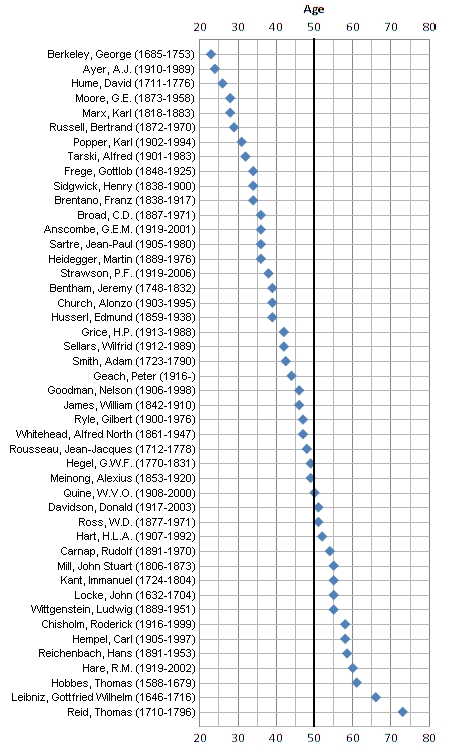
The mean estimated age of this group is 44. The mean age remains 44 if I tweak the measure by adding in any works cited at least half as often as the most-cited work and then take the midpoint of the resulting age range. I would guess that 44 is probably a smidgen on the old side as an estimate of the age at which philosophers' most influential work is done, since most work brews for several years before finally appearing in print. In that sense, the 38-year-old estimate isn't perhaps too far off.
But to my eye the more striking fact about the chart is this: How straight the line is from the mid-20s to the early 60s. If this were a bell-shaped distribution around 44, we should see flatter slopes at the beginning and the end -- as we do in fact see starting in the mid-60s. The straightness of the line suggests that there's isn't so much a peak age at which the most elite work in philosophy has been done but instead a long plateau from the mid-20s into the 60s, then tapering off.
There are various potential explanations for the tapering off that seems to start in the mid-60s; I wouldn't rush to the conclusion that the tapering reflects cognitive decline. Other possibilities include decline in health and the prioritizing of other goals.
Monday, May 10, 2010
Most Cited Journals in the Stanford Encyclopedia of Philosophy
I am going to give you a seriously flawed list. There's your warning, front and center! I think Brian Leiter's list of top general philosophy journals is more plausible as a list of best-regarded general analytic philosophy journals. But for what it's worth, below are the most cited philosophy journals in the non-historical entries of the Stanford Encyclopedia of Philosophy.
Some caveats:
* This list reflects the perspective of the SEP editors and writers -- largely an "analytic"/anglophone perspective, among other things.
* I am excluding historical entries and historical journals.
* I checked all journals that I thought would plausibly be cited at least 100 times, but it's certainly possible that I have missed some. If you think there are journals that should clearly be on this list that are missing, feel free to let me know in the comments. Of course there are quite a few good journals below the 100 citation cut. Philosopher's Imprint especially comes to mind. It has published only 64 articles so far in its lifespan, so it hasn't had much of a chance yet to develop a big log of influential articles.
* The numbers are noisy and approximate for a variety of reasons. Four journals, as indicated below, had titles common enough as bibliographic phrases that I was forced to do statistical sampling.
* To the extent these numbers reflect prestige, they reflect prestige over time rather than current prestige.
* Journals that publish many articles (like Phil Studies, Philosophy of Science, and Synthese) will be relatively advantaged by this measure, while those that publish few articles (like Phil Review and Philosophy and Public Affairs) will be relatively disadvantaged. I tried dividing by the number of articles published in two sample years, but this made the rankings implausible in other ways as measures of prestige; so I leave the raw numbers and note exceptional cases.

 For what it's worth, my own impression is that Phil Review, PPA, and BBS are underranked by this measure relative to their prestige -- presumably due to their low rates of publication -- while Phil Studies, Phil Science, and Synthese, though all excellent journals, are a bit overranked, presumably for complementary reasons. I'm also inclined to think PPR and Nous are a bit underranked relative to current prestige.
Friday, May 07, 2010
The 200 Most-Cited Contemporary Authors in the Stanford Encyclopedia of Philosophy
Yesterday, I posted a list of the forty most-cited contemporary authors in the Stanford Encyclopedia of Philosophy. A number of people have expressed interest in seeing further down my list, so I am expanding it to 200.
Some caveats:
* "Contemporary" means born in 1900 or later.The list of 200 is too long for the main blog page, so I am posting it
* I excluded historical entries, so historians of philosophy will be underreprested.
* Each author is counted only once per entry, and then only if that author receives a bibliographical line on the entry's main page, as either first or solo author.
* The distribution of entries in the SEP should be expected to overrepresent the interests and perspectives of the editors of the SEP, and in particular the SEP has a strongly "analytic"/anglophone perspective.
* This measure emphasizes breadth of influence over depth.
* Citation patterns in the SEP are heavily biased toward recent works, with 2000 being the most cited year. (For a chart see the update to yesterday's entry.)
here in the Underblog.
Thursday, May 06, 2010
The Forty Most-Cited Contemporary Authors in the Stanford Encyclopedia of Philosophy
As part of my background work on discussion arcs, I compiled all the bibliographic entries in the Stanford Encyclopedia of Philosophy, excluding the purely historical entries, and I noted which philosophers were cited in the most different entries.
(Some obvious shortcomings of the method: It favors breadth of influence over depth, the distribution of entries might differ from the distribution of philosophical research energy, and it might favor the perspectives and writings of the SEP editors. My aim, I should emphasize, is to generate a list of people whose discussion arcs might be interesting, not to generate a definitive measure of philosophical prominence. I'm sure I have also made some coding errors; corrections welcomed.)
With those caveats, then, here are the top forty contemporary philosophers on the list (in parens are the number of SEP entries citing them; I examined 664 SEP entries in total; "contemporary" means born 1900 or later).
1. Lewis, David (162)
2. Quine, W.V.O. (133)
3. Rawls, John (95)
4. Davidson, Donald (93)
5. Putnam, Hilary (88)
6. Kripke, Saul (84)
7. Armstrong, David (72)
7. Nagel, Thomas (72)
9. Fodor, Jerry (70)
10. Dennett, Daniel (69)
10. Jackson, Frank (69)
10. Williams, Bernard (69)
13. Nozick, Robert (68)
13. Searle, John (68)
15. Chisholm, Roderick (67)
16. Harman, Gilbert (60)
17. Dummett, Michael (58)
18. Dworkin, Ronald (57)
19. Nussbaum, Martha (55)
19. Raz, Joseph (55)
19. Van Fraassen, Bas (55)
22. Dretske, Fred (54)
22. Van Inwagen, Peter (54)
24. Chalmers, David (52)
24. Goldman, Alvin (52)
24. Kitcher, Philip (52)
27. Goodman, Nelson (51)
28. Strawson, P.F. (50)
29. Parfit, Derek (49)
29. Sober, Elliott (49)
31. Stalnaker, Robert (48)
32. Williamson, Timothy (47)
33. Geach, Peter (46)
33. Scanlon, T.M. (46)
35. Burge, Tyler (45)
35. McDowell, John (45)
37. Mackie, J.L. (44)
38. Plantiga, Alvin (43)
39. Adams, Robert (42)
39. Gibbard, Allan (42)
39. Lycan, William G. (42)
I find one omission particularly striking: Thomas Kuhn, cited in only 29 entries. (Karl Popper is a near miss at 37 entries.) Kuhn's omission probably reflects, in part, the SEP's underweighting of issues in general philosophy of science; it probably also reflects this measure's favoring of breadth over depth of influence.
The absence of "continental" figures like Foucault (13 entries) and Sartre (23 entries) reflects the generally "analytic"/anglophone pespective of the SEP (though Foucault and Sartre do have historical entries devoted to them).
Comparing these results with Brian Leiter's informal survey last year, the top three results are the same (setting aside Wittgenstein, Russell, and Heidegger, who are not "contemporary" by the present standard), though Leiter has Rawls beating Quine.
UPDATE, May 7:
Let me emphasize that I excluded historical entries, so historians of philosophy will be underrepresented in the data. Also, the SEP bibliographies strongly favor recent work, with the work from the year 2000 being the most cited (cited 2.5 times as often as the year 1980, for example). Here's a chart of citation year in the SEP: That might be another factor influencing the poor showing of Kuhn (whose most cited work was in 1962) and, as Brian Leiter points out, of Hart, whose most cited work was in 1961 -- though Quine (1960) still does very well.
SECOND UPDATE, May 7:
I have expanded the list to 200.
Sunday, May 02, 2010
Distribution of Subspecialites among Anglophone Research Philosophers
As background for my work on discussion arcs, I've analyzed the distribution of research interests among research-oriented philosophers. Maybe some readers will find the data interesting.
My sample of research philosophers is non-emeritus professors with their primary appointments in Leiter top-20 ranked Anglophone philosophy departments -- 548 professors total, by my count. I noted the areas of research interest these professors listed on their departmental websites. Most philosophers listed about three to seven areas.
First, I looked at area of specialization, counting only the first listed area: Then I looked at all listed areas of interest:
 I also broke down historical interest by time period (splitting out Asian as a separate category):
 Two things jump out at me from these data: first, the almost complete lack of interest in Asian philosophy among Leiter top-20 faculty; and second, the much greater rate of interest in metaphysics and epistemology than specialization in them. Here is a chart displaying the ratio of interest to specialization in the various subfields.
 Almost five times as many philosophers list epistemology among their areas of research interest as list it as their first area of specialization. Philosophy of action shows an even higher ratio, though the total numbers are smaller. In contrast, philosophers tend not to express research interest in ethics or philosophy of science unless they list them as their first specialization.
On Continental Philosophy:
I also looked at interest in "continental" philosophy -- that is, interest in 19th and 20th century figures in the German-French tradition, like Hegel, Nietzsche, Heidegger, Foucault, and Derrida. Although top-ranked Anglophone departments have a reputation for hostility to 19th and 20th century continental philosophy, 45 philosophers (8.2%) listed continental philosophy or a continental figure among their research interests, an average of 2.3 philosophers per department. About 20% of Anglo-American research philosophers who express a research interest in any area of history of philosophy express a research interest in continental philosophy.
Wednesday, April 28, 2010
Heidegger and Wittgenstein Break Away from the Pack
A philosophical discussion arc (as discussed in Tuesday's post) is the trend, over time, in the use of a term or name as a keyword in philosophy articles and books. As I mentioned Tuesday, discussion of prominent philosophers' work tends to peak around age 55-70. However, not all philosophers show this trend.
Given that the dataset starts in 1940, the only age cohort suitable for examining breakaways -- philosophers whose discussion arcs continue to rise after age seventy -- is the cohort born around the year 1900. Only for that cohort do we have both peak-career discussion rates and later discussion rates in the dataset.
I examined the discussion arcs of eight leading philosophers born between 1885 and 1915: Wittgenstein, Heidegger, Carnap, Ryle, Popper, Sartre, Merleau-Ponty, and Quine. On the x-axis is date, in five-year slices. On the y-axis is a ratio: The number of times the philosopher's name appears as a keyword, divided by a broad index of philosophical keywords in the database, times 100. Five of these philosophers show the usual career arc:
Heidegger and Merleau-Ponty, however, and maybe Wittgenstein, seem to show a different pattern:
To see more clearly how Heidegger and Wittgenstein broke away from the pack, let's remove the clutter by taking averages:
From about 1940-1954, Heidegger, Wittgenstein, Carnap, Ryle, Popper, Sartre, and Quine were all receiving about an equal amount of discussion. But only Heidegger and Wittgenstein increased and sustained that level of discussion in the ensuing decades.
In the previous generation of philosophers, we seem to see the tail end of a similar story, with Frege and Husserl breaking away while Royce, Bergson, Dewey, and Whitehead decline (though declined Dewey is still discussed as much as is broken-away Frege).

Tuesday, April 27, 2010
Discussion Arcs
A philosophical discussion arc, as I'll use the term, is a curve displaying how often a topic or author is used as a "keyword" in a philosophical journal article or book abstract (i.e., in the article's or book's title, abstract, or list of key words). By looking at discussion arcs we can see what topics have been hot and what philosophers have been influential.
Let's begin with topical discussion arcs. On the x-axis is publication year, in five-year slices. The y-axis is a ratio: It's the number of articles in the Philosopher's Index containing the keyword, divided by a representative universe of articles, multiplied by 100. The data begin in 1940.
(A ratio is a much more accurate indicator of influence than is raw number, since the number of philosophy articles has increased about twenty-fold since the 1940s. I generated the representative universes, which serve at the denominators, by broad keyword searches, as indicated with each graph.)
Some topics have generated consistent interest over the decades. Dualism is one, as you can see below. The * is a truncation symbol, so this chart tracks any keyword starting with "dualis". [Representative universe: language + epistemology + mind + metaphysics -- lemmings for short.]
Interest in the leading 17th and 18th century philosophers is also steady across the period (with perhaps Kant gaining discussion and Locke losing discussion): [Representative universe: Lemmings + ethic* + moral* + polit*, or EMPlemmings for short]
Voguish topics, in contrast, are arc shaped.
Here, for example, is "twin earth" (a thought experiment about what the word "water" would mean in a world virtually identical to ours but with a different chemical formula for water): [Representative universe: Lemmings]
And here is "ordinary language" (a way of thinking about philosophical issues popular in the middle of the twentieth century): [Representative universe: Lemmings]
Here's a chart that displays the rise of Nietzsche from the second tier of historical figures into the first tier. (Note Nietzsche's final y-axis numbers are higher than those of Descartes, Locke, or Hume in the chart above.) [Representative univerise: EMPLemmings]
Twentieth century philosophers also have arcs. Here are five influential philosophers born in the 1910s. Note that discussion of their work tended to peak at about age sixty, with the exception of Donald Davidson: [Representative universe: Lemmings]
In fact, there's a fairly consistent pattern for the influence of 20th century analytic philosophers, as measured by discussion arc, to peak around age 55-70. The following chart shows average discussion-arc data from 26 prominent 20th century philosophers, with age on the x-axis. I normalized each philosopher's peak influence to 1. I did not truncate the philosophers' discussion arcs at death. [Representative universe: Lemmings; all included philosophers are Lemmings specialists]
I find it interesting that influence tends to peak at age 55-70, while the age at which philosophers tend to do their most influential work is about 35-40. (Here's a preliminary discussion of that last point; I hope to have fuller data on the matter soon.) I guess it takes time for word to get around!
Update, May 12:
In this more recent post, I (mostly) retract my claim about the age at which the most influential philosophical work tends to be done. Check out this cool chart!
Thursday, April 22, 2010
Chalmers's Fading/Dancing Qualia and Self-Knowledge
David Chalmers defends what he calls a principle of organizational invariance according to which if a system has conscious experiences then any other system with the same fine-grained functional organization will have qualitatively identical experiences. His main arguments for this principle are his "Fading Qualia" and "Dancing Qualia" arguments.
Both arguments are reductios. Let's start with Fading Qualia. Suppose, contra the principle of organizational invariance, that there could be a fine-grained functional isomorph of you without conscious experience -- perhaps a robot (call him Stu) with a brain made of silicon chips instead of neurons. If this is possible, then it should also be possible to create a series of intermediate beings between You and Stu -- perhaps, for example, beings in which different proportions of the neurons are replaced by silicon chips. If You have a hundred billion neurons in your brain, then maybe we can imagine a hundred billion minus one intermediate cases, each with one less neuron and one more silicon chip. The question is: What kind of consciousness do these intermediate beings have? Chalmers argues that there is no satisfactory answer.
There seem to be two ways to go: Consciousness might suddenly disappear somewhere in the progression, say between fifty billion and one neurons and fifty billion. But that seems bizarre. How could the replacement of one neuron make the difference between consciousness and its absence? You and Fifty-Billion-and-One are having vivid visual experience of a basketball game, say, while poor Fifty-Billion is a complete experiential blank. Surely we don't want to accept that.
Seemingly more plausible is a second option: Consciousness slowly fades out between You and Stu. But then what does Fifty-Billion experience? Half of a visual field? An entire visual field, but hazy or in unsaturated color? Note that since You, Stu, and Fifty-Billion are all identical at the level of functional organization, you will all exhibit exactly the same outward behavior. You will all, when asked to introspect, presumably say something like "I am having vivid visual experience of a basketball game". Stu is wrong about this, of course, if it makes sense to attribute assertions to him at all; but he is just a silicon robot without consciousness, so maybe that's okay. But Fifty-Billion is not just a silicon robot. He has some consciousness. But he seems to be badly wrong about it. His visual experience is not, as he says, vivid and sharp, but rather indistinct, or incomplete, or unsaturated. And Chalmers suggests that it's absurd to attribute that kind of radical error to him. Thus Chalmers completes the reductio: There's an absurdity in assuming the denial of the principle of organizational invariance. You, Stu, and Fifty-Billion all have qualitatively identical conscious experience.
I object to the last move in this argument, to the idea that it is absurd that Fifty-Billion could make that kind of mistake. My reason is this: Many of us make exactly the same mistake in ordinary instances of introspection. Some people, for example, when asked how detailed their conscious experience is at any one moment, say that it is extremely rich -- full of precise detail through a wide visual field, and simultaneously full of auditory detail, tactile detail, and detail in other modalities. Others say that their experience is very sparse -- they only experience one or a few things at a time. On the sparse view, when one is attending to the visual environment, one has no experience of the feet in one's shoes; when one is attending to one part of the visual field, one has no experience of the areas outside of attention; etc. I have argued that this dispute does not turn merely on a disagreement about terminology, and does not reflect radical differences in different people's experiences, but rather is a real substantive, phenomenological dispute. One or both parties must therefore be radically wrong about their experience. This is at least, I think, not an absurd view, given the potential sources of error about the richness of experience, such as the refrigerator light illusion (the possibility that thinking about experience in some modality or region creates experience in that modality or region where none was before, causing us to mistakenly think it was there all along). And if it's not absurd to suppose that ordinary people could be mistaken about how rich and detailed their experience is, it's not absurd to suppose that Fifty-Billion could be mistaken.
Dancing Qualia is a variation of Fading Qualia. It requires two visual processing systems with the same functional organization but different associated visual phenomenology, and it requires the capacity for you to switch swiftly between these systems. Since the functional organization of the systems is the same, you won't report any difference in experience when you switch from one to the other, thereby implying that some of your reports will be mistaken -- implausibly mistaken, in Chalmers's view. Therefore, by reductio, the systems cannot really differ in their associated visual phenomenology.
But in cases of "change blindness" -- for example here -- people will fail to notice substantial changes in their visual experience. (Or at least this is true if experience is relatively rich.) Such failures aren't perhaps as severe as what might be created by a visual system switch, and, as Chalmers notes, many of them require that your attention not be on the object of change. However, not all change blindness cases seem to require lack of attention to the changed stimulus -- like when the person you are talking to changes after brief interruption without your noticing (though determining what exactly qualifies as a target of attention may be a difficult matter in such scenarios); and in any case consideration of such cases should, I think, loosen our commitment to the seeming absurdity of failing, especially in weird scenarios, to notice radical changes in experience.
Furthermore, the Dancing Qualia case seems problematically pre-built to frustrate our ability to notice differences, much like radically skeptical brain-in-a-vat scenarios are pre-built to frustrate the sensory abilities on which we depend by giving the same sensory input despite a large change in the far-side objects. The following model is too simplistic, but conveys the idea I have in mind here: Imagine that introspection works by means of an introspection module located near the front of the brain, which receives input from the visual cortex in the back of the brain. The back of the brain has been changed so that experience is radically different (on the assumption of the reductio), but changed only in such a way that the input from the back to the front of the brain is exactly the same. In such a case, it seems not at all absurd to suppose that introspection would fail to notice a difference, despite a real difference in experience. Thus, the Dancing Qualia reductio fails.
Thursday, April 15, 2010
The Moral Behavior of Super-Duper Artificial Intelligences
David Chalmers gave a talk today (at the Toward a Science of Consciousness conference in Tucson) arguing that it is fairly likely that sometime in the next few centuries we will create artificial intelligence (perhaps silicon, perhaps biological) considerably more intelligent than ourselves -- and then those intelligent creatures will create even more intelligent successors, and so on, until there exist creatures that are vastly more intelligent than we are.
The question then arises, what will such hyperintelligent creatures do with us? Maybe they will be us, and we needn't worry. But what if human beings in something like the current form still exist alongside these hyperintelligent artificial creatures? If the hyperintelligent creatures don't care about our welfare, that seems like a pretty serious danger that we should plan ahead for.
Perhaps, Chalmers suggests, we should build only intelligences that value human flourishing or have benign desires. He also advises creating hyperintelligent creatures only in simulations that they can't escape. But, as he points out, these strategies for dealing with the risk might be tricky to execute successfully (as numerous science fiction works attest).
More optimistically, Chalmers notes that on certain philosophical views (e.g., Kant's; I'd add Socrates's) immorality is irrational. And if so, then maybe we needn't worry. Hyperintelligent creatures might necessarily be hypermoral creatures. Presumably such creatures would treat us well and allow us to flourish.
One thing Chalmers didn't discuss, though, was the shape of the moral trajectory: Even if super-duper hyperintelligent artificial intelligences would be hypermoral, unless intermediate stages en route are also very moral (probably more moral than actual human beings are), we might still be in great danger. It seems like we want sharply rising, monotonic improvement in morality, and not just hypermorality at the endpoint.
So the question arises: Is there good empirical evidence that bears on this question, evidence concerning the relationship between morality and intelligence? By "intelligence" let's mean something like the capacity to learn facts or reason logically or design complicated plans, especially plans to make more intelligent creatures. Leading engineers, scientists, and philosophers would tend to be highly intelligent by this definition. Is there any reason to think that morality rises sharply and monotonically with intelligence in this sense?
There is some evidence for a negative relationship between IQ and criminality (though it's tangled in complicated ways with socioeconomic status and other factors). However, I can't say that my personal and hearsay knowledge of the moral behavior of university professors (perhaps especially ethicists?) makes me optimistic about a sharply increasing monotonic relationship between intelligence and morality.
In which case, look out, great-great-great-great-great-great-grandchildren!
Friday, April 09, 2010
What's in People's Stream of Experience During Philosophy Talks?
As you may know, Russ Hurlburt and I recently published a book centering on a woman's reports about her experience as she went about her normal day wearing a random beeper. When the beep sounded, her job was to try to recall her "last undisturbed moment of inner experience" just before the beep. Russ and I then interviewed her about these experiences, trying to get both at the truth about them and at methodological issues about the value of this sort of approach in studying consciousness.
Russ and I have presented our joint work in a number of venues now (including at an author-meets-critics session at the APA last week), and normally when we do so, we "beep" the audience. That is, we set up a random beeper to sound when Russ or I or a critic is presenting material. When the beep sounds, each audience member is to think about what was going on in her last undisturbed moment of inner experience before the beep. We then use a random number generator to select an audience member to report on her experience. We interview her right there, discussing her experience and the method with the audience and each other. We'll do this maybe three times in a three-hour session.
As a result, we now have a couple dozen samples of reported inner experience during our academic talks, and the most striking thing we've found is that people rarely report thinking about the talk. The most recent six samples are representative (three from a presentation by me at Claremont Wednesday, three from the APA).
(1.) Thinking that he should put his cell phone away (probably not formulated either in words or imagery); visual experience of cell phone and whiteboard.
(2.) Scratching an itch, noticing how it feels; having a visual experience of a book.
(3.) Feeling like he's about to fade into a sweet daydream but no sense of its content yet; "fading" visual experience of the speaker.
(4.) Feeling confused; listening to speaker and reading along on handout, taking in the meaning. [I'm counting this as an instance of thinking about the talk.]
(5.) Visual imagery of the "macaroni orange" of a recently seen flyer; skanky taste of coffee; fantasizing about biting an apple instead of tasting coffee; feeling need to go to bathroom; hearing the speaker's sentence. The macaroni orange was the most prominent part of her experience.
(6.) Reading abstract for next talk; hearing an "echo" of the speaker's last sentence; fighting a feeling of tiredness; maybe feeling tingling on tooth from permanent retainer.
Where is the cooking up of objections, the thinking through of consequences, the feeling of understanding the meaning of what is being said, the finding of connections to other people's work? In only one of these samples was taking in the meaning of the talk the foremost part of the experience.
It could just be that Russ and I and our critics are unusually deadening speakers, but I don't think so. My guess is that most audience members, listening to most academic talks, spend most of their time with some distraction or other at the forefront of their stream of experience. They may not remember this fact because when they think back on their experience of a talk, what is salient to them are those rare occasions when they did make a novel connection or think up an interesting objection. (I think the same is true of sex thoughts. People often say they spend a lot of time thinking about sex, but when you beep them they very rarely report it. It's probably that our sex thoughts, though rare, are much more frequently remembered than other thoughts and so are dramatically overrepresented in retrospective memory.)
Here are two hypotheses about understanding academic talks that harmonize with these observational data:
(1.) Our understanding of academic talks comes mostly from our ability to take them in while other things are at the forefront of consciousness. The information gets in there, despite the near-constant layer of distraction, and that information then shapes skilled regurgitations of the content of the talks.
(2.) Our understanding of academic talks comes mostly from those few salient moments when we are actually not distracted. Maybe this happens three or twelve or thirty times, for very brief stretches, during the course of the talk. The understanding we walk away with at the end is a reconstruction of what must plausibly have been the author's view based on our recollection of those few instances when we were actually paying attention to what she was saying.
Any bets on (1) vs. (2)? Or candidates for a (3)? If (2) is closer to the truth, then it may be possible to discover strategies to get much more out of talks by discovering ways to better focus our attention on the content.
Subscribe to:
Posts (Atom)

