You write a book. You believe every single sentence in that book. Yet you also write a preface in which you acknowledge that probably something you've said in the book is false. It seems that you believe each claim p1, p2, p3, ... pn, individually but you disbelieve the conjunction (p1 & p2 & p3 & ... & pn). But of course, it follows straightfowardly from p1, p2, p3, ... pn, that their conjunction is true. In denying it, you commit yourself to an inconsistent set of beliefs. We ordinarily think holding an inconsistent set of beliefs is irrational; yet your acknowledging the likelihood of error in the preface seems eminently rational. Hence, the paradox of the preface.
Much has been written about the paradox of the preface, but I want to focus on just one issue here: The challenge it poses for the idea, raised last Monday that we cannot have flatly contradictory beliefs. For if we accept what we might call the conjunctive principle of belief attribution -- the principle that someone who believes A and who believes B also believes A & B -- then it seems to follow that the preface writer has baldly contradictory beliefs: (p1 & p2 & p3 & ... & pn) [from repeated applications of the conjunction principle] and -(p1 & p2 & p3 & ... & pn) [from what he says in the preface].
The solution, I think, is to deny the conjunction principle. On a representational warehouse model of belief, according to which to believe something is to have representations of the right sort stored in an appropriate location in the mind, denying the conjunction principle invites the unsavory conclusion that in order to believe that I got in the car and drove to work I have to represent both "I got in the car" and "I drove to work" and "I got in the car and drove to work". (On the other hand, if the warehouse-representationalist accepts the conjunction principle, she risks sliding into the even more unsavory position of holding that we believe all the logical consequences of our beliefs.)
On a dispositional approach to belief, according to which to believe something is to act, cogitate, and feel in ways concordant with the truth of the proposition in question, there may be room to deny the conjunction principle, without dragging in a suite of redundant representations. The key is to notice that one needn't be absolutely consistently disposed to act in accord with some proposition P to count as believing that P. For example, one can believe in God despite passing fits of irreligiosity. One need only act appropriately generally speaking, most of the time, and when excusing conditions are not present. One need only match the profile of the full and complete believer to a certain degree. (For more on this, see my Phenomenal, Dispositional, Account of Belief.) And what comes in degrees doesn't conjoin.
To see this last point, consider the lottery paradox: It's approximately certain that Jean won't win and approximately certain that Bob won't win and approximately certain that Sanjay won't win, ..., but it doesn't follow that it's approximately certain that no one will win. The uncertainties compound with conjunction. So also, likewise, in the paradox of the preface: I come pretty close to matching the profile of a full and complete believer in each of p1, p2, p3, ... pn, considered individually, but it doesn't follow that I come at all close to matching the dispositional profile of a full believer in the conjunction (p1 & p2 & pn & ... & pn). This point is often made in terms of Bayesian degrees of belief; but I intend it here as a point of set theory, where the relevant sets are sets of dispositions. Having most of the elements of set A and most of the elements of set B does not necessarily imply that one has most of the elements of A+B.
(By the way, I believe it was Jay Rosenberg who first raised this as a puzzle for my rejection of baldly contradictory beliefs, at an APA meeting some years ago.)
Monday, July 31, 2006
The Paradox of the Preface
Friday, July 28, 2006
Depression and Philosophy
John Fischer once suggested to me that many of the best philosophers are mildly depressed: This gives them the lack of confidence necessary to recheck and rethink their arguments with paranoid care; it prompts them to toss what's less than excellent in the trash; it gives them a realistic appreciation of how someone opposed to their point of view might react to their writing. The average person generally accepts her first thought with blithe confidence and is satisfied to stop there until someone points out a flaw. The mildly depressed philosopher worries that her first thought is off-target or too simple, that there are important objections she hasn't considered, and that her opponent may be right after all. Consequently her thinking deepens.
There's much right in this, I suspect. Surely you can think of philosophers (I won't name any names!) who are rather too satisfied with their own work and their first thoughts in response to challenges, whose philosophy would profit from a loss of self-esteem! (Perhaps in their early careers, before they earned their flattering students and editors, they were rather more depressed?) And contrary to what one might superficially think, a depressive lack of confidence is quite compatible with the seemingly arrogant conviction, essential to the boldest, most creative philosophy, that every other scholar in the world (and Kant) is farther wrong than you.
On the other hand, there's something to be said for euphoric philosophy, too -- philosophy that strikes out in new directions, without too much looking back, philosophy that doesn't detain itself overmuch with fine distinctions and robotic consistency. And of course even mild depression is enervating, making it hard to take up the bold project or even just to sit down and write or revise what one has already planned out. The inner critic speaks too loudly after each sentence, each paragraph -- they don't come out, or half come out, or come out and get deleted.
The best pathology for a philosopher is probably mild manic-depression. The ephoria, self-confidence, and energy of a mild hypomania can drive the drafts, enliven one's thinking, encourage new starts, new directions, bold ideas. The subsequent depression puts one's feet back on the ground when it comes time to revise, rethink, and often just completely abandon the thing. The philosopher's ideal condition is one of gentle fluctuation.
The implications of this for the proper use of caffeine and diurnal rhythms I leave as an exercise for the reader.
Wednesday, July 26, 2006
Do the Mundane Think in Prose?
Do you tend to think in strings of words or in successions of images? (You probably think you know the answer to this question. I'd wager that you don't, but let's bracket my outrageous skepticism for today.) Russ Hurlburt (with Chris Heavey and Sarah Akhter) claims that those who think primarily in inner speech tend to be (among other things):
- above average in logical capacity,
- good at planning sequential operations,
- unimaginative, focused on prosaic facts,
- narrow-minded and overconfident,
- less interested than others in relationships and artistry.
Those who tend to think primarily in images, on the other hand, Hurlburt claims, tend to be
- energetic, optimistic, impatient, and fast-talking,
- creative and visionary,
- self-absorbed and poor at seeing things from another's perspective.
These bold claims (along with some caveats and disclaimers) can be found in Chapter 14 of Hurlburt's just-published book with Chris Heavey. Hurlburt, Heavey, and Akhter hint at some ways in which these different characteristics might follow from features of sentences (logical, sequential, matter-of-fact) vs. pictures (rich, vivid, depicting possibilities), but the main basis of their claims seems to be Hurlburt's decades of experience interviewing people about their everyday thoughts and experiences as sampled by a random beeper. Hurlburt, Heavey, and Akhter also describe a few other types.
I find at least two interesting matters to contemplate here: (1.) The potential truth of these claims, and how we can evaluate their truth or falsity. And (2.) my own jumble of defensive reactions. How easy it is, too, to get this defensive rise out of me ("I'm not unimaginative and narrow-minded!"), though of course Russ isn't claiming that everyone who tends to think in words has these traits. I recall my own occasional visual images. Maybe I'm the perfect blend of speaker and imager? Maybe some folks' inner prose (mine!) carries more than others'? Even before I accept the truth of Russ's claims, I find my self-image shifting defensively in reaction to it.
The mere utterance of generalities about groups, by anyone, tends to engage our defenses -- even when we have excellent reason to be skeptical of the claims. I think I'm now completely immune to horoscopes, but the visceral defensive reactions vanished only years after my intellectual dismissal of astrology. Likewise, two years ago, I read some Nazi-era portrayals of the personalities of different racial types, and (I blush to confess) I found myself having similar defensive and self-congratulatory reactions. Is it just me? How can my self-image and my thoughts be so easily commandeered by what I know to be ungrounded utterances!
Maybe Russ is right. I'm not saying his claims are entirely ungrounded. It does seem plausible that differences in the dominant form of one's stream of conscious experience would both reflect and cause differences in cognition and personality. We can and should investigate the matter more thoroughly. And maybe then I'll just have to buck up and accept my aloof logicistic mundaneness -- and you your impatient egoism!
Tuesday, July 25, 2006
Philosophers' Carnival #33
The new Philosophers' Carnival is up at The Boundaries of Language. Check it out!
Monday, July 24, 2006
No Contradictory Beliefs?
I accept a dispositional account of belief. That is, I think of believing as being disposed to act and cogitate and feel in certain ways under certain conditions. An alternative approach holds that to believe is to have some sentence-like representation stored in one's mind. (See my forthcoming Stanford Encyclopedia entry on belief and my Phenomenal, Dispositional Account of Belief for more on this.)
One point of contrast between these two approaches: On a representational warehouse approach to belief, it seems perfectly natural to suppose that sometimes we have baldly contractory beliefs. One might believe both P and not-P simultaneously; one might believe, say, both that God exists and God doesn't exist, or that lighting the match is safe and that lighting the match is not safe. All that's required is that one has the sentences or representations of both P and not-P stored (in the right way) in one's mind.
Dispositional approaches generally don't countenance baldly contradictory beliefs. The dispositions to act in accord with one belief will tend to flatly contradict the dispositions to act in accord with its negation. One can't, for example, simultaneously be disposed both consistently to act as though God exists and consistently to act as though he does not exist. At most, one will have a muddled, mixed-up, in-betweenish set of dispositions, such that it's not quite right to say that you believe that P and not quite right to say you don't.
Is it ever compelling to suppose that a person genuinely has simultaneous and baldly contradictory beliefs?
Consider the self-deceived person who sometimes and in some respects acts as though she perfectly well knows that her son is a drug dealer and who at other times and in other respects perfectly sincerely denies that he is. We might say part of her believes it and part of her doesn't -- but that's merely metaphorical. She doesn't literally have different compartments in her mind, with divergent judgments, alternating control over her behavior, does she? Surely it's at least as plausible to say that she's in a confused state somewhere between believing it and failing to do so -- perhaps somewhat like H.H. Price's "half belief" (compare the case of Geraldine in my Phenomenal, Dispositional Account of Belief).
Or take the man who lights the match to see in the dark, momentarily disregarding the fact that there's a gas leak -- an example sometimes cited by philosophers as a case of baldly contradictory belief. Is it really compelling to say that he both believes that lighting the match is safe and that it isn't?
Can you think of a better case? (If the "paradox of the preface" comes to mind, I'll deal with that in a future post.)
Friday, July 21, 2006
Do You Have a Heart?
Of course you have an organ that pumps blood. The question is, do you have a heart in the sense often intended in everyday talk about the mind, in phrases like "he has a good heart" and "in my heart, I know that...", a heart in the Romantic sense of having a private emotional life that one can choose to show or to hide, be true or false to?
Maybe it's better to put the question less ontologically. Is the concept of a "heart" useful for philosophy? It certainly hasn't had much play in philosophy of mind!
We contrast the "heart" and the "mind". Your heart might tell you one thing; your mind another. Now of course, in the broad philosophical sense of "mind", the heart is just part of the mind. The heart/mind distinction, if it works, is meant only to capture a difference between judgments, values, or decisions that have some inchoate emotional basis and those that are more explicitly rational. Is this distinction useful?
Antonio Damasio and Nomy Arpaly might say no. Damasio suggests that emotion plays a crucial role in even seemingly "cool" reasoning. Arpaly suggests that the phenomenology of "cool-headedness" often masks what really is emotional and irrational. Maybe the "heart", then, deserves to be dead and buried; it's really just the mind. Yet something still pulls me toward the idea of the heart, maybe not as distinguished from the mind exactly, but as the metaphorical (and sometimes phenomenological?) locus of a certain kind of deep apprehension, a kind of "gut feeling", that's importantly different from abstract, explicit reasoning.
Mencius doesn't mean what we mean by "heart" -- as David Wong and Kwong-loi Shun suggest, he brings together our concepts of the heart and the mind -- but when Mencius says that something in our hearts is troubled by evil and pleased by good, I want to carry that forward into something more like the contemporary notion of the heart. Though we may at an explicit, conscious level, find nothing wrong in our evil actions -- the Nazi may have what seems to him perfectly rational reasons for exterminating the Jews, the professor may have an excellent defense of his abhorrent treatment of his graduate students in mind -- something deep in their hearts, as it were, still rebels.
I want to be able to say that. I think something in the idea of the "heart" is useful here. There's some emotional knowledge of good and evil that persists under our rationalizations. But Damasio and Arpaly worry me. So also does a strand in my own thinking that takes our actions, and our dispositions to act, as the most fundamental facts about our beliefs and values -- a strand in my thinking that wants to keep things on the surface, as it were, to say the man is his actions and the "inner heart" is a sham....
Wednesday, July 19, 2006
Knowing What You Love
In her 1996 paper on self-knowledge, Victoria McGeer proposes that one of the main reasons a person's claims about her attitudes are likely to be true is this: Once you avow an attitude (whether to yourself or others), you are thereafter committed to living and speaking and reasoning in accord with it (unless you can give some account of why you're not doing so). Since you have considerable self-regulatory control over how you live, speak, and reason; and since all there is to having an attitude is being prone to live, speak, and reason in accord with it, you have the power to make what you say about yourself true. In short, you shape yourself to accord with the attitudes you express. In McGeer's view, self-knowledge has more to do with this sort of self-shaping than it does with any introspective phenomenon of discovering attitudes that already exist.
Now, I'm not sure our claims about our attitudes are as likely to be right as philosophers often assume -- especially our most morally relevant implicit habits of acting and reacting, valuing and disdaining, in the ordinary run of life -- but it seems to me that there's something importantly right in McGeer's view here, especially with respect to love.
Suppose I'm up late with some friends at a bar. They're talking jazz, and I'm left in the dust. More to participate in the conversation and to seem knowledgeable than out of any prior conviction, I say, "I just love Cole Porter ballads." I could as easily said that I love Irving Berlin or Rogers and Hart. About all these composers, I really only know a half-dozen songs, which I've heard occasionally performed by different artists. My friends turn to me and ask what I like about Porter; I say something hopefully not too stupid. Later, when we're driving in my car, they expect to hear Cole Porter. When a movie on Porter comes out, they ask my opinion about it. I oblige them. Let's say, furthermore, that such a pattern of behavior isn't just a show for them. In light of what I said, I find myself more drawn to Porter in the future. This isn't at all preposterous: The psychological literature on cognitive dissonance, for example, suggests that we tend to shape our genuine opinions to match what we have said, if it was said without obvious coercion.
Thus, I have transformed myself into a Cole Porter fan by means of an arbitrary remark. It wasn't true of me before I said it; but now I've made it true. If love is a kind of commitment to value something or pattern of valuing it, I embarked on that commitment and began that pattern by making the remark. Its truth derives not from accurate introspection but from the fact that I work to make myself consistent and understandable to myself and others.
If I say to myself -- or, shall we say, decide? -- in the scoop shop that I love Chunky Monkey ice cream, I am at least as much forming a commitment, establishing a pattern, or creating a policy as a reference point for future deliberation, as I am scouring my mind to discover a pre-existing love. (Of course it's highly relevant that I remember enjoying Chunky Monkey so much last time I had it.) If I tell someone for the first time that I love her, I am not -- I hope -- merely expressing an emotion (emotions pass so quickly!) but embarking on a commitment of a certain sort, making a decision, embracing a habit of valuing her in a certain way. (This is partly why first confessions of love are so frightening.) Though the various phenomena we call "love" differ in many ways, it seems to me they share a self-commissive aspect in their expression that makes them ripe for an analysis along McGeer's lines.
Of course, there's a very different kind of commitment involved in deciding one loves Chunky Monkey than in announcing one's love for another person, and we think very differently about people who back out of these different commitments. But even with respect to the smallest love, we need a certain amount of self-consistency. One cannot ceaselessly and arbitarily flop around in one's loves and values and continue to be a normal reasoner and normal member of a community.
Similar observations hold, in varying degrees, for other attitudes: beliefs, desires, fears, hopes, plans. The introspective views of self-knowledge that dominate philosophy (e.g., Nichols and Stich, Goldman) don't give sufficient attention to this self-shaping aspect.
By the way, I'm tempted to think that this kind of self-knowledge through self-shaping can sometimes find a parallel in other-knowledge through other-shaping: Imagine a mother who announces that her four-year-old son loves baseball and then works to make it true. Or imagine Stalin announcing that his people despise Zinovievites.
Monday, July 17, 2006
Emotional Engagement Vs. Philosophical Reflection
More and more, I'm finding myself inclined to think that philosophical reflection about ethical issues is, on average, morally useless. Central to my thinking about this is what I've been calling The Problem of the Ethics Professors -- the fact (I take it to be a fact) that ethics professors do not behave particularly better or worse than others of similar social background, despite (presumably!) a greater penchant for philosophical reflection about ethical issues.
Still, I want to hold onto the idea that ethical reflection is morally profitable. It would be despairing counsel indeed to say that there's no point in thinking about the ethical dimensions of one's behavior! My current thought is this: The kind of ethical reflection that leads to moral improvement is reflection that's emotionally engaged with the affected parties -- reflection that involves empathy, sympathy, trying to see things from the other's perspective, keying into one's feelings of shame, disgust, and visceral approval.
Philosophical reflection (as actually practiced by philosophers) is typically "cooler" than this, more abstract and theoretical. While it may benefit us morally in certain ways -- for example, by revealing the consistency or inconsistency of certain principles -- it may also distract us from a more profitable type of moral reflection. Worse, it may conceal and rationalize immoral desires that we might discover if we reflected with more (or more explicit) emotional engagement. It might, thus, be positively harmful as often as it is helpful.
There are problems, of course, with a simplistic approach to letting one's emotions guide one's moral reflections. For example, if you focus entirely on, say, the wrong done to a member of your group, you may work yourself up into a lather of revenge. A judge needs to avoid being overwhelmed by sympathy for the criminal. But this is merely to say that emotionally engaged reflection needs to be balanced and sophisticated in certain ways -- and perhaps some of what philosophers do can be helpful with that.
Friday, July 14, 2006
Attunement to the Unknown
The fly ball is up. You put your mitt out and... you either caught it or you didn't. Let's say you caught it. You know you did. How do you know?
Maybe you know because of a certain sound? Maybe you know because the mitt tugs at your hand in a particular way when a ball lands in it? Maybe you know because you feel some pressure and resistance in your arm? Or something else? Maybe some combination of these things?
Let's say that you know principally because of how the mitt tugs at your hand. The mitt doesn't tug in that hard-to-define way unless you've caught the ball. If it does tug that way, you think you've caught the ball; if it doesn't you don't. Yet here are two things you might not know: (1.) that the mitt tugged at your hand in that particular way (as opposed to some other way, or not at all), (2.) that if the mitt tugs in that way, you've caught the fly. In fact, you might well deny (1) and (2). If inference requires accepting the premises, you don't reach the judgment that you've caught the ball by inference.
Let's say then that you're attuned to some fact or contingency, if you make judgments in a way that shows sensitivity to that fact or contingency -- judgments that may count as knowledge -- but without necessarily being able to reach an accurate judgment about the fact or contingency to which you are sensitive.
Other examples: I might be attuned to the lift of the interior portion of the eyebrows that often expresses sadness, and know on that basis that someone is sad, and be quite ignorant or mistaken about the position of the eyebrows. I might be attuned to the echoic properties of my footfalls in judging how far away a wall is that I cannot see, yet think I'm judging the distance of the wall on the basis of air pressure on my face. (For an extended discussion of this last example, see my paper on human echolocation.)
Surely attunement is an interesting concept. I'll talk more about a couple things I'd like to do with the idea of attunement in the philosophy of perception and in introspection in a future post.
There are connections here to the epistemological literature on information and tracking, but most epistemologists (that I'm aware of) who talk about tracking and information don't draw as clean a distinction as I'd like between responsiveness to facts that involves judgment, belief, and knowledge, and responsiveness that is non-judgmental.
There are also connections to the philosophy of mind literature and cognitive psychology literature on subpersonal information processing and inference, but I'd prefer to avoid the idea of inference here. One's judgments can be responsive to something without representing that thing in the sense of traditional cognitive science, as long as they are contingent on that thing, by whatever mechanism.
Wednesday, July 12, 2006
Does Social Approval Excuse Vice More Than It Deflates Virtue?
Jennifer Matey, in a recent email, got me thinking about whether there might be differences in the conditions under which we attribute characterological virtues versus vices. Here's my thought: If the people around you all tend to approve of a certain kind of virtuous behavior, and you exhibit that approved behavior, we tend to ascribe characterological virtue to you. But vice may work differently. If the people around you all tend to approve of a certain kind of vicious behavior, and you exhibit that approved behavior, we're somewhat more reluctant to attribute you the characterological vice.
Consider these cases.
(1a.) Everyone in Adam's immediate environment thinks one should flee from battle once the bullets start flying. The bullets start flying and Adam flees. He wouldn't have fleed if it weren't generally approved of. Is he a cowardly person?
(1b.) Everyone in Adam's immediate environment thinks one should stand one's ground in battle once the bullets start flying. The bullets start flying and Adam stands his ground. He wouldn't have stood his ground if it weren't generally approved of. Is he a courageous person?
(2a.) Everyone in Belle's immediate environment thinks one shouldn't give money to neighborhood kids who knock on the door raising funds for extracurricular activities. A neighboorhood kid knocks on her door to raise funds for karate equipment and Belle doesn't give money. She would have given money if it weren't generally disapproved of. Is she a stingy person?
(2b.) Everyone in Belle's immediate environment thinks one should give money to neighborhood kids who knock on the door raising funds for extracurricular activities. A neighboorhood kid knocks on her door to raise funds for karate equipment and Belle gives money. She wouldn't have given money if it weren't generally approved of. Is she a generous person?
(3a.) In Charlie's country, there is a persecuted ethic group, the Junnels. Everyone in Charlie's immediate environment thinks one should offer no quarter to the persecuted ethnic group. A Junnel wants to hide in Charlie's basement and Charlie offers her no quarter. Charlie would have offered her quarter if it were generally approved of in her immediate environment. In Charlie an unkind person?
(3b.) In Charlie's country, there is a persecuted ethic group, the Junnels. Everyone in Charlie's immediate environment thinks one should help the persecuted ethnic group. A Junnel wants to hide in Charlie's basement and he lets her. Charlie wouldn't have let her hide if it weren't generally approved of in her immediate environment. In Charlie a kind person?
Now you might just reflexively say "no" to all these questions, on the general principle that characterological virtues and vices shouldn't be attributable in such cases, where the response is contingent on social approval. But my guess is that if you don't consciously hew to such a principle, you will -- or most people will -- find the social approval to be more excusing in the a-cases than it is deflating in the b-cases. That is, speaking roughly and generally, we're somewhat inclined attribute the virtues in the b-cases, despite the contingency of the act on social approval, but we're disinclined to attribute the vices in the a-cases, because of the acts' contingency on social approval. I suspect this holds for a wide range of virtues, though probably not all of them.
Maybe we simply have a higher threshold, or slightly different standards, for attributing vice than virtue because there's something awkward, conflictual, ungenerous, etc., in attributing vice? Or is that just my own softheartedness?
Monday, July 10, 2006
Thoughts That Linger
Further reflections on inner speech (see here and here and here and here and here for earlier posts on inner speech):
Does it ever happen to you that you have a thought "in inner speech" as it were -- seemingly embodied by a sentence of English running silently through your head -- and the thought continues to linger after the inner speech has ceased? You've thought, maybe, "I shouldn't be spending so much time blogging" (not that you ever have that thought!) and for some moments after that sentence is done, you have no additional inner speech or imagery that you can discern, and yet the thought is kind of still with you?
I wore one of Hurlburt's beepers and took random samples of my daily experience (by being beeped at random intervals, then reflecting on what my experience was at the last undisturbed moment prior to the beep, as far as I could discern), and it seemed to me occasionally that I was caught in just such moments.
If this occurs, it undermines simplistic views of thought as transpiring in inner speech. The inner speech is gone, but the thought is not. In this way, it's a complement to my earlier post about interrupted inner speech, where the thought seems complete before the inner speech is.
It also raises the question of whether one could have such a "lingering thought" without the inner speech (or any other sort of imagery) preceding it at all....
Friday, July 07, 2006
The Philosophy of Hair
When I was a graduate student at Berkeley in the 1990s, the philosophy graduate student lounge had a billboard on which we posted philosophical humor. (Leo Van Munching, bless him, kept it organized; there never was, by the way, a more beautiful unpublished philosophical prose stylist.) Among the items that lived a span upon that board was a newspaper clipping in which a French coiffeur claims not to be a barber but rather "a philosopher of hair". Part of the humor in this, presumably, derives from the strange idea of a philosophy of hair. (Another part of the humor comes from its playing upon the different perceptions of philosophy in France and the U.S.)
But why not a philosophy of hair? It seems to me the following are recognizably philosophical questions:
(1.) What distinguishes a haircut from other events in which one's hair ends up shorter (e.g., fire, lawnmower accident)?
(2.) Is a good haircut timelessly good, or does the quality of a haircut depend in part on the tides of fashion?
(3.) Must a haircut please its bearer to be good? Are there, perhaps, several different dimensions of "goodness" to be pulled apart here?
(4.) To what extent should a haircut be judged by the intent of the hairdresser?
Now maybe these aren't earthshakingly important philosophical questions; but they do bear a certain resemblance to philosophical questions in other branches of philosophy (especially aesthetics). Yet they aren't merely derivative of those other questions: One's answers probably need to involve factors particular to hair. They can't simply and straightforwardly be derived from one's general stances about authorial intent, the quality of works of art, etc. And I don't doubt that our French coiffeur would have opinions on all of them!
Why do I care whether there is a philosophy of hair? Here's why. If there is, it suggests that philosophy is not a subject area. It is an approach, a style of thinking, a willingness to plunge in and consider the deepest onotological, normative, conceptual, and broadly theoretical questions regarding anything. Any topic -- the mind, language, physics, ethics, hair, Barbie dolls, carpentry, auto racing -- can be approached philosophically. For all X, there is a philosophy of X. Ain't that grand?
Consequently, when people say "this is my philosophy of X", I think they are generally using the word "philosophy" quite correctly. We should not cringe. John Madden is a philosopher of football!
Thursday, July 06, 2006
Philosophers' Carnival #32
I should have posted this link a few days ago, but it's never too late to play in the carnival!
Wednesday, July 05, 2006
Inner Speech and Motor Imagery
More on "inner speech". (For earlier posts on inner speech see here and here and here and here.)
Say something silently to yourself. "Peter Piper picked a peck of pickled peppers." If you're like most, you'll have, in some sense, imagined the words auditorially. You'll have heard the words in an "inner voice" of some sort. At least, this is how it seems to me! Here's one way of expressing that fact, if it is a fact: Inner speech involves auditory imagery.
Now, some of the philosophers and psychologists who discuss the phenomenon of inner speech simply call inner speech auditory imagery, as if the auditory experience exhausts the phenomenology of it.
Maybe it does. Or maybe there's something else -- motor imagery perhaps? Just as one can (I think one can) motorically (as opposed to visually) imagine swinging one's leg or raising one's arms, or preparing to leap from a high place (I spent the last two nights in a 35 story hotel, so that particular vertiginous experience is vivid in my memory), so also can one motorically imagine speaking.
Now if I try, deliberately, to involve motor imagery in my inner speech, it seems that I can do so. But does inner speech normally involve such imagery? Hm! Why does this seem a hard question to answer?
Let's say it does. Here, then, is a further question: Is the motor aspect really only motor imagery? Some behaviorists speculated that what we call inner speech really involves subtle activation of the vocal apparatus -- actual sensed movement, not just private imagery. (I have the impression there's some work on this, but all I can seem to find right now are a few studies suggesting that the vocal apparatus is active during auditory hallucination in schizophrenia, and studies suggesting that brain areas associated with the motor aspects of speaking may be active during inner speech.)
Further: Is there a feeling of control or willing in inner speech? A number of people I've asked, including on this blog, seem ready to acknowledge an experiential difference between inner speech (experienced as actively created) and inner hearing (experienced as passively received).
So I'm puzzled about the phenomenology of inner speech. I don't want to overpopulate our inner lives with excessive complexity. Perhaps inner speech is pretty thinly experienced, and the richness we might be tempted to attribute to it -- feelings of motor imagery, feelings of control -- exists only when set our attention to such matters. (See my discussion of the refrigerator light error.) On the other hand, if such experiences generally belong to inner speech, that seems a fairly fundamental and basic thing to leave out in a phenomenological survey.
The cool thing here -- to my taste -- is that it seems like such matters should be obvious to a moment's reflection and introspection. And yet they're not, or not to me.
Monday, July 03, 2006
What We "Believe"
My six-year-old son Davy, after a long, exhausting day, and stuck in traffic for hours, was a bit drunk with sleepiness, I think, and began a disquisition on the nature of the universe. Among the various ideas he endorsed, and discussed at length, with all the metaphysical coherence available to a six-year-old, were that the universe has thousands of dimensions, not just three (or four, including time). Some of them are like ordinary spatial dimensions, perpendicular to our three (I had been talking to him about Flatland and spatial dimensionality a few days previously), while others, which he called "realms" (to distinguish them from the others) were like whole separate universes. Some of these "realms" had aliens with multiple heads. He concluded by saying, "That's what I believe".
Now in what sense does Davy "believe" this? I guess I've come to think that there is a genuine sense in which Davy believes this, and that his psychological state regarding the "dimensions" is not all that different from adult metaphysical stances. He can discourse semi-coherently on it at length. He'll probably endorse the views again in a few days if I remind him of our conversation. He'll draw obvious consequences from it, and argue against conflicting views.
But of course this "belief" has very little connection to his behavior. There's I think quite a different sense of belief in which I believe that this post will appear on the blog when I'm done with it -- a fact I've been taking for granted and which informs and drives my behavior. To give these different types of "belief" names, let's call the latter sort of belief "implicit" and the former "explicit".
Philosophy and ordinary folk psychology tends not to fully appreciate the vastness of the gulf between these two sorts of belief, perhaps. Often the two types of belief do co-occur: I both implicitly act as though my house is on Wilding Place and I verbally endorse the claim that it is. But the disconnection between them is often vast -- as in the cases, I think, of the implicit racist, the person who says she believes in Heaven and Hell but whose actions betray a surprising indifference to her eternal reward and punishment, and the immoral ethics professor. It's one thing to say "X" seriously and quite another to live it.
In a way, I suppose, this is old news and not surprising. But I think we too often overlook the gulf here, in philosophy of mind, philosophy of action, everyday life. Maybe we need two different words for these two different types of state, so as not to confuse things by applying the term "belief" to both. (Indeed, maybe the English "belief" does pretty much just capture the explicit, not-especially-well-connected-with-action type of state. "These are our beliefs....")
To the extent we have special "first-person privilege", near-infallible authority about what we "believe", it's really, I think (believe?), only regarding what we endorse in the explicit sense -- which is really the much less psychologically and morally important form of belief....
Friday, June 30, 2006
Do We Experience Thought as in Our Heads?
Does it seem to you that your thinking is located, phenomenologically, inside your head? Many people report this, both in casual reflection and when their experience is sampled with a beeper.
But I bet Aristotle -- who famously claimed that the brain was merely an organ to cool the blood -- would not have said that. Nor, I suspect, would ancient Chinese philosophers such as Mencius and Xunzi, who characterized thought as occuring in the xin, the heart. Of course, we don't have strictly phenomenological reports about this, but it seems a strain to suppose they thought thinking occurred in the heart yet was referred in experience to another location.
Here's one possibility: Where thought is phenomenologically located varies with one's cultural context -- perhaps specifically with one's culture's views about the organ of thought. How strange and interesting, if true! What governs the felt location of cognition? Why do some feel it here and others feel it there? Why wouldn't this be physiologically determined, at some fairly low and immutable level? Could I feel my cognition as occuring in my feet or shoulders, or on the other side of the room, or back in my kitchen on the other side of town, if the cultural conditions and my background beliefs were right? (Not the last, surely, you say -- but why not?)
If you know me, you'll know that I think we should also consider a more skeptical possibility: Our opinions about our phenomenology are heavily influenced by background theories, metaphors, and cultural constructs, but the phenomenology itself is consistent over time. (Regarding cultural variation in the reported experience of dreaming, see here and here; regarding echolocation, see here; regarding visual perspective, see here and here.) We're no great shakes at reporting even the most basic, most "obvious" features of our phenomenology -- such as, I'd suggest, where (if anywhere) our conscious thoughts are phenomenologically located.
Now, what evidence can be brought to bear in favor of one of these possibilities over the other?
Wednesday, June 28, 2006
Inner Speech vs. Inner Hearing? Inner Sketching vs. Inner Seeing?
Okay, I'm on an inner speech kick. I admit it! I also keep talking about Russ Hurlburt. I'm writing a book with him, so his stuff is on my mind.
Russ draws a distinction between what he calls "inner speech", which is experienced as in some way produced by the thinker, and "inner hearing", which (though obviously in some sense produced by the thinker) is experienced more passively, as "coming at you as a recording would". Many of the people he interviews about their experience seem to find such a distinction intuitive and classify the sentences running through their minds as either one or the other (or both, or sometimes one, sometimes another).
So, first, is there a legitimate distinction to be drawn here? What do you think? If so, it's one that most philosophers who've discussed "inner speech" have been insensitive to.
And, second, if we grant that there's a distinction between inner speech and inner hearing, is it a fairly epiphenomenal distinction, with no real functional significance? Or is there something more passive, or alienated, or something, about those thoughts of ours that come in inner hearing as opposed to inner speech? Or...?
Although Russ doesn't draw a corresponding distinction with respect to visual imagery (nor does anyone else who comes to mind), I'm inclined to wonder whether maybe such a distinction could be drawn -- a distinction between "inner sketching", felt as actively produced by the visualizer, and "inner seeing", felt as passively received.
I cast my gaze inward, I reflect on my own experience. If Descartes were right, I should know nothing with more certainty. Yet I am perplexed....
Monday, June 26, 2006
Knowledge Without Belief?
Suppose that yesterday you read an email about a bridge closure. You'll need to commute on an alternate route for a month. Yet here you are today, governed by habit, driving straight toward the closed bridge. In a moment, you will remember that the bridge is closed, but you haven't yet.
Now normally, I think we'd say the following things about you: You've forgotten that the bridge is closed. And you know the bridge is closed. Consider what you'd say to a passenger, for example, the moment after you remember: "Whoops! I forgot the bridge was closed"; "Oh, that was dumb of me; I knew the bridge was closed".
But do you believe the bridge is closed, as you drive blithely toward it? I don't feel much of an ordinary-language pull one way or another on this. But most contemporary philosophers of mind regard "think" (in the simple present, not the present progressive) as a fairly straightforward ordinary-language substitute for "believe" in many contexts. Do you think the bridge is closed, in those moments of forgetfulness? This sounds strange to my ear.
So maybe we can say you know the bridge is closed, but you don't think or believe that it is? Or (to change the example), as you stand there stammering, with Larry's name momentarily escaping you, that you do know that his name is Larry, after all, though you don't think or believe that it is, right now? Hmm... that seems strange, too!
We could test ordinary folks' intuitions on this. Provide a scenario of the sort above, then ask one group of subjects whether the person "knows" the fact in question, another whether she "believes" it, and a third whether she "thinks" it. I'd predict considerably higher attribution of "knows" than "thinks".
Is there trouble here for the standard view in contemporary epistemology that (propositional) knowledge is a species of belief? Or are ordinary intuitions a poor guide? Or am I wrong about how the intuitions will fall out?
Maybe part of what's going on is that "think" is a bit more temporally narrow in its reference than "knows"?
Friday, June 23, 2006
The Pace of Inner Speech
More thoughts on inner speech. Really, how can anything as pervasive and interesting in consciousness as inner speech -- our silent talking to ourselves -- be so unstudied?
Here's a question: Does inner speech generally transpire at the same speed as outer speech? It's natural, perhaps, to think so. Russ Hurlburt tells me that's what his subjects usually report, when he gives them a beeper to wear during normal daily activity and asks about their sampled experiences (at "the last undisturbed moment prior to the beep").
Yet when Russ and I sampled a subject together, she said that her inner speech seemed to go very fast, "speeded", yet "without being rushed"; and there's something I found appealing in that description. I've begun to wonder whether most people's reports of the pace of inner speech are based more on an unexamined assumption about its pace than on careful observation.
Try this experiment: Say the sentence "I wonder if inner speech is faster or slower than outer speech", first in inner speech, then in outer speech (or the other way around). Did one seem faster than the other?
My impression: The inner speech was faster. I could make the outer speech seem to take about roughly the same time, but only by really rushing it in a way that the inner speech did not feel rushed. But I don't know. There's something awfully artificial about this exercise, and inner speech as it occurs spontaneously in ordinary life might behave very differently.
Another reflection: If you have a complicated thought, and it seems to be in inner speech, such as "If a complicated thought, in a long sentence of inner speech, would take ten seconds to say out loud, does it take ten seconds to think it in inner speech too?" I'm guessing not. But then maybe we're too quick to assume that our thoughts are in inner speech. This tangles up with issues about the sense of what one's about to say that I remarked on Monday.
I'd like some more rigorous way to study this. Any thoughts?
Tuesday, June 20, 2006
History of Philosophy as a Source of Data for Psychology
I've recently become intrigued by the idea of the history of philosophy as a source of data for psychology. What variety of opinion, across cultures and centuries! Surely this says something about the human mind.
In Do Things Look Flat? I examined the course of philosophical variation in the opinion that visual appearances show the kind of shape and size distortions one sees in photographs (e.g., obliquely-viewed coins looking elliptical; distant things looking very much smaller than nearby ones). In Why Did We Think We Dreamed in Black and White? I looked (a little bit) at the history of philosophical opinion about the coloration of dreams. In both essays, I suggested that what people found to be "common sense", and what was endorsed by the most reflective philosophers and psychologists (not different people, generally, before the late 19th century), reflected culturally variable metaphors for aspects of the mind -- metaphors for visual experience and dream experience, respectively.
This variability, I think, to some extent undermines the credibility of what ordinary folk and philosophers now say about visual experience and dreams, since it raises the suspicion that this, too, is grounded in culturally contingent metaphors. We should be very wary of testimonial evidence by consciousness researchers or their subjects regarding the nature of their visual experience or dream experience.
Cultural variation in philosophy gives us a window into the variability of "common sense" and rational opinion -- somewhat like the variability cultural anthropology provides, but with a different and more public set of data, focused more deeply and exclusively, and often more carefully and with greater nuance, on ethics, metaphysics, mind, and other topics of philosophical interest. To the extent psychology analyzes the variability and sources of common sense intuitions (as in developmental psychology) or relies upon the intuitive judgments of researchers and subjects (as in consciousness studies), a sense of the relative cultural stability of those intuitions may be illuminating.
It's too easy to suppose that what we find intuitive is universally so -- or, conversely, that intuitive judgments (e.g., about ethics) vary so radically between cultures that we can find nothing in common between them. The history of philosophy provides crucial data for assessing such suppositions.
Of key importance in such an enterprise are philosophical traditions -- Asian traditions especially -- with a robust written philosophical literature and minimal Western influence.
Monday, June 19, 2006
Is Inner Speech an Action?
Speaking aloud is, normally, a form of intentional action (involuntary ejaculations excepted). Private thoughts are not, seemingly, in the same way intentional (deliberately planned cogitations "let me think about that..." excepted).
What about inner speech? Lev Vygotsky, David Velleman, Dorit Bar-On, and others plausibly regard inner speech as an internalized form of external speech. Vygotsky argues that it occurs developmentally only after outer speech, as a kind of suppressed form of it. Velleman suggests that it requires some kind of restraint (restraint we often don't feel when we're alone in car) to hold speech impulses in, rather than giving vent to them outwardly. If Vygotsky and Velleman are right, it seems natural to suppose that inner speech, like outer speech, is a form of intentional action (maybe even more robustly intentional for requiring an additional act of suppression?). Bar-On quite explicitly endorses the idea of inner speech as a type of action near the end of her 2005 book.
But now if inner speech is a type of thought -- perhaps even the most pervasive form of conscious thought, as Peter Carruthers and William S. Robinson come near to suggesting -- it starts to look like thinking might be intentional action after all. Not just deliberately planned thought, but also all those spontaneous subvocalizations that spring to mind unbidden.
Does this seem as strange to you as it does to me? But where to put on the brakes?
Friday, June 16, 2006
Do Three-Year-Olds Dream?
Three- and four-year-old children have REM sleep, the stage of sleep most associated, in adults, with vivid, narrative dreams. It's natural to suppose they also dream. But do they?
My son Davy, at four, only very rarely claimed to dream -- despite my wife's repeatedly asking him about his dreams (she was trained as a psychotherapist!) -- and when he did confess to a dream, his reports were suspicious for a number of reasons: vague, short, and often just a repetition of something he had claimed to dream before. I'd say about half Davy's dream reports were simply this: "the house was full of popcorn", with no further elaboration to be coaxed from him.
Usually Davy claimed not to have slept at all. He generally seemed to have no awareness of the night's passing while he slept -- a fact that continually surprised my wife and me, given how sophisticated he was about many other things. No reference to clocks, the sun, to our seeing him lying still for hours, etc., could persuade him otherwise.
David Foulkes (e.g., in his 1999 book) systematically woke three- to five-year-old children during REM sleep and found that they generally denied dreaming. If they did give dream reports, those reports were generally short and suspect in a variety of ways. He argues that dreaming is a skill that develops, much as visual imagery is a skill that develops. (There is at least a little evidence that young children are pretty bad at visual imagery.) This would make sense if dreaming is just a form of (visually and otherwise) imagining (see Jonathan Ichikawa's interesting discussion of this).
Now I don't know. Children not dreaming? That's kind of hard to swallow. But I've begun to doubt.
Wednesday, June 14, 2006
Do We Think in Inner Speech?
We often "think" things silently to ourselves -- have the conscious experience of having a certain thought. We also silently "say" things to ourselves in inner speech. Here's the question: Is the latter a species of the former? Does conscious thinking sometimes take place IN inner speech? Or is inner speech more of an epiphenomenon, something that transpires more as a consequence of the thought than as the medium of thought itself? Peter Carruthers has recently argued the former.
Although there's plenty that's appealing in Carruthers' view, one type of case gives me (as it were) second thoughts. Russ Hurlburt and I were running an "experience sampling" experiment with a subject named Melanie. (I've mentioned this experiment in other posts.) We gave Melanie a random beeper. When the beeper went off, she was to note her "inner experience", as best she could ascertain it, at the last undisturbed moment prior to the beep.
In the sample I have in mind, Melanie was backing her car out of the driveway, saying to herself, silently in inner speech, "Why can't I..." when the beeper interrupted her. When we interviewed her about this experience shortly thereafter, she reported having a sense, at the time immediately prior to the beep, that the full content of her thought was this: "Why can't I remember about the parking brake?", and that thought was already completely there in her experience at the time of the beep, though not completely expressed in inner speech.
Let's set aside concerns about the accuracy of self-reports in such conditions (concerns I take quite seriously), and just consider her report on its (plausible) face. It seems, indeed, that we often have an unarticulated sense of what we're about to say -- in either inner or outer speech -- before we say it. No?
Sometimes this sense is only very rough and inchoate; but in other cases -- as perhaps in Melanie's case here -- it's fairly specific and developed. In the latter sort of case, it seems, then, plausible to say that the thought is complete before the speech is complete -- that there's a kind of thoughtless inertia sometimes in speech, inner or outer. But if the thought is complete before the inner speech is complete, then the inner speech can't be the medium of the thought, can it?
Monday, June 12, 2006
On the Epidemiology of Sexual Norms
Shaun Nichols has suggested that social norms with "affective resonance" -- norms, that is, forbidding actions that are emotionally upsetting -- are more likely to persist than "affect neutral" norms. In particular, Nichols proposes that norms against harming people and norms pertaining to "core disgust" (especially involving bodily fluids) are more likely to endure the centuries than norms related to non-harmful, non-bodily-fluid-involving behavior, such as norms governing posture and the position of silverware. We'll let go of norms about elbows on the table; norms against slander and urinating in public we're more attached to.
(Studying, in this way, the "epidemiology" of norms can give us insight into the basis of our moral judgments. And that, of course, is near the core of ethics and moral psychology. Nichols' idea of getting at such questions by looking at the history of etiquette manuals stands among the most intriguingly creative uses of empirical evidence I've ever seen by a philosopher.)
Now, it does seem very plausible on its face that affect-backed norms would survive better than affect-neutral ones. Yet a student of mine, Beth Silverstein, has persuaded me that Nichols hasn't struck to the core of it. Silverstein suggests that norms that have a functional basis are the ones most likely to survive. Thus, affect-backed norms tend to survive because they typically have a functional basis. Disgust-backed norms are functionally grounded in health concerns; harm norms are functionally grounded in the conditions for the smooth operation of society. Non-affect-backed norms that have a functional grounding, such as avoiding pork (which used to be more likely to carry disease) or putting the fork on the left, knife and spoon on the right (in accordance with the traditional left-handed use of the fork), do tend to survive.
I doubt Nichols would want to disagree with the claim that functional norms are more likely to survive. The question is how much of a role is left over for affect as the basis of norms, once those driven by function are taken account of. Perhaps not much? Looking at the history of norms against flatulence and body odor might be relevant here. But the example that I find most interesting is the evolution of sexual norms.
We live in a society of relatively low sexual disgust (at least by recent European standards). Nichols points out our increasing sensitivity over time to hygiene, and our increasingly refined sense of disgust in that domain; but the opposite seems to be occurring with respect to sexual norms: What is counted as "pornography", what bodily exposures are seen as "disgusting", and how disgusting they seem -- in such matters we have become more lax, rather than more restrictive, especially over the last several decades.
I hypothesize that this has to do with the change in the functionality of sexual restrictions: With the advent of birth control of sexual disease prevention and cure, sexuality became functionally less dangerous, and our norms responded. In the 80's there was something of a reversal with the advent of AIDS, but as AIDS is coming more under control (in the middle-class U.S.), norms are liberalizing again. In large, traditional civilizations, sexual norms had to be restrictive because of the threat of the spread of disease; less so, perhaps, in small, traditional tribes. (I don't claim novelty for this hypothesis, though I can't now recall a source.)
So in the sexual domain at least, I'd suggest that Silverstein fares better than Nichols: The evolution of norms is driven more by function than by affective disgust. The sense of disgust comes after, shifting to match our function-driven norms.
More Technical Difficulties
Ugh, Blogger seems to be on the fritz again. My apologies if it dumped you while trying to make a comment (as it did me, trying to reply to Brad C's last comment). Hopefully they'll straighten everything out soon!
Friday, June 09, 2006
The Morality of Ethics Professors: Survey
In an earlier post, The Problem of the Ethics Professors, I asked why ethics professors often behave so badly. What does this suggest about the connection between ethical reflection and moral behavior?
Of course, implicit in this question is the presumably empirically testable assumption that ethics professors do behave (at least as) badly as the rest of us. But how to test that assumption?
I can think of no better way than to ask people who know ethics professors. While asking people about their impressions invites, of course, a variety of problems, the altenatives -- actually trying to run a controlled study or a direct observational study (or looking at criminal records!) -- seem patently infeasible. And perhaps if people are asked in the right way, the answers they give will deserve some credit.
So I've designed a questionnaire. My thought is to set up a table at an APA meeting or two (if the APA will let me!) with a sign saying something like "take this brief questionnaire, get a brownie!"
Q's 1 and 2 of the questionnaire would be:
1. As best you can determine from your own experience, do professors specializing in ethics tend, on average, to behave morally better, worse, or about the same as philosophers not specializing in ethics? (Please circle one number below.)
[Here there'd be a likert scale of 1-7 from "substantially morally better" (1) through "about the same" (4) to "substantially morally worse" (7). I can't reproduce the actual look of scale here due to formatting constraints.]
2. As best you can determine from your own experience, do professors specializing in ethics tend, on average, to behave morally better, worse, or about the same as non-academics of similar social background? (Please circle one number below.)
[Here would be the same likert scale as above.]
I would then ask questions about academic rank, area of teaching/research focus, and whether they knew in advance the topic of the questionnaire or had discussed it with anyone.
Thoughts, reactions, and suggestions welcome! Is this lame and pointlessly irritating? What would you predict for the results?
Technical Difficulties
Blogger has been in and out of commission over the last few days. Apologies to those of you who tried to visit and found it down or impossibly slow! For much of the past few days, it has been showing my text but not accepting comments.
Hopefully, it's fixed now.
Wednesday, June 07, 2006
The Flight of Colors
If you glance briefly at a high-wattage light bulb or at the sun, then close your eyes, you will experience an enduring afterimage that slowly changes colors. This is called the "flight of colors".
The flight of colors should be relatively easy to study: Just close your eyes and report the colors! The course and variability of the flight of colors might reveal something potentially valuable about the visual system. Yet oddly -- despite the thousands of articles that have been written about other aspects of vision -- almost nothing is known about it.
E.B. Titchener (1901-1905) claims that after staring with dark-adapted eyes at a uniformly colored sky, the flight of colors is blue-green-yellow-red-blue-green -- though it may take a number of trials, and some introspective training, to reliably report that. William Berry (1922 and 1927) argues that there is no consistent pattern in the flight of colors, either between or within stimulus situations. J.L. Brown in his influential 1965 review of the literature on afterimages seems at one point to agree roughly with Titchener's description, then elsewhere, apparently inconsistently, to endorse Berry's claim that the flight of colors varies greatly from person to person. There has been very little subsequent literature on the issue. (For a review see my essay Introspective Training Apprehensively Defended.)
So: Will two normal people in the same circumstances experience roughly the same flight of colors? How much does the flight of colors vary with differences in circumstance? What conditions govern the progression of colors? How can we not know any of this?! Really, it's amazing how fresh and uncut much of psychology still is.
Monday, June 05, 2006
Reporting What We Think, Want, and Fear
Gareth Evans, Robert Gordon, Richard Moran, and others have noted that one way to answer questions about what you believe involves reflecting not on your beliefs but rather on the things your beliefs are about. If someone asks me whether I think Schwartzenegger will be re-elected, I can answer that question simply by reflecting on Schwartzenegger and his chances, expressing the results of that reflection with the self-attributional sentence: "I think he'll win".
I could even go so far as to say the "I think..." swiftly, before I've done any reflection at all. I can then contemplate Schwartzenegger at leisure, as though the question were just about his chances (and not at all about my beliefs about his chances), saying "... he'll win" in whatever way and by whatever mechanism I normally, and non-self-attributively, express my opinions about the world. The idea here is that whatever ordinary means I have of expressing views like "the office closes at 5:00" or "the 49ers are doomed" -- things I can surely say without introspective self-examination -- can also be employed to say "I think the office closes at 5:00" or "I know the 49ers are doomed". The difference between the former expressions and the latter is a difference in tone and confidence, not a difference in the presence or absence of introspection. But, of course, technically the latter sentences are in some sense about my mental states in a way the former are not.
Moran and Gordon hope that an account of this sort can work generally to explain self-attributions of attitudes. Others, like Shaun Nichols and Alvin Goldman, who see self-attributions of attitudes as involving something more closely akin to self-scanning, suggest that accounts of this sort work best (if at all) for belief, and fail completely for desire, fear, etc.
Part of the problem here is that Moran and Gordon have not been as clear and explicit as they might be about how such an account would work with attitudes such as desire and fear.
For desire, do I look at the world and assess whether (for example) ice cream is desirable? For fear, do I look at the world and assess whether that big dog is something I should be afraid of? Perhaps. But it seems that what I capture most accurately by such techniques is not the desire for ice cream but rather the belief that ice-cream is desirable, not an absence of dog fear but rather the belief that that dog doesn't warrant fear. And of course the beliefs here can come apart from the other attitudes, as in the case of avowedly irrational fear.
So maybe the Evans/Gordon/Moran account only works for belief after all?
No, I think it's still open to them to give an account of the following sort: To answer the question about whether I'm afraid of the dog, I can look at the dog itself, prepared in advance to express any fear I might have with a self-attributional sentence like "I'm afraid of that dog". This expression may be the result not of scanning my own mind but rather a direct response to the world -- as an expression like "that hurts!" or "I'm so happy to see you!" is plausibly a direct response to the world rather than a result of self-scanning, not psychologically very different from non-self-attributive expressions like "ow!" or "you look great!"
(Technical note: Thus, it seems to me, there can be a happy marriage between accounts like Evans/Gordon/Moran with "expressivist" accounts like that of Dorit Bar-On -- despite the sharp line Bar-On draws between those accounts and hers [see also Brie Gertler's Stanford Encyclopedia entry on Self-Knowledge].)
But let me note in conclusion (lest it seem that I've forgotten everything I've written about belief in earlier blogs) that the connection between a sentence like "I think Schwartzenegger will win" (or "I think God exists" or "I believe all men were created equal") and one's actual beliefs is in certain cases rather dubious. It better expresses one's (potentially very superficial) conscious judgments than one's deep, implicitly accepted, action-animating beliefs.
Friday, June 02, 2006
Turning Back Your Eyes
I'm in the Washington U. library in St. Louis, at the Society for Philosophy & Psychology meeting (great program so far!), and I don't have time to work my thoughts into the shape I'd like for a blog entry, but perhaps the following will entertain you, or even precipitate a thought:
About a week ago, my six-year-old son Davy had rotated his eyes high in their sockets so that I could barely see the pupils. So, naturally, I rotated mine as high as they could go, while pulling down on my cheeks so that (I hoped) only the whites of my eyes were visible. (If you don't know what I'm talking about, you were never a 12-year-old boy.)
Davy said: That's what I do to see what I'm thinking. I turn my eyes around until they can look at my brain.
I said: Isn't it dark in there?
Davy said: No, my ideas light it up.
So there you have it: A six-year-old account of introspection! No better or worse, I suspect than many of the theories already out there!
Wednesday, May 31, 2006
Why Does "Believe" Have No Present Progressive?
In English, the distinction between dispositional and occurrent uses of verbs is often marked in the present tense, dispositional uses taking the simple present and occurrent uses taking the present progressive. For example: "Corina runs" usually suggests that Corina has the tendency, or disposition, to run, though she may not be running now; while "Corina is running" suggests that running is going on at the very moment of the utterance. "Jamie reads the Bible" suggests that Jamie has the habit of reading the Bible from time to time; while "Jamie is reading the Bible" suggests that Jamie is presently (whether in a narrow or broad sense of the present) reading some bit of, or in the course of reading through, the Bible.
Most philosophers of mind accept a distinction between dispositional vs. occurrent senses of belief as well. Five minutes ago, before the thought crossed your mind, you dispositionally believed that Jupiter is a planet. Now that you're thinking about it, you occurrently believe that fact. The idea is that we can talk about a person's beliefs dispositionally, without knowing what is presently running through her mind (she might even be in a dreamless sleep), but that beliefs also sometimes come up front, as it were, to play a role in active inference or conscious reasoning, in some more occurrent sense.
It's interesting, then, that ordinary English usage has no (or at least very little) use for the present progressive form of "believes", which we might think would be the natural way to talk about occurrent belief as it occurs. We don't say "Harry is believing that New York City is large." Indeed, my version of MS Word marks that sentence as ungrammatical -- though it has no problem with "Harry is saying that New York City is large"! Likewise, if you search for "is believing" in Google, you find instance after instance of "seeing is believing". If you exclude pages with "seeing", you'll find "hearing is believing", "stealing is believing", and the like, but not a present progressive in sight!
Philosophers of mind sometimes point out that in ordinary English we often use "thinks" to ascribe beliefs: "Joan thinks plaid ties are chic". But here again, English steers us away from occurrent belief: The present progressive of "thinks" -- "is thinking" -- generally does not ascribe an occurrent belief: "I am thinking of Paris", "Jee Loo is thinking about philosophy". Perhaps closest to an ascription of occurrent belief, with the present progressive "is thinking" in natural English, would be something like this: "I've been thinking that maybe we should be leaving soon". But even that last seems not so much to ascribe the belief that maybe we should be leaving soon as the thought that we should be.
I'm not a huge fan of the examination of ordinary language to reveal truths about the mind -- at least in the way philosophers have often done it. But in this case, I wonder if English usage isn't onto something. I wonder whether, maybe, there's enough of a difference between occurrent mental states, like thoughts and judgments, and dispositional ones like beliefs, that we shouldn't simply assimilate the former into the latter in the guise of "occurrent belief".
(If so, this would fit nicely with my sense -- as explored in my earlier racism and God & Heaven posts -- that we often sincerely judge or assert things we don't fully and genuinely believe.)
Monday, May 29, 2006
Happy Lynchers
To render the photos below less viscerally disturbing, I've blanked out sections. They remain, I think, ethically quite disturbing.
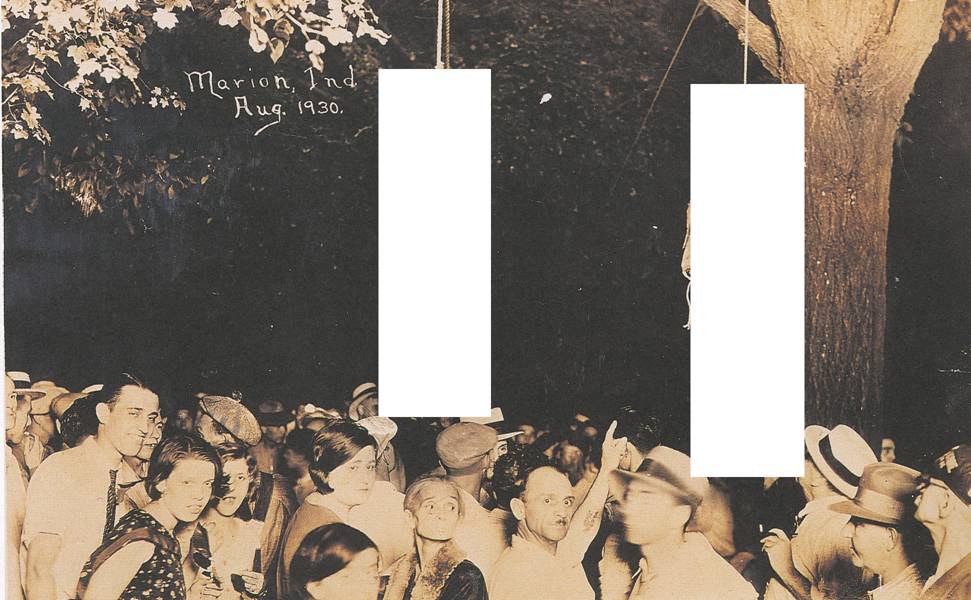

The blanked out parts of the pictures are, of course, the victims of lynchings (all African-American) in early 20th-century United States. I won't risk the sensibilities of readers any more than I already have by describing the details of the corpses, but to put it blandly, in the first and third pictures especially, they are grotesquely mutilated.
I post these pictures not (I hope) from any motive of voyeurism, but to share with you my sense that they powerfully raise one of the most important issues in moral psychology: the emotions of perpetrators of evil. Though it's a bit hard to see in these small pictures (the maximum size Blogger allows), I hope it's nonetheless evident that most of the lynchers look relaxed and happy -- though they're only feet from a freshly murdered corpse. It was not uncommon to bring small children along to lynchings, to collect souvenirs, to take photos and sell them as postcards. (These pictures are from a collection of just such postcards: James Allen's Without Sanctuary.)
Although I'm attracted to a roughly Mencian view of human nature, according to which something in us is deeply revolted by evil, when that evil is nearby and "in one's face" as it were, I find pictures like this somewhat difficult to reconcile with that view. Are these people inwardly revolted, under their smiles?
Friday, May 26, 2006
Images as "Pictures"
In Wednesday's post, I wrote about the picture analogy for vision and the implicit (and possibly erroneous) assumptions about visual experience invites. Well, the picture analogy for visual imagery, visual imaginings, is even more pervasive. It almost doesn't feel like a metaphor to call an image a "picture" in the mind or to say "picture to yourself".
This struck me with particular force as I was reading through English translations of ancient Greek texts, looking for analogies between visual experience and paintings or pictures (I found exactly one in the whole corpus, though I can't pretend to have given it exhaustive coverage), pursuing thoughts relevant to the issues in Wednesday's post. I kept finding reference to "picturing" in the English translations, in discussions of imagery -- but, oddly, different translations would use that word in different places. Going back to the original Greek, it was evident in nearly every case I examined that it was the translator bringing in the metaphor (possibly not even aware of its metaphorical status or its potential interest in understanding the history of conceptions of imagery).
The analogy between images and pictures has worked its way so deeply into our thoughts about imagery that it's almost invisible as an analogy.
Now in some sense, surely, images are like pictures and the analogy between them is a good one. But let me suggest some ways in which images might not be like pictures (might not -- I don't think these issues have been adequately explored yet).
(1.) Images might be three-dimensional in some robust sense, while pictures are flat. Perhaps even (as some people have reported and as Borges describes in his story "The Zahir") images can be experienced simultaneously from multiple angles?
(2.) Images might be indeterminate in a way it's difficult for pictures to be. For example, it might be indeterminate whether the man you're imagining is wearing a hat, or what color his jacket is, or whether he has a beard.
(3.) Images might have their interpretations built into them in a way that pictures do not. For example, when we imagine an "ambiguous figure" like Wittgenstein's duck-rabbit or the Necker cube, the image might incorporate or involve one interpretation then another, while nothing in the "picture" before our mind changes. (This thought arose recently in conversation with Charles Siewert, as we were reading a paper by William Robinson that seemed to assume that there's nothing different in the visual imagery experience of a Necker cube interpreted one way and that same Necker cube interpreted another.)
As I mentioned in Wednesday's post, I'm inclined to think our metaphors for the mind often distort our understanding of it. So I wonder: Would people be more likely to accept features 1-3 as aspects of our imagery experience if the picture analogy weren't so deeply ingrained in our thinking?
Wednesday, May 24, 2006
Do Tilted Coins Look Elliptical? (Part Two)
Does a tilted coin, in some sense, "look elliptical"? Do farther-away streetlights in some sense look smaller than nearer ones? Monday, I raised some geometrical concerns for the apparently commonsensical view that they do.
Now perhaps it's just introspectively obvious and undeniable that tilted coins look elliptical, geometrical cavils aside? I've put a coin on my desk and I'm staring at it now. Does it look elliptical, in some sense -- in any sense? I confess uncertainty.
It's strange, though, in a way, to feel uncertain about such a thing. What, after all, is nearer to us than our own experience? Don't I have an immediate, privileged access to it? -- an access of the sort that many philosophers, at least since Descartes, have thought infallible or indubitable or incorrigible or at least overwhelmingly accurate? How could I go wrong about how things seem to me visually? And if I can't go wrong, then what is there to be uncertain of?
(Readers who know my work will know that much of what I've written recently is dedicated to undermining optimistic views about how well we know our own conscious experience. See especially here.)
Maybe part of what leads us to think the coin looks elliptical is that if I were to take a photograph of the scene from my perspective, or draw a painting of it, the image of the coin in that photograph or painting would be an ellipse. But we shouldn't infer straightaway from the ellipticality of the coin in a potential picture to its ellipticality in my experience. Perhaps, indeed, we only think the coin looks elliptical because we implicitly over-analogize our visual experience to pictures.
We over-analogize our experience to outward media and technology quite commonly I think. Alva Noe has argued, for example, that we often over-analogize vision to photography in taking our visual experience to have photographically rich detail deep into the periphery. I have argued that we over-analogize dreams to movies -- so much so that in the 1950s most Americans said they dreamed in black and white. Similarly, might we, in analogizing visual experience to snapshots and movies, go so far as mistakenly to attribute features of those outward technologies back into our experience?
It's interesting to note in this connection that in ancient Greece, where vision was commonly analogized to impressing a seal in wax and hardly ever analogized to painting, philosophers generally did not say that tilted coins look elliptical, that farther columns look smaller, etc. Epicurus went so far to assert positively that visual experiences have the same three-dimensional shape as the objects they are experiences of.
Of course we can tell by looking that a coin viewed obliquely would project as an ellipse upon an intervening plane -- but we can also tell by looking that it would project as a concave ellipsoid upon the surface of a sphere and that it would make a certain type of impression on wax from its current orientation. Could it only be because we implicitly think of vision as like photography that we're inclined to think of the first of these, rather than the other two, as the more adequate characterization of the experience of visual perspective?
(For fuller reflections on this topic see my essay "Do Things Look Flat?")
Monday, May 22, 2006
Do Tilted Coins Look Elliptical? (Part One)
Put a coin on your desk and look at it from an angle. Is there some sense in which it looks elliptical? Look out your window at a row of receding streetlights. Is there some sense in which the farther ones look smaller?
Many philosophers have said such things -- from Malebranche in the 17th century through contemporary philosophers of perception Michael Tye (e.g., here) and Alva Noe. But is this right?
One reason to have some doubts is this: It's just not clear what the geometry of such a view is supposed to be.
Tye and others have suggested that it involves something like projection onto a plane perpendicular to the line of sight: If you drew a straight line from your eye to the object, then interposed between yourself and that object a plane perpendicular to the line, what kind of shape would you have to put on that plane to perfectly occlude the object? An ellipse, in the case of the coin. A smallish figure in the case of a distant streetlight, a larger figure in the case of a nearer streetlights.
So far, so good. But the problem with doing the geometry that way is that lines projected onto the plane from objects off to the side will intersect the plane obliquely, with the consequence that they will appear much larger in the plane than their straight-ahead counterparts -- weirdly larger, if projective size is supposed to correspond to experienced size. My friend Glenn Vogel drew me up a figure that very nicely illustrates this point:
See how the sphere to the right makes a much bigger shadow in the plane?
One could avoid the problem of the projective size of objects off to the side by making the projective surface, between you and the objects, a sphere rather than a plane. Imagine bending the plane in the figure back to the right, wrapping it around until it was an even sphere encircling the point where the lines converge. Then the projective shadows would be the same size. Projecting onto a sphere rather than a plane would also respect the idea that apparent size varies with visual angle subtended.
But now we've lost our ellipse! The ellipse is a planar figure. Projecting onto a sphere generates not an ellipse but rather a concave ellipsoid.
Should we say, then, that strictly speaking the coin looks concave? That would be strange! In fact, that seems just plainly, observably false -- even with a larger circular object, like a plate, held close to the face so that its concavity given a spherical projection would be considerable.
So the puzzle remains: Is there some way to make sense of the geometry of a view according to which circular objects, viewed obliquely, look elliptical and distant things look smaller than their nearer counterparts? Despite the frequency with which philosophers say such things, no one has adequately explained how this is supposed to work.
(Steven Lehar has perhaps come closest, attempting to get very clear about the geometry; but I suspect that his view will end up making the coin look concave.)
In Part Two, I'll say a bit about what cultural influences and metaphors might be driving all this. You can also look at my essay here.
Friday, May 19, 2006
Can a State Be "Half-Conscious"?
I'm no fan of sharp lines. I'm deeply committed to the idea that the world -- especially the most complex parts of it, like the mind -- is thoroughly vague, blurry, splintered, dissociative, in-betweenish. (See for example my essays here and here and here.) But one thing I can't get my head around is an in-between state of consciousness -- a state of mind that is somewhere between being an experience and not being an experience. I see no theoretical reason to suppose such states can't exist; and given gradualism in the development and phylogeny of brains, there seems to be excellent reason to suppose there'd be a vague zone between conscious and nonconscious. But that idea, despite its appeal in the abstract, eludes my understanding when I try to reflect on it more deeply.
Of course there could be peripheral experiences, such as the experience of feeling your feet in your shoes when you're thinking about other things. (Maybe there aren't such experiences in fact, but that's a different question; at least they're conceivable.) Such states may in some sense be "less conscious" than experiences in focal attention, as it were. But, it seems to me, if you experience your feet in your shoes, no matter how peripherally, inarticulately, fuzzily, inattentively, then you genuinely experience them in that peripheral, inarticulate, fuzzy, inattentive way. If frogs (or ants or slugs or whatever) have the hazy beginnings of conscious experience -- say visual and tactile conscious experiences -- then it seems to me that they are genuinely conscious, in that hazy way. Either their stream of conscious is a total blank (i.e., there is no stream of conscious experience, for them) or it has some limited range of components. If the former, they have no conscious states; if they latter then they are conscious. I cannot envision a "between" state here.
Thus, it seems to me that "being conscious" is more like "having money" than "being red". (Does Searle say this somewhere?) Having money comes in degrees -- some people have more and some have less. But even one cent is money. Either you have money or you don't (setting aside issues like debt and illiquid goods). Being red also comes in degrees -- one thing can be redder than another -- but there are "in-between" states -- shades along the spectrum from red to purple, say, or red to orange, where it makes sense to say "Well, it's a vague matter whether this shade counts as red or not -- it depends on how one draws one's lines -- it's kind of between red and purple." What I don't see is how that could be the case for consciousness. Can we say of a state -- a peripheral conscious state in a human being, or a state in a frog, that whether it's a state that is experienced, whether it has "phenomenal character", is a vague issue, that it depends on how one draws one's lines, that it's kind of between having a phenomenal character and not having one?
Surely there are those who will say yes. And I'd like to say yes. But I can't quite figure out how this could be so (without adding something to "conscious" to change the meaning from that intended here -- like changing it to mean "self-conscious" or "acutely aware"). So I'm rather stuck. Is this just a failure of imagination?
Wednesday, May 17, 2006
How Many People *Really* Believe in God and Heaven?
Most people in the United States say they believe in God and Heaven. If all there is to believing something is being disposed sincerely to claim it, then I suppose they do believe. But what if believing something requires being disposed consistently to think and act in accord with one's belief? Then the matter becomes less clear.
Consider the implicit racist (discussed in an earlier blog entry "Do You Know If You're a Racist?") who says (for example) that "dark-skinned people are as intelligent as light-skinned people" but whose pattern of behavior, apart from her occasional avowals to the contrary, consistently reveals racist expectations -- she's surprised when an African-American says something smart; she expects, with no real basis, LeShaun to do poorly in her class; etc. I don't think we want to say that such a person really believes that dark-skinned people are as intelligent as light-skinned -- at best, she's in a muddled state somewhere between believing it and failing to believe it. (See also here my essay "In-Between Believing".)
I suspect most people who avow belief in God and Heaven are in a muddled, in-betweenish state of this sort. What you wouldn't do with a neighbor watching, you would do with God watching, when eternal bliss and suffering is at stake? One could posit massive irrationality here; but it seems easier and more plausible to me -- once one is comfortable with the idea of in-between beliefs and dissocations between avowals and one's real attitudes -- to suspect that such a person doesn't fully and completely, genuinely believe that God watches every move. Why is Hell less frightening than jail? Because, I suspect, belief in Hell is not fully written into the "believer's" structure of dispositions, reactions, and patterns of thought -- just as belief in the equality of the races is not written into the implicit racist's stucture of dispositions, reactions, and patterns of thought.
"Faith" can mean a lot of things. But perhaps we can think of one type of "faith" as merely sincere profession and hope, and desire to believe, without the fully saturated, implicit, taking-for-granted of the truth of the thing that is the province of full and genuine belief.
Monday, May 15, 2006
What Does It Mean to Say "Human Nature Is Good"?
I've been thinking a bit recently about the claim that "human nature is good", famously advocated by Rousseau in the West and by Mencius in ancient China.
Well, already that way of putting it is disputable! Is there one claim that both Rousseau and Mencius make? -- or, instead, when Rousseau says "la nature humaine est bonne" and Mencius says "xing shan", though the best English translation of their statements is "human nature is good", each means something quite different?
One might be led to this thought, especially, if one bears in mind the "state of nature" thought experiment that is given high prominence in many discussions of Rousseau. The "state of nature", per Rousseau, is a (perhaps fictional) state in which human beings exist without any societal or cultural ties. A certain reading of Rousseau's Discourse on Inequality might lead one to suppose that when Rousseau says "human nature is good" he means that people in the state of nature are good. If that's what Rousseau means, then he must mean something different from Mencius, since Mencius does not even contemplate "the state of nature" but always imagines people as thoroughly embedded in some society or other.
But I don't think we need to read Rousseau this way. For one thing, it saddles Rousseau with a strange view of the "natural". Human beings, of course, are naturally social -- like wolves and ants. No naturalist (not even in Rousseau's day!) would think to separate the wolf from the pack or the ant from its colony to determine its "natural" behavior. Human beings deprived of society -- like the occasionally discovered "wild child" -- will lack language and fear humans. But surely this isn't our "natural" state!
If we look to Mencius and to Rousseau's later work Emile (which Rousseau himself said was the key to understanding all the rest of his work) we see, I think, a developmental approach to the "natural". What is natural is what arises in a healthy process of normal development, in normal people, without external imposition. Both Rousseau and Mencius think morality arises from such a natural, healthy process; and that, I'd suggest is what is at the core of each of their claims about "human nature".
Interpreted in that way, and developed a bit (as both Rousseau and Mencius do develop it) the question whether "human nature is good" gains some specific, interesting, and empirically explorable content.
By the way, Hobbes and Xunzi (Rousseau’s and Mencius’s most famous opponents on the issue of human nature) would both say, I think, that morality is the result of external imposition, rather than something that emerges from within in a normal process of development, so this interpretation can get them right, too.
I’ve been revising an essay on this recently, which you can see here.

