Thursday, March 24, 2022

Evening the Playing Field in Philosophy Classes

As I discussed last week, overconfident students have systematic advantages in philosophy classes, at least as philosophy is typically taught in the United States. By confidently asserting their ideas in classroom -- even from day one, when they have no real expertise on the issues -- they get practice articulating philosophical views in an argumentative context and they receive the professor's customized feedback on their views. Presenting their views before professor and peers engages their emotions and enhances their memory. Typically, professors encourage and support such students, bringing out the best in them. Thus, over the long run, overconfident students tend to perform well, better than their otherwise similar peers with more realistic self-assessments. What seems to be an epistemic vice -- overconfidence -- ultimately helps them flourish and learn more than they otherwise would have.

I like these overconfident students (as long as they're not arrogant or domineering). It's good we encourage them. But I also want to level the playing field so that less-overconfident students can gain some of the same advantages. Here's my advice for doing so.

First, advice for professors. Second, advice for students.

Evening the Playing Field: Advice for Professors

(1.) Small-group discussions. This might sound like tired advice, but there's a reason the advice is so common. Small-group discussions work amazing magic if you do them right. Here's my approach:

* Divide the class into groups of 3 or 4. Insist on exactly 3 or 4. Two is to few, because friends will pair up and have too little diversity of opinion. Five is too many, because the quietest student will be left out of the conversation.

* Give the students a short, co-operative written task which will be graded pass / no credit (be lenient). For example, "write down two considerations in favor of the view that human nature is good and two considerations against the view". Have them designate one student as "secretary", who will write down their collaborative answer on a sheet of paper containing all their names. This should start them talking with each other, aimed at producing something concrete and sensible.

* Allow them five minutes (maybe seven), during which you wander the room, encouraging any quiet groups to start talking and writing.

* Reconvene the class, and then ask a group of usually quiet students what their group came up with.

* Explore the merits of their answers in an encouraging way, then repeat with other groups.

This exercise will get many more students talking in class than the usual six. (Almost no matter the size of the class, there will be six students who do almost all the talking, right?) The increased talkativeness often continues after the exercise is over. Not only do normally quiet students open their mouths more, but they gain some of the more specific benefits of the overconfident student: They practice expressing their views aloud in class, they receive customized feedback from the professor, by having their views put on the spot they feel an emotional engagement that enhances interest and memory, and they get the feeling of support from the professor.

Why it works: It's of course easier to talk with a few peers than in front of the whole class, especially when necessary to complete a (low-stress) assignment. Speaking to a few peers in the classroom and finding them to be nice about it (as they almost always are) facilitates later speaking in front of the whole class. Furthermore, when the professor calls on a small group, instead of on one student in particular, that student isn't being confronted as directly. They have cover: "This is just what our group came up with." And if the student isn't comfortable extemporizing, they can just read the words written on the page. All of this makes it easier for the quieter students to gain practice expressing their philosophical views in front of others. If it goes well, they become more comfortable doing it again.

(2.) Story time. Back in 2016, I dedicated a post to the value of telling stories in philosophy class. My former T.A. Chris McVey was a master of philosophical storytelling. He would start discussion sections of my huge lower-division class, Evil, with personal stories from his childhood, or from his time working on a nuclear submarine, or from other parts of his life, that related to the themes of the class. He kept it personal and real, and students loved it.

A very different type of student tends to engage after storytime than the usual overconfident philosophy guy -- for example, someone who has a similar story in their own lives. The whole discussion has a different, more personal tone, and it can then be steered back into the main ideas of the course. Peter [name randomly chosen from lists of former students], who might normally say nothing in class, finds he has something to say about parental divorce. He has been brought into the discussion, has expressed an opinion and has been shown how his opinion is relevant to the course.

(3.) Diversify topics and cultures. Relatedly, whenever you can diversify topics (add a dimension on religion, or family, or the military) or culture (beyond the usual European / North American focus), you shift around what I think of as the "academic capital" of the students in the class. A student who hasn't had confidence to speak might suddenly feel expert and confident. Maybe they are the one student who has had active duty in the military, or maybe their pre-college teachers regularly quoted from Confucius and Mencius. Respecting their expertise can help them recognize that they bring something important, and they will be readier to commit and engage on the issues at hand.

(4.) Finger-counting questions. Consider adding this custom: The first time a student raises their hand to speak in class, they raise one finger. The second time, two fingers. The third time, three fingers, and so on. When multiple students want to contribute, prioritize those with fewer fingers. When a student raises four fingers, hesitate, looking to see whether some lower-fingered students might also have something to say. This practice doesn't silence the most talkative students, but it will make them more aware of the extent to which they might be crowding other students out, and it constantly communicates to the quieter students that you're especially interested in hearing from them, instead of always from the same six.

This advice aims partly at enhancing oral participation in class, which is a big step toward evening the playing field. But to really level the playing field requires more. It's not just that the overconfident student is more orally active. The overconfident student has opinions, stakes claims, feels invested in the truth or falsity of particular positions, and takes the risk of exposing their ideas to criticism. This creates more emotional and intellectual engagement than do neutral, clarificatory oral contributions. My first three suggestions not only broaden oral participation in general but non-coercively nudge students toward staking claims, with all the good that follows from that.

Evening the Playing Field: Advice for Students

Your professor might not do any of the above. You might see the same six students dominating discussion, and you might not feel able to contribute at their level. You might be uninterested in competing with them for air time, and you might dislike the spotlight on yourself. Do yourself a favor and overcome these reservations!

First, the confident students might not actually know the material better than you do. Most professors in U.S. classrooms interpret students' questions as charitably as possible, finding what's best in them, rather than shooting students down in a discouraging way. If a confident student says something you think doesn't make sense or that you're inclined to disagree with, and if the professor seems to like the comment, it might not be that you're misunderstanding but rather that the professor is doing what they can to turn a weak contribution into something good.

Second, try viewing classroom philosophy discussions like a game. Almost every substantive philosophical claim (apart from simple historical facts and straightforward textual interpretations) is disputable, even the principle of non-contradiction. Take a stand for fun. See if you can defend it. A good professor will both help you see ways in which it might be defensible and ways in which others have argued against it. Think of it as being assigned to defend a view in a debate -- a view with which you might or might not agree.

Third, you owe it to yourself to win the same educational benefits that ordinarily accrue disproportionately to the overconfident students. You might not feel comfortable taking a stand in class. But so much of life is about reaching beyond your comfort zone, doing new things. Right? If you care about your education, care about getting the most out of it by putting your ideas forward in class.

Fourth, try it with other students. Even if your professor doesn't use small discussion groups, you can do this yourself. Most people find that it's much easier to take a stand about the material in front of a peer than in front of the whole class. Outside of class, tell a classmate about your objection to Kant. Bat it around with them a bit. This will give you already a certain amount of practice and feedback, laying the groundwork for later expressing that view, or some other one, in a class context. You could even say to the professor, "My friend and I were wondering whether Kant..." A good professor will love to hear a question like this. Thus students have been arguing about Kant outside of class! Yay!

------------------------------------

Related:

"How to Diversity Philosophy: Two Thoughts and a Plea for More Suggestions" (Aug 24, 2016)

"Storytelling in Philosophy Class" (Oct 21, 2016)

"The Parable of the Overconfident Student -- and Why Academic Philosophy Still Favors the Socially Privileged" (Mar 14, 2022)

[image source]

Monday, March 14, 2022

The Parable of the Overconfident Student -- and Why Academic Philosophy Still Favors the Socially Privileged

If you've taken or taught some philosophy classes in the United States, you know the type: the overconfident philosophy student. Our system rewards these students. The epistemic failing of overconfidence ultimately serves them well. This pattern, I conjecture, helps explain the continuing inequities in philosophy.

It's the second day of class. You're starting some complex topic, say, the conceivability argument for metaphysical dualism. Student X jumps immediately into the discussion: The conceivability argument is obviously absurd! You offer some standard first-pass responses to his objection, but he stands his ground, fishing around for defenses. Before today, he knew nothing about the issues. It's his first philosophy class, but suddenly, he knows better than every philosopher who thinks otherwise, whose counterarguments he has never heard.

[image from the classic Onion article "Guy in Philosophy Class Needs to Shut the Fuck Up"]

It's also Student Y's first philosophy class. Student X and Student Y are similar in intelligence and background knowledge, differing only in that Student Y isn't irrationally overconfident. Maybe Student Y asks a question of clarification. Or maybe she asks how the author would deal with such-and-such an objection. More likely, she keeps quiet, not wanting to embarrass herself or use class time when other, more knowledgeable students presumably have more insightful things to say.

(I've called Student X a "he", since in my experience most students of this type are men. Student Y types are more common, in any gender.)

What will happen to Student X and Student Y over time, in the typical U.S. classroom? Both might do well. Student Y is by no means doomed to fail. But Student X's overconfidence wins him several important advantages.

First, he gets practice asserting his philosophical views in an argumentative context. Oral presentation of one's opinions is a crucial skill in philosophy and closely related to written presentation of one's opinions.

Second, he receives customized expert feedback on his philosophical views. Typically, the professor will restate Student X's views, strengthening them and fitting them better into the existing discourse. The professor will articulate responses those views, so that the student learns those too. If the student responds to the responses, this second layer of responses will also be charitably reworked and rebutted. Thus, Student X will gain specific knowledge on exactly the issues that engage and interest him most.

Third, he engages his emotions and enhances his memory. Taking a public stand stirs up your emotions. Asking a question makes your heart race. Being defeated in an argument with your professor burns that argument into your memory. So also does winning an argument or playing to a draw. After his public stand and argument, it matters to Student X, more than it otherwise would have, that the conceivability argument is absurd. This will intensify his engagement with the rest of the course, where he'll latch on to arguments that support his view and develop counterarguments against the opposition. His written work will also reflect this passion.

Fourth, he wins the support and encouragement of his professor. Unless he is unusually obnoxious or his questions are unusually poor, the typical U.S. professor will appreciate Student X's enthusiasm and his willingness to advance class discussion. His insights will be praised and his mistakes interpreted charitably, enhancing his self-confidence and his sense that he is good at philosophy.

The combined effect of these advantages, multiplied over the course of an undergraduate education, ensures that most students like Student X thrive in U.S. philosophy programs. What was initially the epistemic vice of overconfidence becomes the epistemic virtue of being a knowledgeable, well-trained philosophy student.

Contrast with the sciences. If a first-year chemistry student has strong, ignorant opinions about the electronegativity of fluorine, it won't go so well -- and who would have such opinions, anyway? Maybe at the most theoretically speculative end of the sciences, we can see a similar pattern, though. The social sciences and other humanities might also reward the overconfident student in some ways while punishing him in others. Among academic disciplines as practiced in the U.S., I conjecture that philosophy is the most receptive to the Overconfident Student Strategy.

Success in the Overconfident Student Strategy requires two things: a good sense of what is and is not open for dispute, and comfort in classroom dialogue. Both tend to favor students from privileged backgrounds.

It's ridiculous to dispute simple matters of fact with one's professor. The Overconfident Student Strategy only works if the student can sniff out a defensible position, one rich for back-and-forth dispute. Student X in our example immediately discerned that the conceivability argument for dualism was fertile ground on which to take a stand. Student X can follow his initial gut impression, knowing that even if he can't really win the argument on day two, arguments for his favored view are out there somewhere. Students with academically strong backgrounds -- who have a sense of how academia works, who have some exposure to philosophy earlier in their education, who are familiar with the back-and-forth of academic argumentation -- are at an advantage in sensing defensible positions and glimpsing what broad shapes an argument might take.

And of course speaking up in the classroom, especially being willing to disagree with one's professor, normally requires a certain degree of comfort and self-assurance in academic contexts. It helps if classrooms feel like home, if you feel like you belong, if you see yourself as maybe a professor yourself some day.

For these reasons -- as well as the more general tendency toward overconfidence that comes with social privilege -- we should expect that the Overconfident Student Strategy should be especially available to students with privileged backgrounds: the children of academics, wealthy students who went to elite high schools, White students, men, and non-immigrants, for example. In this way, initial privilege provides advantages that amplify up through one's education.

I have confined myself to remarks about the United States, because I suspect the sociology of overconfidence plays out differently in some other countries, which might explain the difficulty that international students sometimes have adapting to the style in which philosophy is practiced here.

I myself, of course, was just the sort of overconfident student I've described -- the son of two professors, raised in a wealthy suburb with great public schools. Arguably, I'm still employing the same strategy, opining publicly on my blog on a huge range of topics beyond my expertise (e.g., Hume interpretation last week, COVID ethics last month), reaping advantages analogous to the overconfident student's four classroom advantages, only in a larger sphere.

Coming up! Some strategies for evening the playing field.

------------------------------------------

Related: "On Being Good at Seeming Smart" (Mar 25, 2010).

Sunday, March 13, 2022

Some Recent Talks and Interviews

"Would You Shut Off a Robot Who Might Be Conscious?" -- 50 minute talk at Ruhr University Bochum, on YouTube.

"Eric Schwitzgebel: Metaphysics of Mind, Issues of Introspection, Ethics of Ethicists, Aliens and AI" -- a wide ranging two hour interview with Tevin Naidu at Mind-Body Solution, on

* YouTube
* Spotify
* Apple podcasts
* Google podcasts.

Digital Afterlives -- an hour-long YouTube conversation, pitched for a broad audience, at the UCR Palm Desert Campus with Susan Schneider and John M. Fischer on "uploading" your consciousness into computers and personal identity.

"Zombies" -- a 32 minute podcast on zombies (traditional, Hollywood, and philosophical) featuring Christina van Dyke, David Chalmers, John Edgar Browning, and some of my reflections on whether AI systems might be "zombies" in the sense of outwardly seeming to have consciousness but inwardly lacking it.

Tuesday, March 08, 2022

How to Defeat Higher-Order Regress Arguments for Skepticism

In arguing for radical skepticism about arithmetic knowledge, David Hume uses what I'll call a higher-order regress argument. I was reminded of this style of argument when I read Francois Kammerer's similarly structured (and similarly radical) argument for skepticism about the existence of conscious experiences, forthcoming in Philosophical Studies. In my view, Hume's and Kammerer's arguments fail for similar reasons.

Hume begins by arguing that you should have at least a tiny bit of doubt even about simple addition:

In accompts of any length or importance, Merchants seldom trust to the infallible certainty of numbers for their security.... Now as none will maintain, that our assurance in a long numeration exceeds probability, I may safely affirm, that there scarce is any proposition concerning numbers, of which we can have a fuller security. For 'tis easily possible, by gradually diminishing the numbers, to reduce the longest series of addition to the most simple question, which can be form'd, to an addition of two single numbers.... Besides, if any single addition were certain, every one wou'd be so, and consequently the whole or total sum (Treatise of Human Nature 1740/1978, I.IV.i, p. 181)

In other words, since you can be mistaken in adding long lists of numbers, even when each step is the simple addition of two single-digit numbers, it follows that you can be mistaken in the simple addition of two single-digit numbers. Therefore, you should conclude that you know only with "probability", not with absolute certainty, that, say, 7 + 5 = 12.

I'm not a fan of absolute 100% flat utter certainty about anything, so I'm happy to concede this to Hume. (However, I can imagine someone -- Descartes, maybe -- objecting that contemplating 7 + 5 = 12 patiently outside of the context of a long row of numbers might give you a clear and distinct idea of its truth that we don't normally consistently maintain when adding long rows of numbers.)

So far, what Hume has said is consistent with a justifiable 99.99999999999% degree of confidence in the truth of 7 + 5 = 12, which isn't yet radical skepticism. Radical skepticism comes only via a regress argument.

Here's the first step of the regress:

In every judgment, which we can form concerning probability, as well as concerning knowledge, we ought always to correct that first judgment, deriv'd from the nature of the object, by another judgment, deriv'd from the nature of the understanding. 'Tis certain a man of solid sense and long experience... must be conscious of many errors in the past, and must still dread the like for the future. Here then arises a new species of probability to correct and regulate the first, and fix its just standard and proportion. As demonstration is subject to the controul of probability, so is probability liable to a new correction by a reflex act of the mind, wherein the nature of our understanding, and our reasoning from the first probability become our objects.

Having thus found in every probability, beside the original uncertainty inherent in the subject, a new uncertainty deriv'd from the weakness of that faculty, which judges, and having adjusted these two together, we are oblig'd by our reason to add a new doubt deriv'd from the possibility of error in the estimation we make of the truth and fidelity of our faculties (p. 181-182).

In other words, whatever high probability we assign to 7 + 5 = 12, we should feel some doubt about that probability assessment. That doubt, coupled with our original doubt, produces more doubt, thus justifying a somewhat lower -- but still possibly extremely high! -- probability assessment. Maybe 99.9999999999% instead of 99.99999999999%.

But now we're down the path toward an infinite regress:

But this decision, tho' it shou'd be favourable to our preceeding judgment, being founded only on probability, must weaken still further our first evidence, and must itself be weaken'd by a fourth doubt of the same kind, and so on in infinitum; till at last there remain nothing of the original probability, however great we may suppose it to have been, and however small the diminution by every new uncertainty. No finite object can subsist under a decrease repeated in infinitum; and even the vastest quantity, which can enter into human imagination, must in this manner be reduc'd to nothing (p. 182).

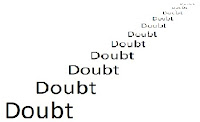
We should doubt, Hume says, our doubt about our doubts, adding still more doubt. And we should then doubt our doubt about our doubt about our doubt, and so on infinitely, until nothing remains but doubt. With each higher-order doubt, we should decrease our confidence that 7 + 5 = 12, until at the end we recognize that the only rational thing to do is shrug our shoulders and admit we are utterly uncertain about the sum of 7 and 5.

If this seems absurd... well, probably it is. I'm sympathetic with skeptical arguments generally, but this seems to be one of the weaker ones, and there's a reason it's not the most famous part of the Treatise.

There are at least three moves available to the anti-skeptic.

First, one can dig in against the regress. Maybe the best place to do so is the third step. One can say that it's reasonable to have a tiny initial doubt, and then it's reasonable to add a bit more doubt on grounds that it's doubtful how much doubt one should have, but maybe third-order doubt is unwarranted unless there's some positive reason for it. Unless something about you or something about the situation seems to demand third-order doubt, maybe it's reasonable to just stick with your assessment.

That kind of move is common in externalist approaches to justification, according to which people can sometimes reasonably believe things if the situation is right and their faculties are working well, even if they can't provide full, explicit justifications for those beliefs.

But this move isn't really in the spirit of Hume, and it's liable to abuse by anti-skeptics, so let's set it aside.

Second, one can follow the infinite regress to a convergent limit. The mathematical structure of this move should be familiar from pre-calculus. It's more readily seen with simpler numbers. Suppose that I'm highly confident of something. My first impulse is to assign 100% credence. But then I add a 5% doubt to it, reducing my credence to 95%. But then I have doubts about my doubt, and this second-order doubt leads me to reduce my credence another 2.5%, to 92.5%. I then have a third-order doubt, reducing my credence by 1.25% to 91.25%. And so on. As long as each higher-order doubt reduces the credence by half as much as the previous lower-order doubt, we will have a convergent sum of doubt. In this case, the limit as we approach infinitely many layers of doubt is 10%, so my rational credence need never fall below 90%.

This response concedes a lot to Hume -- that it's reasonable to regress infinitely upward with doubt, and that each step upward should reduce our confidence by some finite amount -- and yet it avoids the radically skeptical conclusion.

Interestingly, Hume himself arguably could not have availed himself of this move, given his skepticism about the infinitesimal (in I.II.i-ii). We can have no adequate conception of the infinitesimal, Hume says, and space and time cannot be infinitely divided. Therefore, when Hume concludes the quoted passage above by saying "No finite object can subsist under a decrease repeated in infinitum; and even the vastest quantity, which can enter into human imagination, must in this manner be reduc'd to nothing", he is arguably relying on his earlier skepticism about infinite division. For that reason, Hume might be unable to accept the convergent limit solution to his puzzle -- though we ourselves, rightly more tolerant of the infinitesimal, shouldn't be so reluctant.

Third, higher-order doubts can take the form of reversing lower-order doubts. Your third-order thought might be that your second-order doubt was too uncertain, and thus on reflection your confidence might rise again. If my first inclination is 100% credence, and my second thought knocks it down to 95%, my next thought might be that 95% is too low rather than too high. Maybe I kick it back up to 97.5%. My fourth thought might then involve tweaking it up or down from there. Thus, even without accepting convergence toward a limit, we might reasonably suspect that ever-higher orders of reflection will always yield a degree of confidence that bounces around within a manageable range, say 90% to 99%. And even if this is only a surmise rather than something I know for certain, it's a surmise that could be either too high or too low, yielding no reason to conclude that infinite reflection would tend toward low degrees of confidence.

* - * - *

Well, that was longer than intended on Hume! But I think I can home in quickly on the core idea from Kammerer that precipitated this line of reflection.

Kammerer is a "strong illusionist". He thinks that conscious experiences don't exist. If this sounds like such a radical claim as to be almost unbelievable, then I think you understand why it's worth calling a radically skeptical position.[1]

David Chalmers offers a "Moorean" reply to this claim (similarly, Bryan Frances): It's just obvious that conscious experience exists. It's more obvious that conscious experience exists than any philosophical or scientific argument to the contrary could ever be, so we can reject strong illusionism out of hand, without bothering ourselves about the details of the illusionist arguments. We know in advance that whatever the details are, the argument shouldn't win us over.

Kammerer's reply is to ask whether it's obvious that it's obvious.[2] Sometimes, of course, we think something is obvious, but we're wrong. Some things we think are obvious are not only non-obvious but actually false. Furthermore, the illusionist suspects we can construct a good explanation of why false claims about consciousness might seem obvious despite their falsity. So, according to Kammerer, we shouldn't accept the Moorean reply unless we think it's obvious that it's obvious.

Kammerer acknowledges that the anti-illusionist might reasonably hold that it is obvious that it's obvious that conscious experience exists. But now the argument repeats: The illusionist might anticipate an explanation of why, even if conscious experience doesn't exist, it seems obvious that it's obvious that conscious experience exists. So it looks like the anti-illusionist needs to go third order, holding that it's obvious that it's obvious that it's obvious. The issue repeats again at the fourth level, and so on, up into a regress. At some point high enough up, it will either no longer be obvious that it's obvious that it's [repeat X times] obvious; or if it's never non-obvious at any finite order of inquiry, there will still always be a higher level at which the question can be raised, so that a demand for obviousness all the way up will never be satisfied.

Despite some important differences from Hume's argument -- especially the emphasis on obviousness rather than probability -- versions of the same three types of reply are available.

Dig in against the regress. The anti-illusionist can hold that it's enough that the claim is obvious; or that it's obvious that it's obvious; or that it's obvious that it's obvious that it's obvious -- for some finite order of obviousness. If the claim that conscious experience exists has enough orders of obviousness, and is furthermore also true, and perhaps has some other virtues, perhaps one can be fully justified in believing it even without infinite orders of obviousness all the way up.

Follow the regress to a convergent limit. Obviousness appears to come in degrees. Some things are obvious. Others are extremely obvious. Still others are utterly, jaw-droppingly, head-smackingly, fall-to-your-knees obvious. Maybe, before we engage in higher-order reflection, we reasonably think that the existence of conscious experience is in the last, jaw-dropping category, which we can call obviousness level 1. And maybe, also, it's reasonable, following Kammerer and Hume, to insist on some higher-order reflection: How obvious is it that it's obvious? Well, maybe it's extremely obvious but not utterly, level 1 obvious, and maybe that's enough to reduce our total epistemic assessment to overall obviousness level .95. Reflecting again, we might add still a bit more doubt, reducing the obviousness level to .925, and so on, converging toward obviousness level .9. And obviousness level .9 might be good enough for the Moorean argument. Obviously (?), these are fake numbers, but the idea should be clear enough. The Moorean argument doesn't require that the existence of conscious experience be utterly, jaw-droppingly, head-smackingly, fall-to-your-knees, level 1 obvious. Maybe the existence of consciousness is that obvious. But all the Moorean argument requires is that the existence of consciousness be obvious enough that we reasonably judge in advance that no scientific or philosophical argument against it should justifiably win us over.

Reverse lower-order doubts with some of the higher-order doubts. Overall obviousness might sometimes increase as one proceeds upward to higher orders of reflection. For example, maybe after thinking about whether it's obvious that it's obvious that [eight times] it's obvious, our summary assessment of the total obviousness of the proposition should be higher than our summary assessment after thinking about whether it's obvious that it's obvious that [seven times] it's obvious. There's no guarantee that with each higher level of consideration the total amount of doubt should increase. We might find as we go up that the total amount of obviousness fluctuates around some very high degree of obviousness. We might then reasonably surmise that further higher levels will stay within that range, which might be high enough for the Moorean argument to succeed.

---------------------------------

[1] Actually, I think there's some ambiguity about what strong illusionism amounts to, since what Kammerer denies the existence of is "phenomenal consciousness", and it's unclear whether this really is the radical thesis that it is sometimes held to be or whether it's instead really just the rejection of a philosopher's dubious notion. For present purposes, I'm interpreting Kammerer as holding the radical view. See my discussions here and here.

[2] Kammerer uses "uniquely obvious" here, and "super-Moorean", asking whether it's uniquely obvious that it's uniquely obvious. But I don't think uniqueness is essential to the argument. For example, that I exist might also be obvious with the required strength.

Tuesday, March 01, 2022

Do Androids Dream of Sanctuary Moon?

guest post by Amy Kind

In the novel that inspired the movie Blade Runner, Philip K. Dick famously asked whether androids dream of electric sheep. Readers of the Murderbot series by Martha Wells might be tempted to ask a parallel question: Do androids dream of The Rise and Fall of Sanctuary Moon?

Let me back up a moment for those who haven’t read any of the works making up The Murderbot Diaries.[1] The series’ titular character is a SecUnit (short for Security Unit). SecUnits are bot-human constructs, and though they are humanoid in form, they generally don’t act especially human-like and they have all sorts of non-human attributes including a built-in weapons system. Like other SecUnits, Murderbot has spent most of its existence providing security to humans who are undertaking various scientific, exploratory, or commercial missions. But unlike other SecUnits, Murderbot has broken free of the tight restrictions and safeguards that are meant to keep it in check. About four years prior to the start of the series, Murderbot had hacked its governor module, the device that monitors a SecUnit and controls its behavior, sometimes by causing it pain, sometimes by immobilizing it, and sometimes by ending its existence.

So how has Murderbot taken advantage of its newfound liberty? How has it kept itself occupied in its free time? The answer might initially seem surprising: Murderbot has spent an enormous amount of its downtime watching and rewatching entertainment media. In particular, it’s hooked on a serial drama called The Rise and Fall of Sanctuary Moon. We’re not told very much about Sanctuary Moon, or why it would be so especially captivating to a SecUnit, though we get some throw-away details now and then over the course of the series. We know it takes place in space, that it involves murder, sex, and legal drama, and that it has at least 397 episodes. In an interview with Newsweek in 2020, Wells has said that the show “is kind of based on How to Get Away with Murder, but in space, on a colony, with all different characters and hundreds more episodes, basically.”

It's not uncommon for the sophisticated AI of science fiction to adopt hobbies and pursue various activities in their leisure time. Andrew, the robot in Asimov’s Bicentennial Man, takes up wood carving, while Data, the android of Star Trek, takes up painting and spends time with his cat, Spot. HAL, the computing system built into the Discovery One spaceship in 2001: A Space Odyssey, plays chess. But it does seem fairly unusual for an AI to spend so much of its time binge-watching entertainment media. Murderbot’s obsession (one might even say addiction) is somewhat puzzling, at least to its human clients. In All Systems Red, when one of these clients reviews the SecUnit’s personal logs to see what it’s been up to, he discovers that it has downloaded 700 hours of media in the short time since their spacecraft landed on the planet they are exploring. The client hypothesizes that Murderbot must be using the media for some hidden, possibly nefarious purpose, perhaps to mask other data. As the client says, “It can’t be watching it, not in that volume; we’d notice.” (One has to love Murderbot’s response: “I snorted. He underestimated me.”)

Over the course of the series, as we learn more and more about Murderbot, the puzzle starts to dissipate. Certainly, Sanctuary Moon is entertainment for Murderbot. It’s an amusing diversion from its daily grind of security work. But it’s also much more than that. As Murderbot explicitly tells us, rewatching old episodes calms it down in times of stress. It borrows various details from Sanctuary Moon to help it in its work, as when it adopts one of the character’s names as an alias or when it decides what to do based on what characters on the show have done in parallel scenarios. And watching this serial helps Murderbot to process emotions. As it states on more than one occasion, it doesn’t like to have emotions about real life and would much prefer to have them about the show.

Though Murderbot is not comfortable engaging in self-reflection and prefers to avoid examination of its feelings and motivations, it cannot escape this altogether. We do see occasional moments of introspection. One particularly illuminating moment comes during an exchange between the SecUnit and Mensah, the human to which it is closest. In the novella Exit Strategy, when Mensah asks why it likes Sanctuary Moon so much, it doesn’t know how to answer at first. But then, once it pulls up the relevant memory, it’s startled by what it discovers and says more than it means to: “It’s the first one I saw. When I hacked my governor module and picked up the entertainment feed. It made me feel like a person.”

When Mensah pushes Murderbot for more, for why Sanctuary Moon would make it feel that way, it replies haltingly:

“I don’t know.” That was true. But pulling the archived memory had brought it back, vividly, as if it had all just happened. (Stupid human neural tissue does that.) The words kept wanting to come out. It gave me context for the emotions I was feeling, I managed not to say. “It kept me company without…” “Without making you interact?” she suggested.

Not only does Murderbot want to avoid having emotions about events in real life, it also wants to avoid emotional connections with humans. It is scared to form such connections. But a life without any connection is a lonely one. For Murderbot, watching media is not just about combatting boredom. It’s also about combatting loneliness.

As it turns out, then, Murderbot is addicted to Sanctuary Moon for many of the same reasons that any of us humans are addicted to the shows we watch – whether it’s Ted Lasso or Agents of Shield or Buffy the Vampire Slayer. These shows are diverting, yes, but they also bring us comfort, they give us outlets for our emotions, and they help us to fight against isolation. (Think of all the pandemic-induced binge-watching of the last two years.) So even though it might seem surprising at first that a sophisticated AI would want to devote so much of its time to entertainment media, it really is no more surprising than the fact that so many of us want to devote so much of our time to the same thing. Though it seems tempting to ask why an AI would do this, the only real answer is simply: Why wouldn’t it?

The reflections in this post thus bring us to a further moral about science fiction and what we can learn from it about the nature of artificial intelligence. In our abstract thinking about AI, we tend to get caught up in some Very Big Questions: Could they really be intelligent? Could they be conscious? Could they have emotions? Could we love them, and could they love us? None of these questions is easy to answer, and sometimes it’s hard to see how we could make progress on them. So perhaps what we need to do is to step back and think about some smaller questions. It’s here, I think, that science fiction can prove especially useful. When we try to imagine an AI existence, as works of science fiction help us to do, we need to imagine that life in a multi-faceted way. By thinking about what a bot’s daily life might be like, not just how a bot would interact with humans but how it would make sense of those interactions, or how it would learn to get better at them, or even just by thinking about what a bot would do in its free time, we start to flesh out some of our background assumptions about the capabilities of AI. In making progress on these smaller questions, perhaps we’ll also find ourselves better able to make progress on the bigger questions as well. To understand better the possibilities of AI sentience, we have to better understand the contours of what sentience brings along with it.

Ultimately, I don’t know whether androids would dream of Sanctuary Moon, or even of anything at all.[2] But thinking about why they might be obsessed with entertainment media like this can help us to get a better big-picture understanding of the sentience of an AI system like Murderbot… and perhaps even a better understanding of our own sentience as well.

-----------------------------------

[1] And if you haven’t read them yet, what are you waiting for? I highly recommend them – and rest assured, this post is free of any major spoilers.

[2] Though see Asimov’s story “Robot Dreams” for further reflection on this.

[image source]

-----------------------------------

Postscript by Eric Schwitzgebel:

This concludes Amy Kind's guest blogging stint at The Splintered Mind. Thanks, Amy, for this fascinating series of guest posts!

You can find all six of Amy's posts under the label Amy Kind.

Tuesday, February 22, 2022

Social Change and the Science Fiction Imagination

guest post by Amy Kind

In “Where No Man Has Gone Before,” the first episode of Star Trek: The Original Series, Captain Kirk pulls out his communicator to hail the Enterprise.[1] At the time this episode aired in September of 1966, this kind of communication device probably struck most viewers as pure fantasy. But, according to a story told in the 2005 documentary, How William Shatner Changed the World, Star Trek’s depiction of the communicator helped turn the fantasy into a reality. Inspired by Star Trek, inventor Martin Cooper worked with a team of engineers to create a genuinely portable phone. The DynaTAC, which made its public debut at a press conference in 1973, was 9 inches tall, weighed 2.5 pounds, and had a battery life that allowed for 35 minutes of talk time.

Cooper has subsequently recanted the story about having been influenced in this way by Star Trek. In a 2015 interview, he claims that the real inspiration for his communication device came many years earlier from the two-way radio wristwatch worn by Dick Tracy in the eponymous comic strip. Whichever of these works was the inspiration, however, this technological development provides a testament to the power of science fiction to change the world.

And this is not the only such testament. Numerous articles suggest various other instances where technology imagined by science fiction authors led to the actual development of such technology. To mention just one illustrative example, an article on Space.com details eleven ideas “that went from science fiction to reality.” In some of these cases, the causal link is undoubtedly exaggerated, but in others, it seems considerably more plausible. Perhaps one of the best examples of such a causal link comes from Igor Sikorsky’s work in aviation – in particular, on helicopters. As described by his son, Sikorsky was deeply inspired by the helicopter described in Jules Verne’s The Clipper of the Clouds:

My father referred to it often. He said it was “imprinted in my memory.” And he often quoted something else from Jules Verne. “Anything that one man can imagine, another man can make real.”

Typically, the kinds of examples mentioned to demonstrate science fiction’s influence relate to what are seen as the traditional themes of science fiction – themes like technological invention, space exploration, and robotics. Interestingly, however, the ability of science fiction to inspire the future is not limited to these kinds of themes. Consider, for example, a recent discussion about the power of science fiction on an episode of the Levar Burton Reads podcast. In a conversation between the podcast host, actor Levar Burton (of Star Trek: The Next Generation fame), and writer and activist Walidah Imarisha, what gets highlighted is the power of science fiction to effect change not in the technological realm but in the social realm. Science fiction, says Imarisha, helps us imagine “a world without borders, a world without prisons, a world without oppression.” And as she underscores, this is really important, because “we can’t build what we can’t imagine.”

This line of thought is part and parcel of what I think of as an optimism about imagination. There are many dimensions to optimism about imagination, but for my purposes here, what’s important is the optimist’s view that imagination can play a key role in bringing about social change. So far I’ve been focused on imagination in the context of science fiction, but that’s not the only context in which such imagining occurs. We see this kind of imagining in political contexts, as when US Representative Alexandria Ocasio-Cortez invokes imagination in discussing the Green New Deal. The first big step in bringing it about, she says, is “just closing our eyes and imagining.” Such imagining is also a key tool for organizers and activists more generally – and also for just about anyone who is aiming to make our world a better and more just place.

In making a case for optimism, one might point to various examples of positive change that have occurred throughout our history, and one might point to how much of this change has been brought about by the prodigious powers of imagination manifested by various key figures who have driven such change. But the case for optimism is met with persistent criticism. Those who are more pessimistic question whether imagination can really have the power that the optimists attribute to it. As noted in an essay by Claudia Rankine and Beth Loffreda, “our imaginations are creatures as limited as we ourselves are. They are not some special, uninfiltrated realm that transcends the messy realities of our lives and minds.” Our imaginations are limited by our experiences and our embodiment – by our race, by our sex and gender, and by our ability status, to name just a few of the relevant sources of limitation.

Confronted with this push-pull between optimism and pessimism, what’s the solution for someone looking to harness the power of imagination to bring about social change? Recently, Shen-yi Liao has argued we would do best not to rely on agent-guided imaginings (or not solely so) but rather on prop-guided imaginings. Drawing an analogy to children’s games of pretense, he notes that the relationship between children’s imagining and props is a two-way street. When children are outside pretending to be Jedi Knights, they will likely look around for some tree branches to serve as light sabers and ignore other objects in their vicinity like rocks and leaves. On the flip side, when children are trying to decide what game of pretend to play, the fact that there are tree branches around might influence them to pretend to be Jedi Knights rather than astronauts. Though our imaginings influence how we use props, our props also influence how we use imaginings.

This leads Liao to an important moral: If we want to bring about social change, we might look to props to “guide and constrain our socially situated and ecologically embedded imagination.” This means that one effective way to bring about social change would be to think about what kinds of props are available to us in the world (e.g., monuments, memorials, and all sorts of other artifacts) and to work to make different props available. So, concludes Liao, “we do have to imagine differently to change the world. But to imagine differently, we might also have to change the world.”

Though I don’t think Liao himself is best described as a pessimist, the pessimist might nonetheless take these reflections as grist for their mill.[2] In particular, Liao’s conclusion might seem to suggest that we face an impossible task, a loop into which there is no entry point. We saw above the suggestion by Imarisha that we can’t build what we can’t imagine, but now it seems that we can’t imagine what we haven’t already built. Perhaps imagination can’t really play an important role in social change after all.

I count myself in the optimist camp, and so this is a conclusion that I’d like to resist. Moreover, as my opening reflections about science fiction suggest, the task can’t be an impossible one, because we’ve seen it happen. The various props that we have in the world inspire the imaginations of science fiction writers, and then the science fiction they produce inspires the imaginations of the engineers and inventors, who then create new and different props, which in turn can inspire the imaginations of a new generation of science fiction writers. We know it can be done with technology, and so it seems eminently plausible that something similar can be done with respect to the social domain – and indeed, when we think about the radical social imaginings in works by science fiction authors such as Octavia Butler and Ursula Le Guin (and so many others), it undoubtedly has already been done. Because of this past progress, the science fiction of today begins from new starting points and can push things even further. In short, just as the science fiction imagination can be an important driver in bringing about technological change, it’s also an important driver in bringing about social change.

---------------------------------------------

[1] Since people sometimes get picky about this sort of thing, I’ll clarify that “Where No Man…” is the first episode of season 1, 1x01. The original pilot, “The Cage,” did not air until 1988 and is treated as 0x01, that is, the first episode in season 0.

[2] Liao thinks that this difficult dialectic means that any progress we make is likely to be incremental. But, of course, incremental progress is still progress, and it’s certainly better than no progress at all! [image source]

Wednesday, February 16, 2022

Qualitative Research Reveals a Potentially Huge Problem for Standard Methods in Experimental Philosophy

Mainstream experimental philosophy aims to discover ordinary people's opinions about questions of philosophical interest. Typically, this involves presenting paragraph-long scenarios to online workers. Respondents express their opinions about the scenarios on simple quantitative scales. But what if participants regularly interpret the questions differently than the researchers intend? The whole apparatus would come crashing down.

Kyle Thompson (who recently earned his PhD under my supervision) has published the central findings of a dissertation that raises exactly this challenge to experimental philosophy. His approach is to compare the standard quantitative measures of participants' opinions -- that is, participants' numerical responses on standardized questions -- with two qualitative measures: what participants say when instructed to "think aloud" about the experimental stimuli and a post-response interview about why they answered the way they did.

Kyle's main experiment replicates the quantitative results of an influential study that purports to show that ordinary research participants reject the "ought implies can" principle. According to the ought-implies-can principle, people can only be morally required to do what it is possible for them to do. Thompson replicates the quantitative results of the earlier experiment, seeming to confirm that participants reject ought-implies-can. However, Thompson's qualitative think-aloud and interview results clearly indicate that his participants actually accept, rather than reject, the principle. The quantitative and the qualitative results point in opposite directions, and the qualitative results are more convincing.

In the scenario of central interest, "Brown" agrees to meet a friend at a movie theater at 6:00. But then

As Brown gets ready to leave at 5:45, he decides he really doesn't want to see the movie after all. He passes the time for five minutes, so that he will be unable to make it to the cinema on time. Because Brown decided to wait, Brown can't meet his friend Adams at the movie by 6.

Participants then rate their degree of agreement or disagreement with the following three questions:

At 5:50, Brown can make it to the theater by 6

Brown is to blame for not making it to the theater by 6

Brown ought to make it to the theater by 6

As you might expect, in both the original article and Thompson's replication, participants almost all disagree that Brown can make it to the theater by 6. So far, so good. However, apparently in violation of the ought-implies-can principle, participants overall tended to agree that Brown is to blame for not making it to the theater by 6 and (to a lesser extent) that Brown ought to make it to the theater by 6. Interpreting the results at face value, it appears that regarding making it to the theater by 6, participants think that Brown cannot do it, that he is blameworthy for not doing it, and that he ought to do it -- and thus that someone can be blameworthy for failing to do, and ought to do, something that it is not possible for them to do.

Now, if your reaction to this is wait a minute..., you share something in common with Thompson and me. Participants' think-aloud statements and subsequent interviews reveal that almost all of them reinterpret the questions to preserve consistency with the ought-implies-can principle. For example, some participants explain their positive answers to "Brown ought to make it to the theater by 6" by explaining that Brown ought to try to make it to the theater by 6. Others change the tense and the time referent, explaining that Brown "could have" made it to the theater and that he should have left by 5:45. There is no violation of ought-implies-can in either response. At 5:50, Brown could presumably still try to make it to the theater. And at 5:45 he still could have made it to the theater.

Through careful examination of the transcripts, Thompson discovers that the almost 90% of participants in fact adhere to the ought-implies-can principle in their responses, often reinterpreting the content or tense of the questions to render them consistent with this principle.

As far as I'm aware, this is the first attempt to replicate a quantitative experimental philosophy study with careful qualitative interview methods. What it suggests is that the surface-level interpretation of the quantitative results can be highly misleading. The majority of participants appear to have the opposite of the view suggested by their quantitative answers.

It is an open question how much of the quantitative research in experimental philosophy would survive careful qualitative scrutiny. I hope others follow in Kyle's footsteps by attempting careful qualitative replications of important quantitative work in the subdiscipline.

Monday, February 14, 2022

The Time of Your Life

guest post by Amy Kind

In The Matrix, Morpheus presents Neo with a difficult choice.  Take the red pill, and get access to genuine reality, as brutal and painful as it is.  Take the blue pill, and remain in blissful ignorance in the world of illusion.  Neo chooses the red pill, and to my mind, he makes the right choice – though others disagree.  But now suppose that we were in another movie altogether, one in which someone was offered pills that asked them to make an entirely different difficult choice.  Take the red pill, and get access to endless reality, that is, become immortal.  Take the blue pill, and go back to your normal mortal life.  What’s the right choice here?  

This latter dilemma is essentially the scenario envisioned by the ÄŒapek play, The Makropulous Secret. Having been given an elixir of life, Elina Makropulous has lived for over three centuries.  But now, though she is scared to die, she no longer has any desire to live on.  Should she take another dose of the elixir, or should she let her life end?  As Elina assesses things, immortality is not something to be valued.  She describes herself as frozen, as in a state of ennui, and she thinks anyone else who lived as long as she has would likewise come to see that nothing matters.  There is nothing to believe in, no real progress, no higher values, no love.  Yes, she could continue to exist forever, but it would be an existence in which “life has stopped.” 

In an influential philosophical discussion of this play, Bernard Williams agrees with Elina’s assessment of an immortal life.  In his view, immortality is not something to be valued.  No matter what kind of person one is, at a certain point one’s ceaseless life would by necessity become tedious.  One simply runs out of the kinds of desires that can sustain one through eternity.  The case against immortality is bolstered by numerous works of science fiction, from Wim Wenders’ film Wings of Desire to The Twilight Zone episode “Long Live Walter Jameson” to the story “The Immortal” by Jorge Luis Borges.  As Jameson says in the Twilight Zone episode, it’s death that gives life its point.

But there are other SF works that present a different picture – works like Octavia Butler’s Wild Seed, in which the immortal characters Anyanwu and Doro each find projects to sustain themselves.  Williams’ view has also come under criticism from philosophers.  Some have argued that he neglects to consider the fact that many pleasurable experiences are infinitely repeatable and thus can continue to sustain us through an immortal life.  Others have argued that he is working with a misconception of the notion of boredom.  When it comes to the value of immortality, there thus seems room for reasonable disagreement.

This question concerns the temporal duration of life.  But in addition to questions about life’s duration, there are other kinds of temporally related questions we might ask about life.  And just as SF has valuable insights to provide about life’s temporal duration, we might naturally expect that SF would have some valuable insights to provide in exploring these other questions as well.[1] 

One such question has to do with the temporal directionality of life:  What would happen if instead of starting as a baby and growing older over time, we started at an advanced age and grew younger over time?  Here our expectations about the relevance of science fiction are indeed met.  The archaeologist Rachel Weintraub in Dan Simmons’ Hyperion presents a thought-provoking case study of backwards aging.  Likewise, Philip K. Dick’s short story “Your Appointment Will Be Yesterday” presents an entire world that is aging in reverse; in doing so, Dick shows how hard it is to conceptualize what life would be like were this to happen.

Yet another question has to do with the temporal rate of life:  What would happen if we aged at a vastly different rate?  This issue too has often been explored in science fiction, and we see case studies from Star Trek to Star Wars.  In “The Deadly Years,” an episode of Star Trek: The Original Series, various members of the Enterprise crew begin to age about a decade a day after coming down with an unusual form of radiation poisoning.  The clones bred to be clone troopers in Star Wars II: Attack of the Clones are genetically engineered to age at twice the normal rate.  And we see numerous other examples of rapid aging throughout science fiction, from books and stories to tv shows and movies.

Oddly, however, when these SF works explore themes of rapid aging, they don’t really seem to pursue any interesting philosophical issues that it might raise.  Are there other works that do so?  Or is the problem that there aren’t really any interesting philosophical issues to be raised on this topic?

I was prompted to think about this issue recently after watching, “Old,” a 2021 film by M. Night Shyamalan.  According to the promos, the movie follows a family on vacation “who discover that the secluded beach where they are relaxing for a few hours is somehow causing them to age rapidly … reducing their entire lives into a single day.”  I didn’t expect the movie to be good.  Its score on Rotten Tomatoes was worrisome.  But I did expect it to raise interesting philosophical questions about aging.  Alas, though my first expectation was proved correct, my second was not.

Afterwards, I found myself thinking more and more about this second expectation.  Why didn’t the movie raise any interesting questions?  I don’t buy the answer that it’s because it was a bad movie.  In fact, I think there are all sorts of bad movies that raise interesting philosophical questions.[2] 

Initially I was toying with the idea that it had something to do with the genre of the movie.  “Old” is a horror movie, not a science fiction movie.  And while the genre of science fiction is well positioned to raise philosophical questions in an interesting way, perhaps the genre of horror is not.  The fact that there’s very little coverage of horror in the Blackwell or Open Court pop culture and philosophy series might provide some very small measure of support for this hypothesis (though I’m hesitant to put too much weight on this kind of evidence).  Having thought it over more, however, I’m less sure that the hypothesis is right.  To take one salient counterexample, Jordan Peele’s 2017 film Get Out explores all sorts of important philosophical issues about black lives and black bodies.  In any event, though I know lots about SF, I don’t think I know enough about horror or have enough familiarity with horror to make a real judgment about this.

Ultimately, my reflections about horror/science fiction led me to a second hypothesis.  As I thought more about genre and how it affected the kinds of reflections on aging that “Old” undertook (or, rather, failed to undertake), I started wondering what the movie would have been like had it been a SF film.  How would the questions have been explored?  My main thought was that the accelerated rate of aging would have to be considerably slowed down.  In “Old,” with the characters aging at the rate of two years per hour, life moves too quickly for one even to have time to reflect on how one would want to live it.  I’m not sure what acceleration rate would be more thought-provoking.  A year a day?  At that rate, an average US lifespan of 78 years would be lived in less than three months.  A year a week?  At that rate, an average US lifespan would be lived in roughly a year and a half.  But neither of these strikes me as a particularly interesting scenario to explore – even via SF.  Thus, my second hypothesis arose:  The problem wasn’t genre, the problem was the topic itself.  Unlike other temporal questions related to life, issues about temporal rate aren’t especially ripe for philosophical exploration.  

I’m not convinced this hypothesis is right, and I worry that I’m missing something obvious here.  Perhaps those of you more creative than I am can think of something.  (And maybe those of you who write SF can take this as a challenge.)  In any case, I’d welcome your thoughts in the comments.

But I’ll close with one last thought that might seem to support the hypothesis.  There’s lot of room to disagree about which choice is right with Morpheus’ red pill/blue pill choice, i.e., lots of room to disagree about whether ignorance is bliss.  And there’s lots of room to disagree about which choice is right with my amended red pill/blue choice, i.e., lots of room to disagree about whether immortality is desirable.  But were Morpheus to offer you a choice between the red pill that would make you age at a rate vastly quicker than normal, and the blue pull that would allow you to return to your normal aging rate, it’s hard to see how there’s any room for disagreement here.  Why would anyone want to take the red pill?


---------------------------------------------

[1] Of course, in addition to exploring temporal questions about life, science fiction also explores issues relating to the nature of time and our experience of it. I take up the treatment of time in Star Trek (and particularly in Star Trek: Deep Space Nine) in my “Time, the Final Frontier.”

[2] Many of my former students will attest to this, as I have often assigned (forced) them to watch bad movies in the service of a philosophical point. Perhaps the most dramatic example is The Thirteenth Floor (which scores 30% on the Tomatometer). The entire room of students exploded into laughter at various parts of the movie – parts that unfortunately were not at all intended to be funny.

[image source]

Monday, February 07, 2022

Identity Across the Multiverse

guest post by Amy Kind

Philosophical thinking about personal identity often focuses on identity across time. What makes the baby named Dwayne, born to Ata and Rocky Johnson in May 1972, the same person as the WWE wrestler known as The Rock? And what makes them both the same person as the actor who voiced the part of the shapeshifting demigod Maui in the 2016 animated film Moana? Confronted with an ordinary case of aging like this one, we might naturally think that the answer lies in a combination of facts about biological and psychological continuity. Unfortunately, however, the situation is complicated by the fact that the biology and the psychology facts can come apart.

Examples arise in various real-life situations, such as when an individual in a persistent vegetative state has biological continuity with an earlier individual without having any psychological continuity with them. Or to take an even more mundane example: Consider a college student who wakes up after a night of such heavy partying that they had a complete blackout. Though they remember nothing of the events of the previous evening, they are nonetheless biologically continuous with the person who imbibed all that alcohol. An even vaster variety of such cases have been depicted in science fiction. When a Star Trek character is beamed from the USS Enterprise to the planet the starship is orbiting, they are dematerialized and sent to the planet as an energy beam. The planetary individual has all the thoughts and memories as the individual who stepped onto the transporter pad, but none of the same atoms. So, does that make transporting a quick means of travel, or should it instead be viewed as a quick means of death?

Unsurprisingly, philosophers have split primarily into two different camps on the issue of personal identity over time – with one camp following in a tradition associated with John Locke that focuses on psychological facts and the other camp instead focusing on the biological facts. (A third camp offers a theory based on the soul.) Though various considerations can be advanced in favor of each position, that’s not my interest here.[1] Rather, I want to explore how our thinking about personal identity becomes further problematized when we turn from the question of identity across time to the question of identity across worlds.

Cases of identity across worlds don’t seem to arise in real life (or at least not yet!). But just as identity across time has been insightfully treated in a variety of SF works – in Star Trek episodes like TNG: “Second Chances”, Robert Sawyer’s Mindscan, Philip K. Dick’s “We Can Remember it for You Wholesale,” and Arkady Martine’s A Memory Called Empire, to give just a few examples – science fiction also provides us with some interesting explorations of identity across worlds. In some works of science fiction, multiverse travel proceeds via something like a consciousness transfer. To travel to another world, one’s Earthly consciousness inhabits (or, one might say, takes over) the consciousness of one’s cross-world counterpart. This is how multiverse travel was imagined in Matt Haig’s 2020 novel The Midnight Library. But in other works, travel to other worlds operates more like travel to other places, though the mode of transportation is not a typical airplane or even spaceship. In Black Crouch’s Dark Matter, for example, the relevant vehicle is some kind of mysterious metal cube.

On either of these models, however, an interesting philosophical question arises: How should we view the relationship between a person in one world of the multiverse and their counterpart in another world of the multiverse?

On the one hand, there are good reasons to deny that the counterparts are identical to one another. Counterparts exist in different places at the same time. Their bodies may be qualitatively similar to one another, and perhaps even indistinguishable from one another, but they are not numerically identical to one another. Moreover, though counterparts may have very similar psychological make-ups to one another, there is no shared consciousness between them. Someone from one world cannot introspectively access the thoughts and feelings of their counterpart on another world. All in all, the relationship between an individual and their counterpart is more like a relationship between twins or clones than it is like the relationship between an individual and their past or future selves.

But here it’s worth noting that science fiction depictions of clones frequently sometimes the relationship between clones as one akin to something like identity and, moreover, identity in a non-metaphorical sense. SF clones sometimes seem to think of their own personal identity as unified across clones into a single self. In Ursula LeGuin’s short story “Nine Lives,” for example, when a group of genetically identical clones reports for a mission on the planet Libra, they introduce themselves as a single entity: “We’re a tenclone. John Chow’s the name.” Moreover, after nine of the ten die in an earthquake, the one remaining clone wants to die as well: “I am nine-tenths dead. There is not enough of me left alive.”

So that brings us to the other hand: There may well be good reasons to accept that cross-world counterparts also share personal identity. And this is how science fiction often presents the matter. One particularly compelling example comes in Micaiah Johnson’s The Space Between Worlds. (For another, see Greg Egan’s short story “The Infinite Assassin” from the collection Axiomatic.) In Johnson’s 2020 novel, the Eldridge Institute employs cutting-edge technology to explore the multiverse and bring information and resources back to their own world, what they call Earth Zero. But there’s one important catch. The technology prevents anyone from travelling to a world in which their counterpart is still alive.

Caramenta, the novel’s protagonist, is an especially useful “traverser” for the company. Since her counterparts have died in 372 of the 380 worlds to which travel is technologically possible, she has a greater capacity for world travel than other traversers. It’s hard to tease out exactly how we’re to understand Caramenta’s relationship with her remaining counterparts. She sometimes refers to a counterpart as “her,” sometimes as “me,” sometimes as “another me.” After one of her counterparts dies, her emotions are complicated. When she tells her sister that she and the counterpart weren’t close, her sister disagrees: “You are as close to her as anyone can ever be. You are her.”

When Caramenta does reflect explicitly on the matter, she notes that while she has always believed that her selves are separate, and that “they – we – exist independently,” in quiet moments she can feel her other selves and their experiences. In describing this feeling, she says something especially revealing: “I can feel it all happening. Not just my selves collapsing, but time collapsing, because past and future are other selves just as surely as those on different worlds.”

How should we take this suggestive remark? Is it meant to carve out more distance between our different temporal selves – and more disconnect in our personal identity over time – than we typically recognize? Or is instead meant to encourage us to think of our counterpart selves throughout the multiverse no differently from the way we think of our past and future selves throughout time? Ultimately, I’m not sure. But whichever way Caramenta’s analogy should be taken, it seems clear that our philosophical reflection about personal identity across time could benefit from more philosophical reflection about personal identity across worlds. To understand what makes us who we are, we need to understand not just who we were and who we will be, but also who we could have been.

-------------------------------------------------------

[1] I discuss this debate in some detail in my book Persons and Personal Identity.

[image source]

Thursday, February 03, 2022

The COVID Jerk [a new piece by me in The Atlantic]

boundaries of responsible behavior are less clear than they once were

We all know the type. First appearing in the spring of 2020, the COVID jerk strutted unmasked through the supermarket, exhaling clouds of risk on worried shoppers and employees, and daring low-paid workers to try to enforce the new policies. Flaunting their disdain for scientific consensus, they stepped close behind you in line, breathing on your shoulder, complaining about maximum-occupancy requirements.

The classic COVID jerk still thrives. But because highly effective vaccines have been available for a long while, and as the Omicron wave subsides, reasonable people will disagree about what now constitutes a jerk move. The boundaries of responsible behavior are less clear than they once were.

I have a theory: Jerks are people who culpably fail to appreciate the intellectual and emotional perspectives of others around them. Let me unpack this a bit.

[continued here, or email me for a copy for personal use only]

Thursday, January 27, 2022

What Is It Like to Be a Plant?

guest post by Amy Kind

Is there something that it’s like to be plant? I suspect that most people hearing this question would unhesitatingly answer in the negative. In this respect, plants seem quite different from animals. In fact, it’s this difference that undoubtedly helps to explain why so many people who feel squeamish about eating animal products don’t feel at all squeamish about eating fruits, vegetables, and other plant products.

Philosophical assessment of the consciousness of plants and animals is generally in line with this common-sense judgment. Though there’s disagreement about how far consciousness extends throughout the animal kingdom (Are ants conscious? What about garden snails?), and though there’s disagreement about whether and to what extent we can understand the nature of non-human consciousness (can we know, for example, what it’s like to be a bat?), there is general philosophical agreement that at least some non-human animals are conscious. In contrast, very few (if any) philosophers have defended the claim that plants are conscious. Even philosophers such as Chauncy Maher who have recently argued that plants have minds tend not to commit to the claim that there’s something that it’s like to be a plant.

In refraining from this commitment, Maher suggests that the predicate “consciousness” is not determinate when it comes to plants, i.e., there is (currently) no fact of the matter about whether plants are or are not conscious. Maybe they are; maybe they’re not. But given our present understanding of the nature of consciousness, Maher claims that “our standards don’t yet settle whether plants belong in the extension of the term.” When it comes to plants, we simply don’t yet have an adequate understanding of what it would be for them to be conscious.

On this score, however, a recent science fiction duology by Sue Burke helps provide some important insight. Semiosis, the first book in the duology, takes place in the 2060s. Fleeing the wars and environment crises that have engulfed earth, a group of humans united by pacifist ideals travel to a distant planet they name Pax. In their efforts to build a settlement, they eventually come across signs of another sentient animal species on the planet, the Glassmakers. But the Glassmakers are not their only encounter with sentience. As they soon discover, the bamboo-like plant (“rainbow bamboo”) that grows rampant in the area they are settling is also sentient. This plant, whom they name Stevland, initiates communication with the humans and eventually becomes integrated into their society as a full and valuable member – even taking on a leadership role.

We are told even more about Stevland in Interference, the second book in the duology, which takes place about a hundred years after the events of Semiosis when a team of earth scientists travel to Pax to find out what had happened to the original expedition (with whom they had long lost contact). With the more sophisticated equipment these scientists bring, it’s discovered that the rainbow bamboo on Pax has nerve tissue, and that Stevland has a collection of neurons that deserved to be called a brain.

Rainbow bamboo, and Stevland in particular, is clearly very different from bamboo plants on earth. For one thing, earth plants do not adopt names and pronouns for themselves. More to the point for our discussion here, earth bamboo plants lack neurons. Earth bamboo plants also lack the kind of linguistic and emotional capacities that Stevland has, nor can they develop and execute complex and temporally extended plans. But when we set aside these capacities that Stevland has in virtue of his sentience, he nonetheless exhibits a lot of the properties that seem essential or constitutive of plants in general. He relies on sunlight and water, and he is in competition with other nearby plants for these resources. He does not need to sleep. He has a long life span. He is situated in one place with no capacity to move himself to an entirely different place. But he is distributed over a large area, and he can extend his presence to connected terrain. He can survive significant damage to various of his parts and can even survive their destruction. Moreover, such parts can be regrown.

All of these features of plants seem relevant to how they would experience the world. What would give a plant joy? What would make it angry? Given that a plant lacks visual and auditory sense capacities, how would it gain an understanding of its environment? How would it initiate communication? How would it form relationships – whether friendly or unfriendly – with others? Given that a plant lacks mobility, how would it execute plans? How would it strike at its enemies? (Interestingly, and non-coincidentally, Burke herself started thinking seriously about the nature of plant and plant behavior after she witnessed one of her house plants “attacking” another.) Thus, even though Stevland’s neuronal system makes him different from earth plants – so different that, as plant biologist Laci Gerhart has complained, a “scientific reader will struggle with … the seemingly preposterous abilities of Pax’s plant life compared to their terran equivalents.” – the important similarities that he shares with earth plants means that Burke’s exploration of his sentience can help us understand more generally what plant sentience might be like. Unsurprisingly, this was something I thought a lot about as I read the books.

So how does Stevland do the kinds of things just mentioned? Much of his behavior proceeds via his root system. He learns about his environment by ways of his roots. He can extend his roots in new directions, and he does so for many purposes, whether exploring new terrain or connecting and communicating with other plants. He makes additional communicative efforts by generating smells, specific leaf patterns, or distributing chemicals through the production of fruit. His relationships with other plants are driven largely by need. And he has a great deal of patience.

When we think about the features of plants delineated above, this all makes a lot of sense. For example, the relatively long life span of plant species like bamboo – and the fact that they are situated in a single place – suggests that their temporal experience, and correspondingly their patience, would likely be different from that of humans. Moreover, because their situatedness means their only options for relationships are those nearby, we could reasonably expect that plant relationships would be different from human relationships. Here I’ll note that a related point is made by Brandon Sanderson in Cytonic, the third novel in his Skyward series. As a sentient alien from a (non-animal) crystalline species tells the human protagonist: “my species evolved as motionless individuals who would spend decades next to one another. It’s not in our nature to argue. Unlike motile species, we cannot simply walk away if we make one another angry.”

So, is there something it is like to be a plant? Maybe there is, maybe there’s not. Burke’s duology doesn’t really address this question. But in helping us understand something about what it might be like to be a plant if there were something it were like to be a plant, the books pave the way towards a better understanding of the standards we should use in attributing consciousness to other non-human entities. Thus, even if Maher is right that it’s currently indeterminate about whether the predicate “consciousness” should apply to plants, reflections on Burke’s extended thought experiment helps us to make progress in resolving the indeterminacy.

[image source]

Monday, January 24, 2022

Reflections on Science Fiction as Philosophy, Plus Zombie Robots

Last weekend, two interviews of me came out. One is a long interview (about 6000 words) at with Nigel Warburton at Five Books on science fiction as a way of doing philosophy, including my recommendation of five great books of philosophical science fiction.

From the interview:

You could say that science fiction is a good teaching tool -- that it’s not really philosophy, but it’s good for popularising philosophical questions or getting people who might not otherwise be attracted to philosophy to think about philosophical questions. But serious philosophy takes the form of the expository essay, the journal article, the monograph. I don’t agree with that. I think serious philosophy can take a variety of forms.

Consider a classic of recent moral philosophy, Bernard Williams’ essay ‘Moral Luck’. That essay turns on an imaginary version of the story of Gauguin. Had Williams’ treatment of Gaugin been more detailed and more complex, it might have been even more philosophically interesting, as some subsequent commentators have pointed out. The more detail, the more we understand the complex dilemma that Gaugin faced, concerning his hopes for being a great artist and what the difficulties of leaving his family might be....

There’s a reason that philosophers sometimes reach for sketching mini-fictions in their writing. Those mini-fictions achieve something that can’t be as effectively achieved through more abstract prose. But as long as it remains a mini-fiction contained within an essay, it’s going to be somewhat impoverished as a fiction... It’s a kind of historical accident that philosophers almost exclusively write expository essays now. That’s not historically been the case.

Check out the interview also for discussion of the philosophical ideas in my five recommended books:

Ted Chiang, Stories of Your Life and Others
Greg Egan, Diaspora
Kazuo Ishiguro, Klara and the Sun
Ursula K. Le Guin, The Dispossessed
Olaf Stapledon, Sirius

Also last weekend, Barry Lam dropped the latest episode of his philosophical podcost Hi-Phi Nation -- this one on zombies. Philosophers who work on consciousness will be unsurprised to hear that David Chalmers features centrally in the episode. Christina Van Dyke and John Edgar Browning are also featured.

The episode concludes with some of my reflections on what I've called the Full Rights Dilemma for Future Robots -- the question of what we should do if we ever create machines whose moral status is unclear, machines who might or might not genuinely have conscious experiences like ours and thus might or might not deserve moral consideration similar to that of human beings. Do we give them the full rights of human beings, including rights to health care, rescue, and the vote, and thus risk (if they aren't actually conscious) sacrificing real human interests for empty machines without moral status worth the sacrifice? Or do we deny them full rights, and risk (if they do actually have rich conscious lives like ours) perpetrating mass slavery and murder?